LACMA

ShopMembershipMyLACMATickets
LACMA
Los Angeles County Museum of Art
5905 Wilshire Blvd.
Los Angeles, CA 90036
info@lacma.org
(323) 857-6000
Sign up to receive emails
Subscribe
© Museum Associates 2026
  • About LACMA
  • Jobs
  • Building LACMA
  • Host An Event
  • Unframed
  • Press
  • FAQs
  • Log in to MyLACMA
  • Privacy Policy
© Museum Associates 2026
Collections

Emanuel de Witte
Interior of the Oude Kerk, Amsterdamcirca 1659

On view:
Geffen Galleries
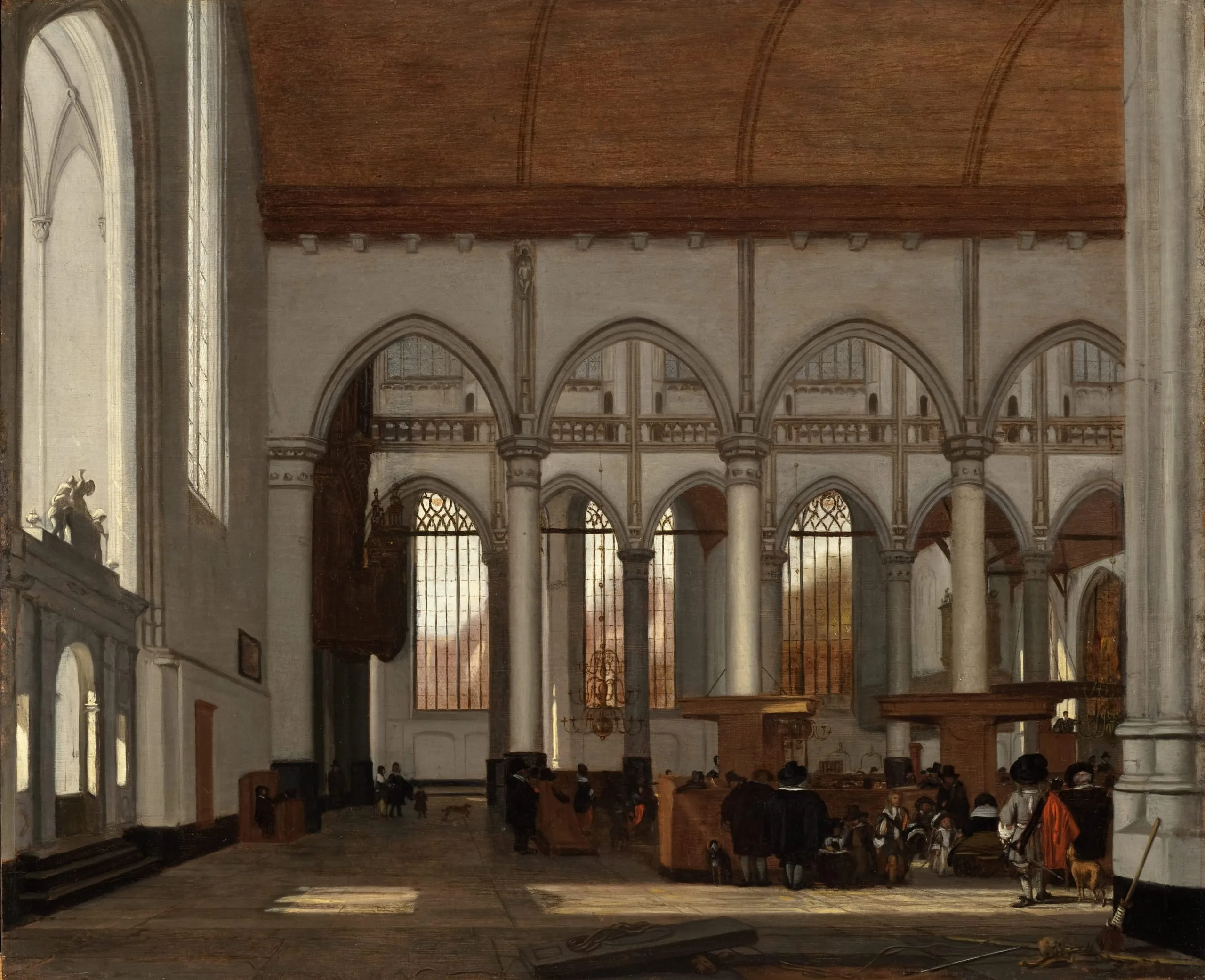
Oil painting of a vast Gothic church interior with tall gray columns, pointed arches, a wooden ceiling, and small figures gathered near choir stalls
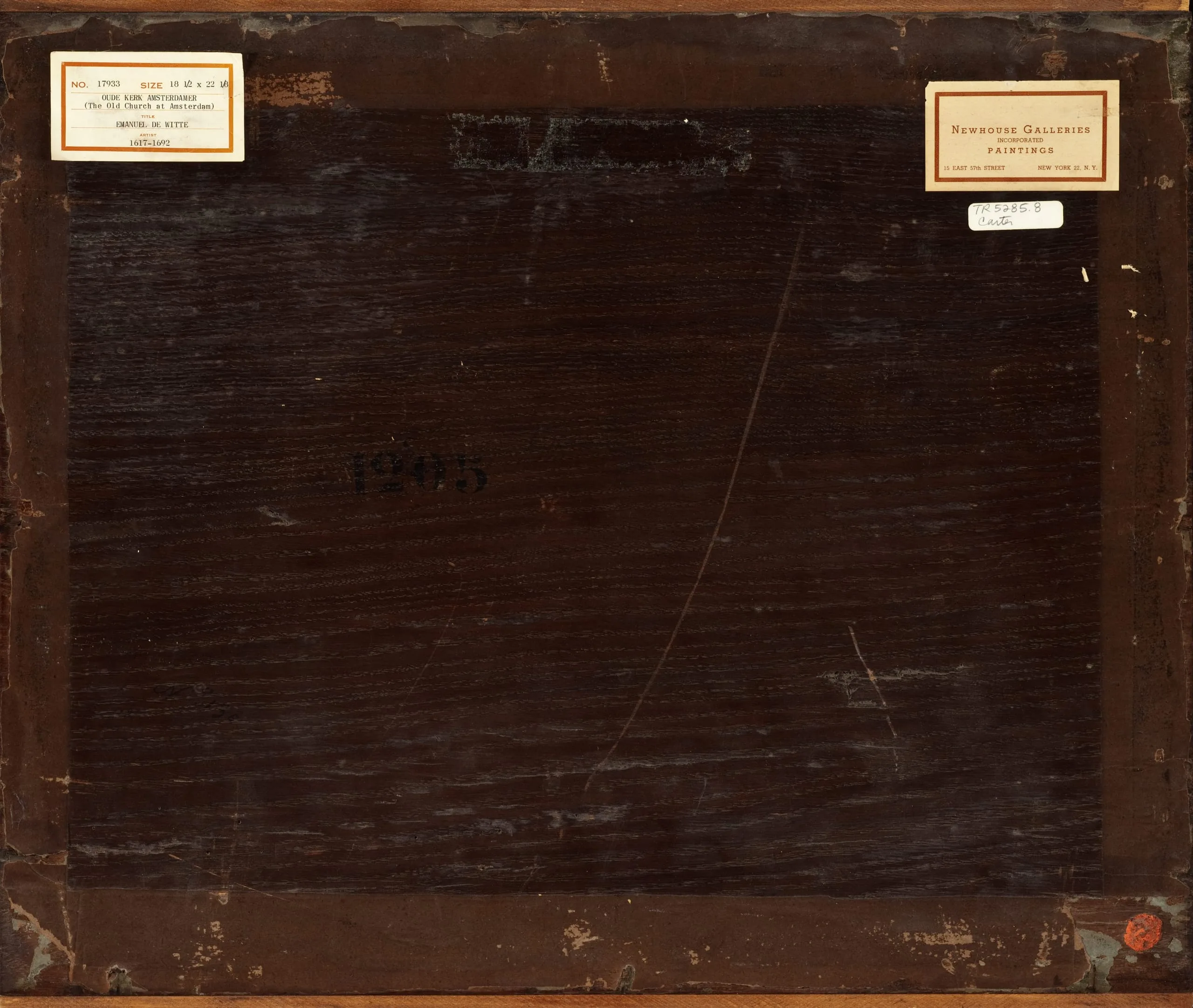
Reverse of a painting panel, showing dark wood with two paper gallery labels in upper corners: a handwritten label at upper left and a printed Newhouse Galleries label at upper right.
Artist or Maker
Emanuel de Witte
Northern Netherlands, 1617-1692
Title
Interior of the Oude Kerk, Amsterdam
Date Made
circa 1659
Medium
Oil on wood panel
Dimensions
Panel: 18 1/8 × 22 1/8 in. (46.04 × 56.2 cm) Framed: 29 × 32 × 2 1/2 in. (73.66 × 81.28 × 6.35 cm)
Credit Line
Gift of Mr. and Mrs. Edward William Carter
Accession Number
M.2009.106.18
Classification
Paintings
Collecting Area
European Painting and Sculpture
Curatorial Notes

The Oude Kerk in Amsterdam was built in the early fourteenth century as a Catholic church in the Gothic style. Emanuel de Witte’s serene image, painted about a hundred years after the Protestant Reformation swept the Netherlands, shows the building’s complete transformation into a Dutch Reformed Church. The whitewashed walls and absence of artistic decoration signal the earlier iconoclastic destruction and, perhaps to some contemporary Dutch viewers, not only a break from Catholicism but from Spanish control. But the true subject of the painting is its “spirited play of light,” as described by contemporary artist and biographer Arnold Houbraken (1660−1719). De Witte’s strategic use of reflected light and shadow defines elements of the church interior and the figures below. From his vantage point, a southwest chapel facing the north aisle, he captured afternoon light streaming through the chapel at left and the tall windows behind the arched colonnade. Blurry foliage is visible through the north windows. The chapel’s marble screen entrance and crowning sculpture are backlit by bright sunlight, as is the preacher on the podium at far right. People of various classes, diminutive in relation to the soaring architecture, mill about the space or listen attentively to the Calvinist sermon. Shrouded in darkness at the upper left is the pipework of the Oude Kerk’s magnificent organ.

De Witte made his career painting primarily church interiors, including thirty-eight of Oude Kerk, as well as at least three of Amsterdam’s Portuguese Synagogue. While the artist sometimes distorted structural elements for aesthetic purposes, his pictures maintain a sense of verism. These popular architectural portraits of community and congregation appealed to more than just Protestant buyers; wealthy citizens of different faiths bought such images for their aesthetic and civic qualities.

Provenance

Probably Wierman, Amsterdam (sale, Amsterdam, Van der Land, 18 Aug. 1762, lot 106, "Een Gezigt van een gedeelte der Oude Kerk te Amsteldam, van binnen langs de Westzyde en het Orgel heen te zien naar den Predikstoel, voorzien met een ryke stoffagie van allerhande Beeldjes; alles zeer natuurlyk met een Zonnelicht, dat ’er kwik en aardig in speeld, geschildert, door Emanuël de Wit; hoog 17 1/2, breet1 2 1/2 duimen. [sold for] 63– 0 [florins]").(1) Nicholaas Nieuhoff, Amsterdam (sale, Amsterdam, Philippe van der Schley, Hendrick de Winter, and Jan Yver, 14–17 Apr. 1777, lot 242, "Hoog 18, en breed 22 duim. Pnl. Een gezigt van een gedeelte der oude kerk, van Amsterdam, van binnen ter regter zyde, ziet men den predikant op den stoel, de welke van een menigte volk, der beide sexen, word aangehoord, ter linke zyde een capel, en verder ’t groote orgel, boven den ingang, dit stuk is zeer uitvoerig en verstandig, door zyn aangename valligten en groote glaazen gedaagd," sold for 95 florins to); Wagenaer, Amsterdam.(2) Anonymous (sale, London, Christie’s, 31 May 1902, lot 102).(3) [art trade, Paris, 1942].(4) Francois Boucher (1885–1966),(5) Paris, sold to; M. Salavin,(6) Paris, sold to; [Frederick Mont, Inc., New York, owned with]; [Newhouse Galleries, New York, sold 1968 to]; Mr. and Mrs. Edward William Carter, Los Angeles, given 2009 to; LACMA.

Footnotes

(1) Hoet and Terwesten 1770 (1976), vol. 3, no. 106, p. 270. The description agrees with the painting.The length noted in the transcription by Hoet and Terwesten does not, however, match that of the Carter painting but may indicate either a misreading or a typo. The numeral 1 directly follows the word Breet and is separated from the 2.

(2) This is not Jan Wagenaar, the historian of the city of Amsterdam who died in 1773.

(3) The sale was called H. Bedingfeld and others. This lot is listed under "Other Properties."

(4) Trautscholdt 1947, p. 125.

(5) According to the dealer Frederick Mont (letter to Mr. Carter, De Witte object file, Department of European Painting and Sculpture, LACMA), Salavin bought the painting from "Monsieur Francois Boucher (deceased) who was formerly the Conservateur du Musee Carnavalet in Paris." In 1944 Boucher mounted an exhibition at the museum to celebrate and document for future historians the liberation of Paris.
Selected Bibliography
  • Walsh, Jr., John., and Cynthis P. Schneider. A Mirror of Nature: Dutch Paintings from the Collection of Mr. and Mrs. Edward William Carter (Second Edition). Los Angeles: Los Angeles County Museum of Art, 1992.

  • Walsh, Amy L. The Mr. and Mrs. Edward Carter Collection of Dutch Paintings. Los Angeles: Los Angeles County Museum of Art, 2019. https://archive.org/details/Carter_Collection_Dutch_Paintings (accessed May 23, 2022).