- Title
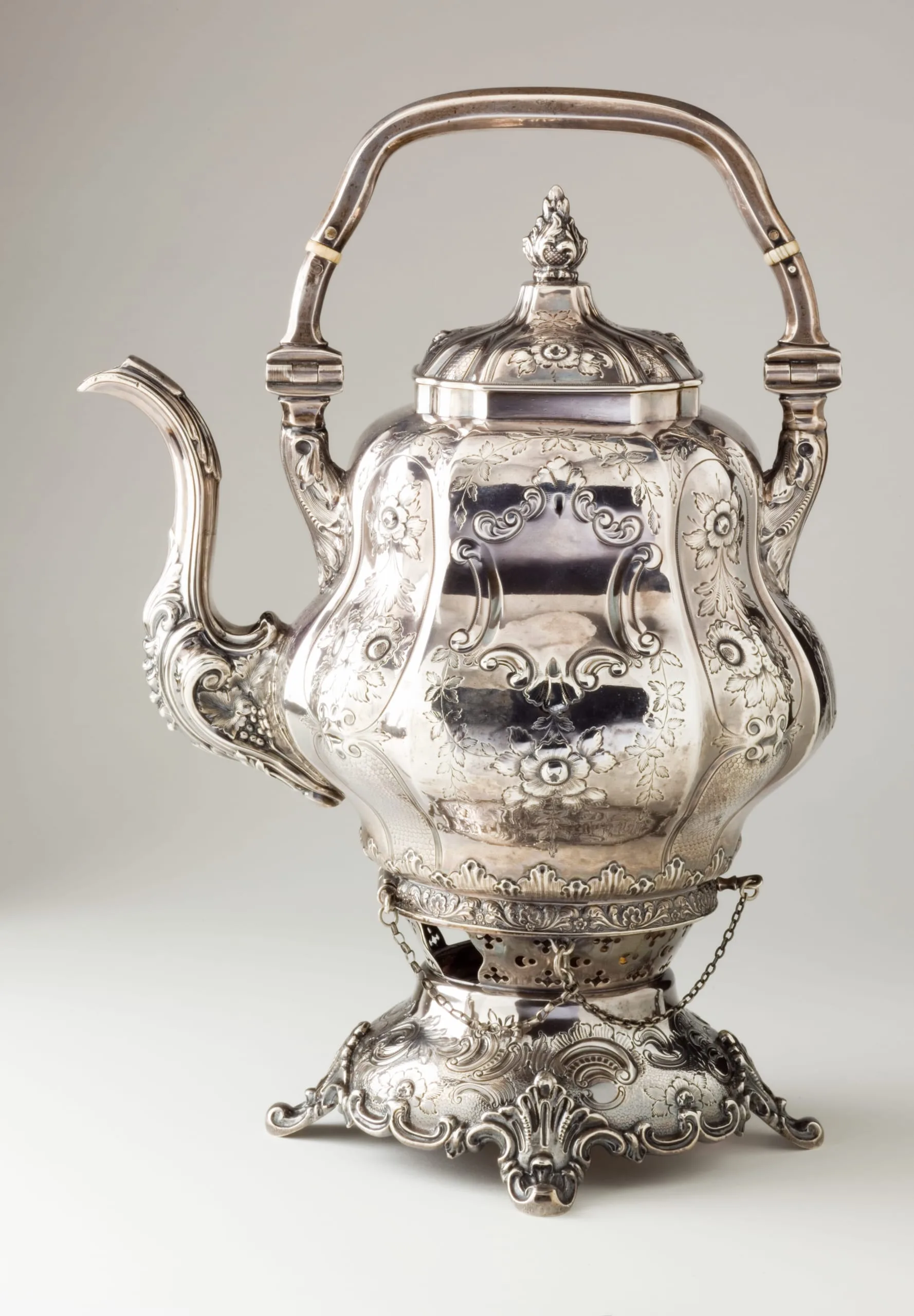
- Tea Kettle on Stand
- Date Made
- 1850
- Medium
- Silver, ivory
- Dimensions
- Diameter (a) Kettle diameter): 9 3/4 in. (24.765 cm)
Height (a) Kettle height): 8 in. (20.32 cm)
Diameter (b) Stand diameter): 5 3/8 in. (13.6525 cm)
Height (b) Stand height): 3 in. (7.62 cm)
- Accession Number
- M.2005.173.1a-b
- Curatorial Notes
This kettle, designed to heat and store hot water, probably originally formed part of a matching silver tea service. The bulbous body and chased and engraved floral panels suggest that it was made around 1850 when the Rococo Revival style was the height of fashion. Cast scrolls on the spout and base recall the Rococo ornament on silver made a century earlier. A small alcohol burner sits within the base and heats the kettle from below. If one removes the silver pin that secures the kettle to the base, the kettle tips forward on a hinge, allowing one to add hot water to a teacup or teapot without having to lift the kettle. Small ivory disks on the handle insulate the grip from heat.
The careers of William Gale and his son spanned the transition from preindustrial workshops in the eighteenth century to mechanized manufacture of silver in the nineteenth century. The New York City census of 1850 lists William Gale Jr. as a manufacturing silversmith living with his father. They worked in partnership between 1850 and 1866, after which the son formed a series of other partnerships and eventually sold his business to Dominick & Haff, one of New York’s leading silver manufacturers, until the firm closed in 1928.