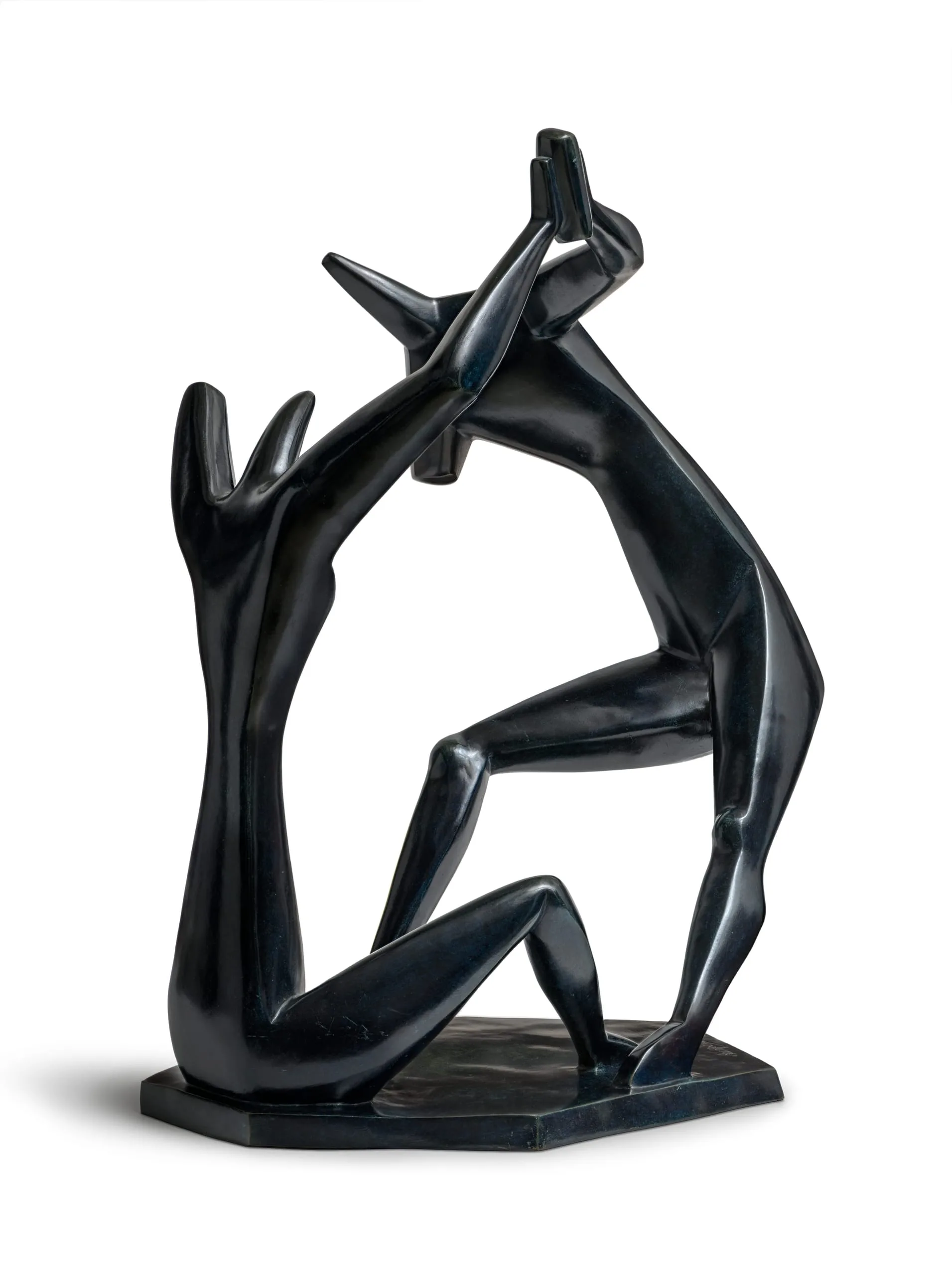
Conceived in 1912, Dance (version C) boldly explores the relationship between form and space with two figures–one seated, one standing–who touch only where their raised hands meet, framing a large, central void. Alexander Archipenko scholar Katherine Janszky Michaelson has written that his conception of the sculpture as a framing element for space—with space not only taking on an active role but becoming the very reason for the sculpture—was unprecedented at the time. This work bears a striking similarity in subject and form to Henri Matisse's celebrated painting The Dance, 1909-10 (in the collection of the Museum of Modern Art, New York), which Archipenko no doubt saw while living in Paris . Executed with a more pronounced angularity than Matisse's painting and incorporating the contemporary, Futurist notion of dynamism, Dance (version C) celebrates the body in motion and gives equal value to the space enclosed by the figures and the figures themselves.
Casting Notes:
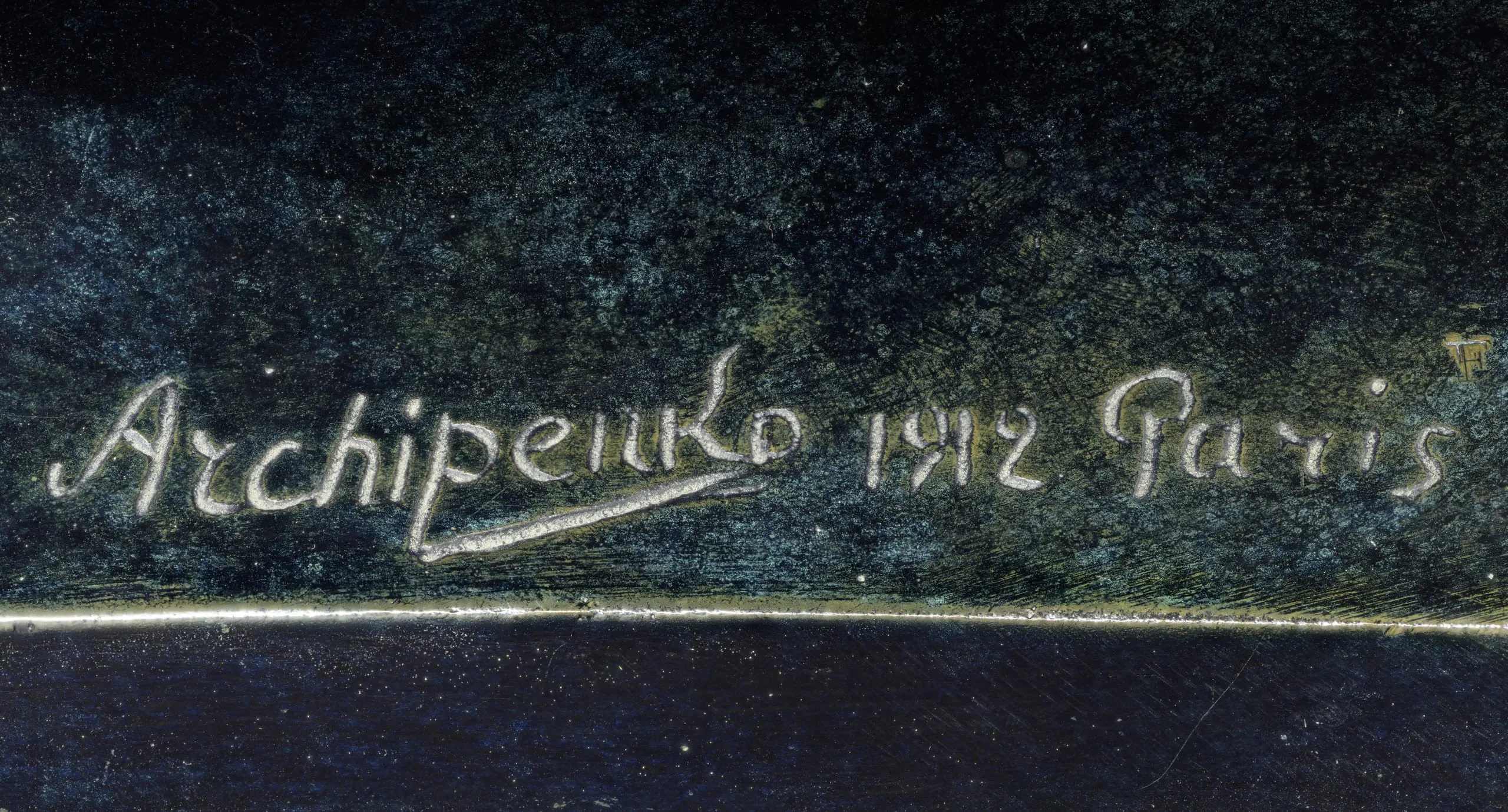
In 1913, Archipenko exhibited the plaster version of Dance (version C)in Berlin at Herwarth Walden’s Der Sturm gallery. An early colored plaster version is now in the Saarland Museum, Saarbrücken. Archipenko executed this work in two different dimensions, one version twenty-four and a half inches in height and the other, modified around 1917, twenty-nine and a half inches tall. In the 1950s, Archipenko began to issue editions of the sculpture in both dimensions, inscribing the larger and later version V.3. It has been suggested that the inscription might have been added to distinguish it from the smaller and earlier versions in plaster and bronze which are inscribed “Archipenko Paris.” LACMA’s sculpture, marked 5/8 F, is from an edition of eight, plus one artist's proof. As indicated by the addition of the letter F to the cast, this bronze was cast posthumously and was sold by Archipenko’s long-time dealer in New York, Perls Gallery.