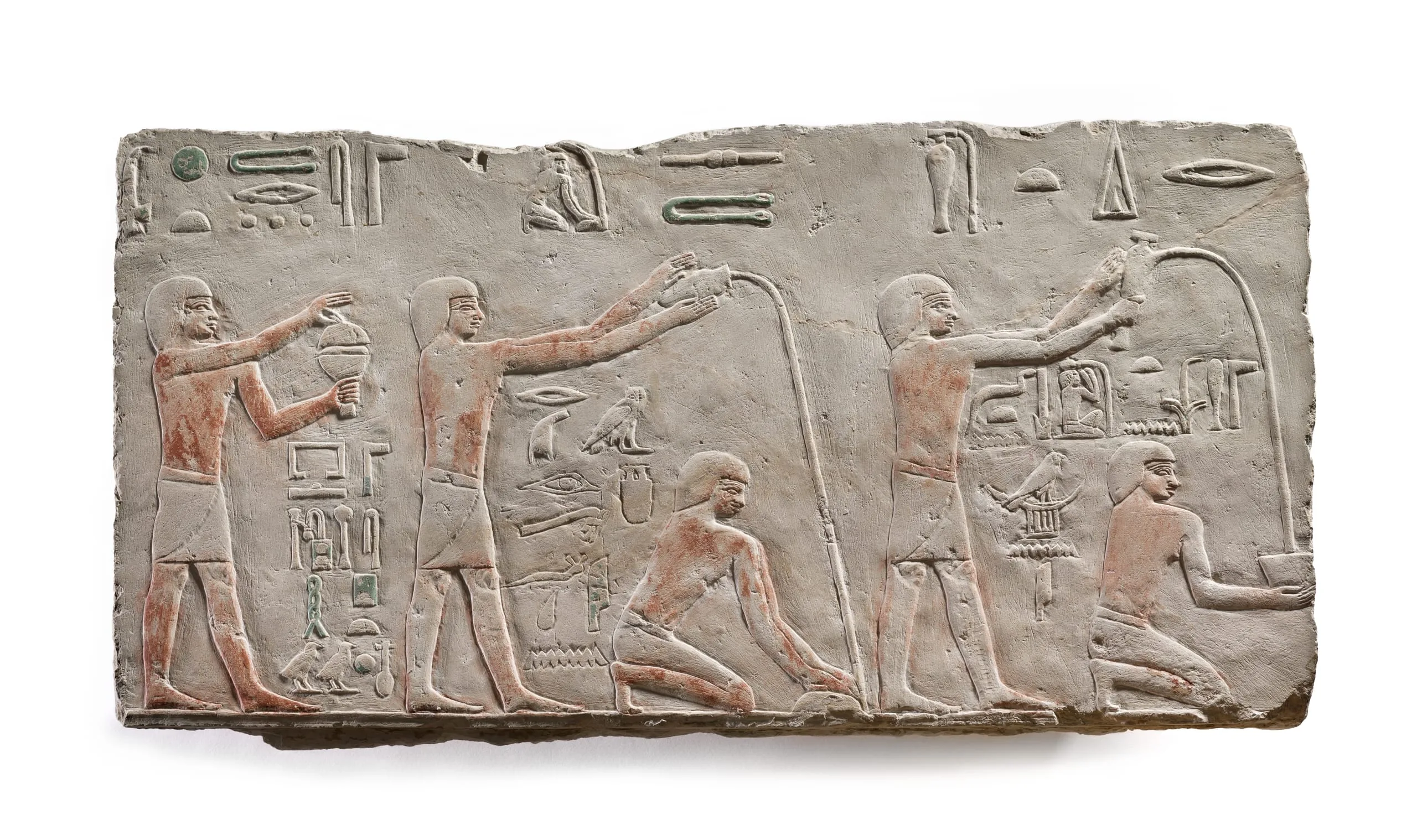
The inscribed blocks from the tomb of Ni’ankhnesut are the most widely dispersed of all ancient Egyptian tomb reliefs. The tomb was in substantial disrepair when identified around 1917; soon after, more than sixty reliefs were sold to collectors and museums worldwide. This relief depicts five men presenting incense and libations to the tomb owner, their actions labeled by hieroglyphic inscriptions above each vignette. For example, on the left, the text sntr accompanies the vignette of a man lifting the lid of an incense burner as part of the ceremony. Two other individuals with unnaturally long arms pour liquids from jars onto a mound or jar accompanied by kneeling men.
The positioning of the scene within the tomb offering chapel may be reconstructed from other contemporaneous examples. A portrait such as the one in LACMA’s collection (47.8.3) would have been located in the offering chapel to the right of this scene. The relief retains much of its original color, red ochre for the flesh of the men and copper green for a selection of hieroglyphs. During the 1990s, LACMA undertook a spectrographic study with the Jet Propulsion Lab in Pasadena to determine if any additional pigments could be identified. Although this test did not reveal the presence of other colors, viewers should imagine the brightly painted elements of the original scene.
Provenance: Tomb of Ni’ankhnesut, Saqqara; Purchased by Dr. Jacob Hirsch (1874-1955) in Geneva, Switzerland 1922; William Randolph Hearst Foundation; Gift to LACMA, 1947.