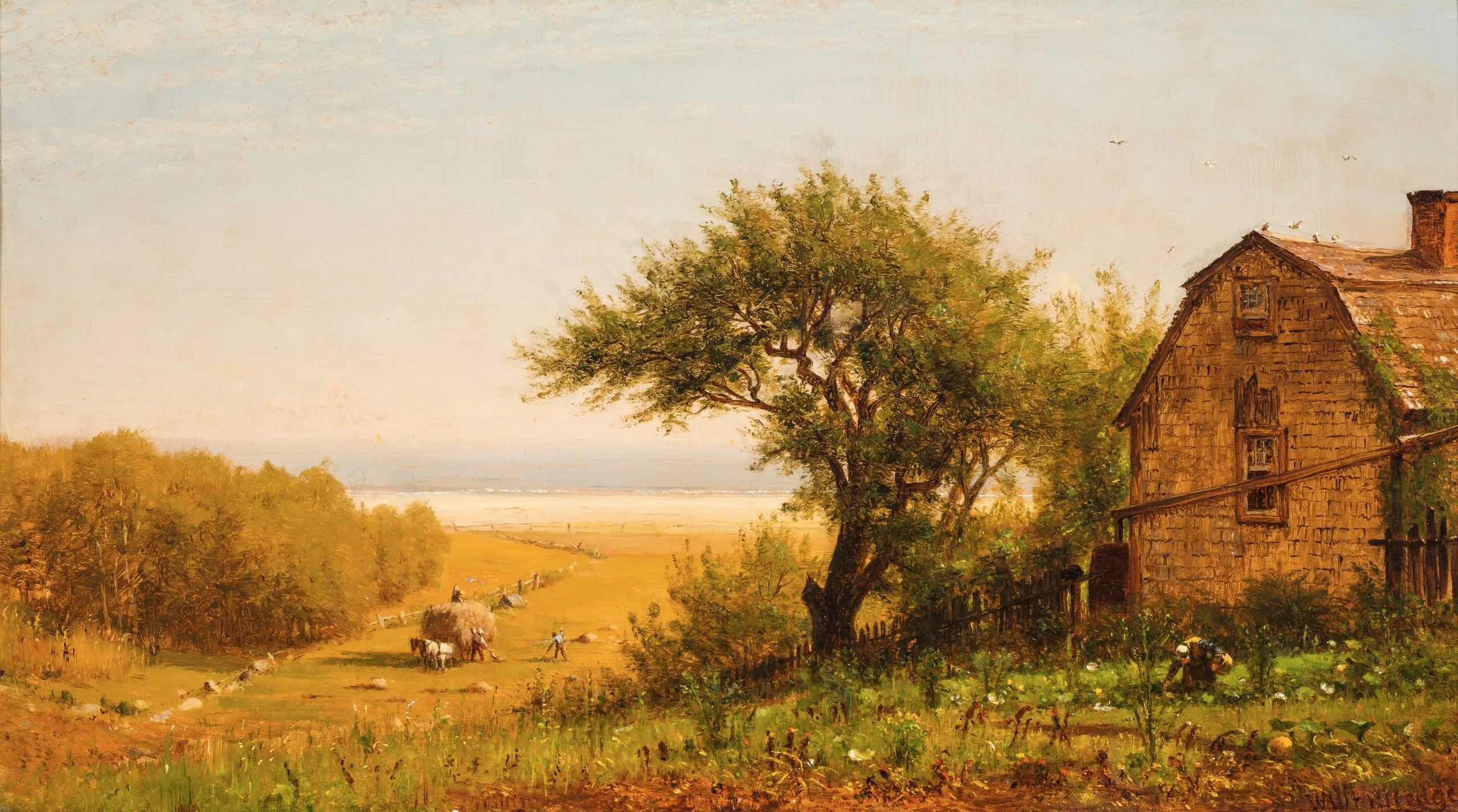
The location of this landscape has been identified as Newport, Rhode Island. Whittredge may have first visited the area as early as 1859, immediately following his return to America. He visited it often and even built a summer house there. He became fascinated with the colonial architecture of the area, drawing and painting Bishop George Berkeley’s house, Whitehall. Whittredge’s first Newport painting dates from 1865, and in the early 1870s he began a series of Newport landscapes in which the focus was a shingled, gambrel-roofed farmhouse near the sea. In most of these landscapes, such as Home by the Sea, c. 1872 (Westmoreland County Museum of Art, Greensburg, Pennsylvania), and Old Homestead by the Sea, 1883 (Museum of Fine Arts, Boston), the artist assumed an elevated position away from the house to obtain an expansive view of the surrounding countryside and distant ocean.
A Home by the Seaside is the only painting in this series in which Whittredge moved closer to the house, which serves as a framing device leading the viewer into the scene and down the hill to the field below where men are working. The image of hayers was a popular motif, frequently used by Whittredge and other artists of the period to convey the nationalistic pride of a country rich in natural resources and human energy. Although Whittredge explained his attraction to Newport as returning to the land of his forefathers, a land made familiar to him through tales heard as a child, his fascination was also part of a general cultural trend during the late nineteenth century called the colonial revival. The farmhouse in A Home by the Seaside has not been specifically identified, but its type and age added a note of native picturesqueness to the scene. Whittredge did not depict Newport as the fashionable summer resort of the elite but as the land he had heard about as a child. The soft autumnal haze contributes to the general sentiment of nostalgia.
By the 1870s Whittredge had become known for his serene, sun-filled, open landscapes. When this painting was exhibited, such critics as George Sheldon praised its diffused light and quiet mood.