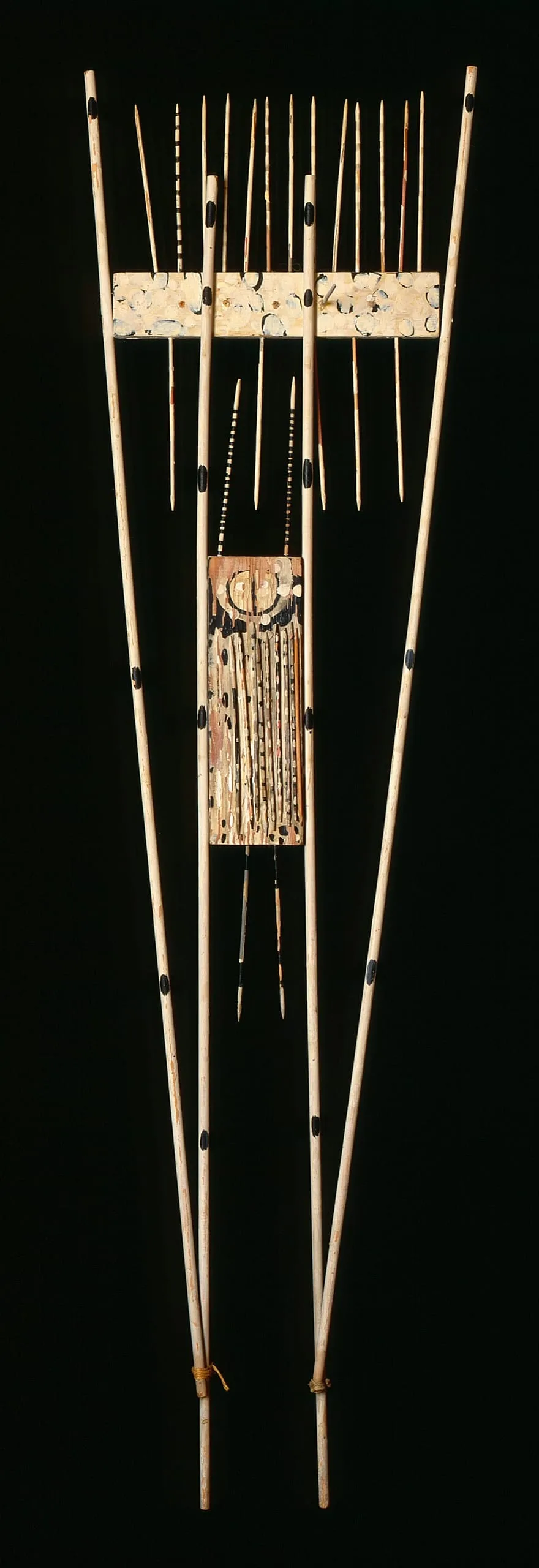
For over fifty years, Lee Mullican created paintings, drawings, and sculptures that synthesized art, science, and the imagination. Born in Oklahoma, Mullican first became interested in art as a child. Inducted into the Army Corps of Engineers during World War II, he served as a topographical draftsman, working with aerial photographs, which, with their dense patterning of vegetation, roads, and rivers, had an enormous impact on his later paintings.
Following his discharge in 1946, Mullican moved to San Francisco, where he met fellow artists Wolfgang Paalen, Gordon Onslow Ford, and Luchita Hurtado. Together, they founded the Dynaton group, a loose collective focused on creating artworks rooted in archaic forms, metaphysics, and biomorphic abstraction—what one critic called “Surrealism for the New World.” The group’s shared vision culminated in the Dynaton exhibition at the San Francisco Museum of Art, which featured their work alongside a selection of Native American objects that had influenced them. Immersed in this creative circle, Mullican began a series of found-object sculptures made from dowels and spiked sticks, string, and feathers. Paalen dubbed these works “Tactile Ecstatics,” reflecting Mullican’s intention to create “attenuated images that stepped out of my canvases like ritual objects.”
Frances Lazare