LACMA

ShopMembershipMyLACMATickets
LACMA
Los Angeles County Museum of Art
5905 Wilshire Blvd.
Los Angeles, CA 90036
info@lacma.org
(323) 857-6000
Sign up to receive emails
Subscribe
© Museum Associates 2025

Museum Hours

Monday

11 am–6 pm

Tuesday

11 am–6 pm

Wednesday

Closed

Thursday

11 am–6 pm

Friday

11 am–8 pm

Saturday

10 am–7 pm

Sunday

10 am–7 pm


  • About LACMA
  • Jobs
  • Building LACMA
  • Host An Event
  • Unframed
  • Press
  • FAQs
  • Log in to MyLACMA
  • Privacy Policy
© Museum Associates 2025
Collections

Unidentified artist
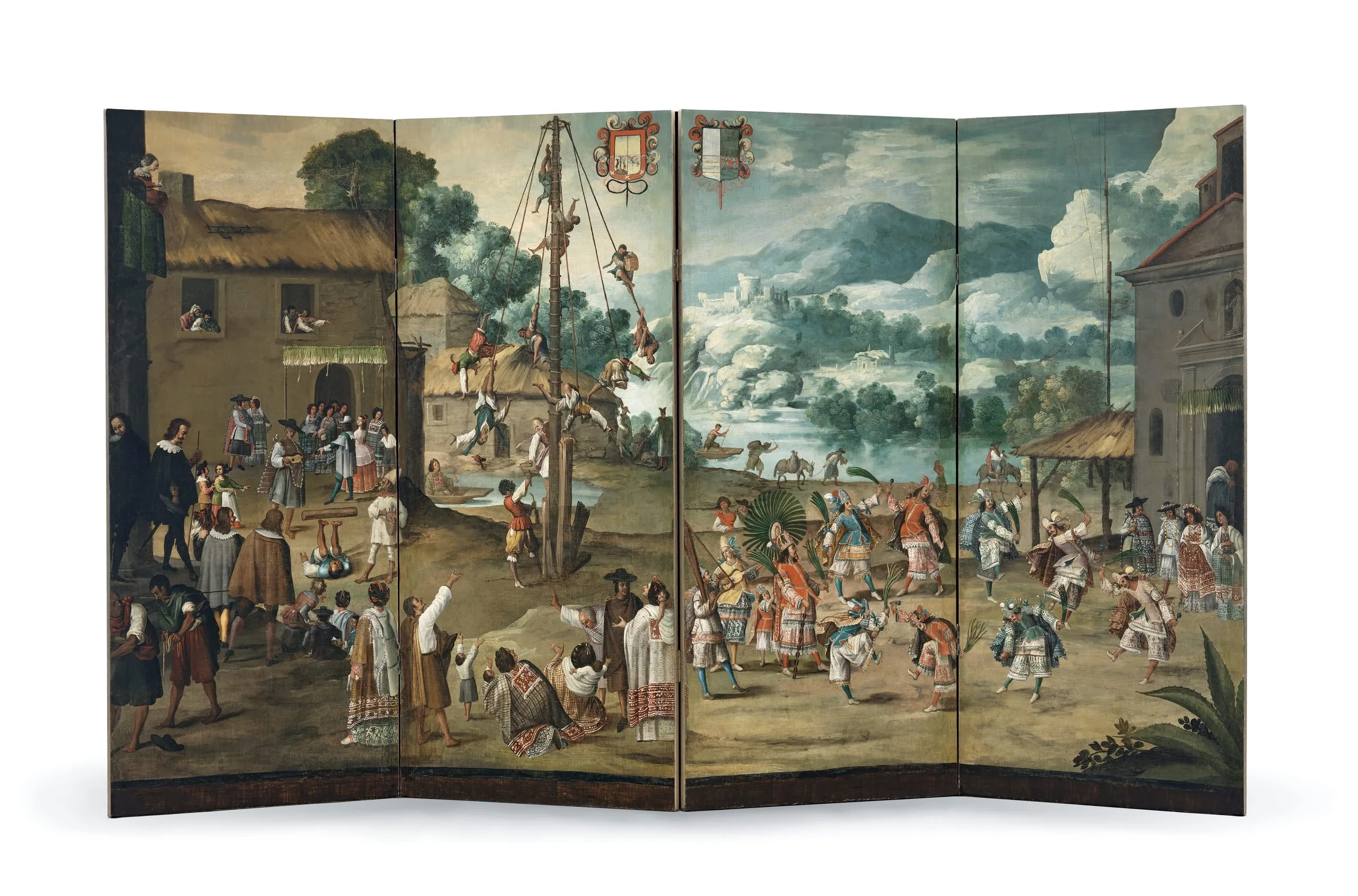
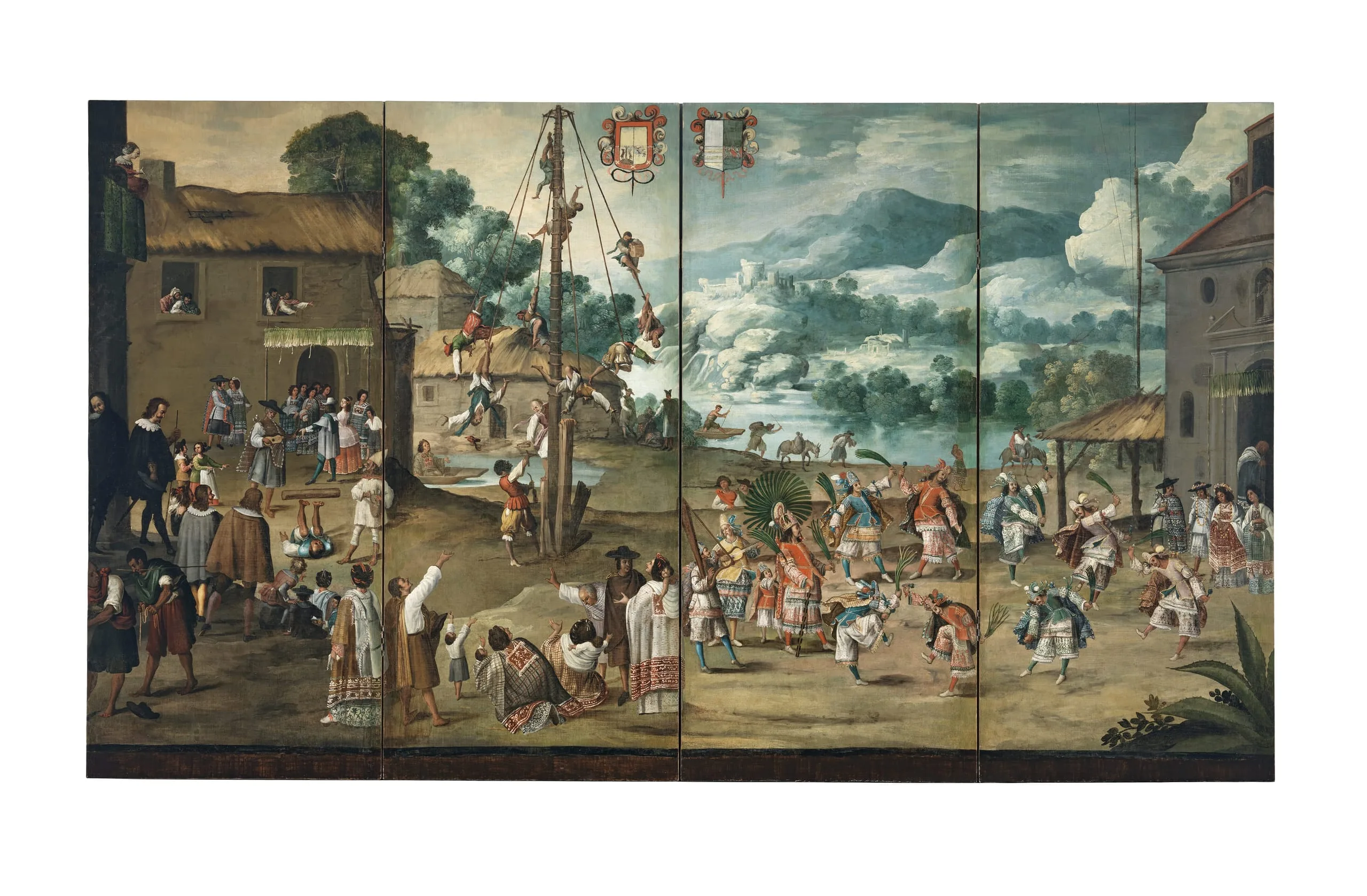
Folding Screen with Indian Wedding, Mitote, and Flying Pole (Biombo con desposorio indígena, mitote y palo volador)circa 1660-1690

On view:
Geffen Galleries, Spanish America at the Center of the World
Four-panel folding screen, oil on panel, depicting a crowded outdoor festival with European and indigenous figures, a pole ceremony, elaborate feathered dancers, adobe buildings, and a mountain landscape
Four-panel painted folding screen depicting a colonial outdoor festival scene with numerous figures in diverse dress; a volador pole with performers at center, procession of dancers in feathered regalia at right, crowd of onlookers at left near thatched buildings, landscape with mountains and sky in the background, a heraldic cartouche at top center.
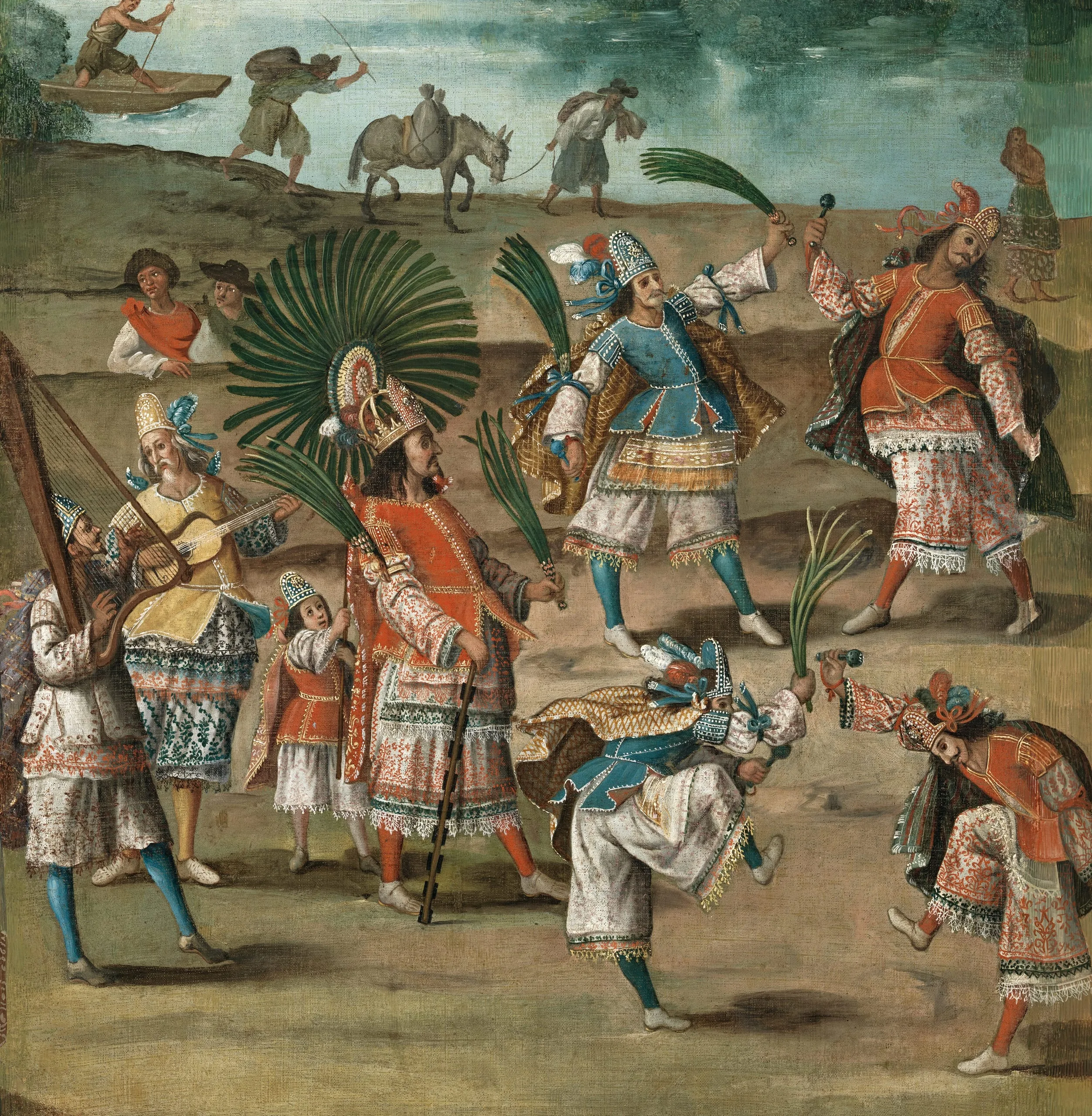
Oil painting of multiple figures in elaborate ceremonial dress with red, white, and turquoise embroidered garments, feathered headdresses, and fringed textiles, gathered outdoors in a processional scene; one figure plays a guitar-like instrument while others carry palm fronds and staffs; background includes a rider on a donkey, a figure in a canoe, and a pale blue-grey sky.
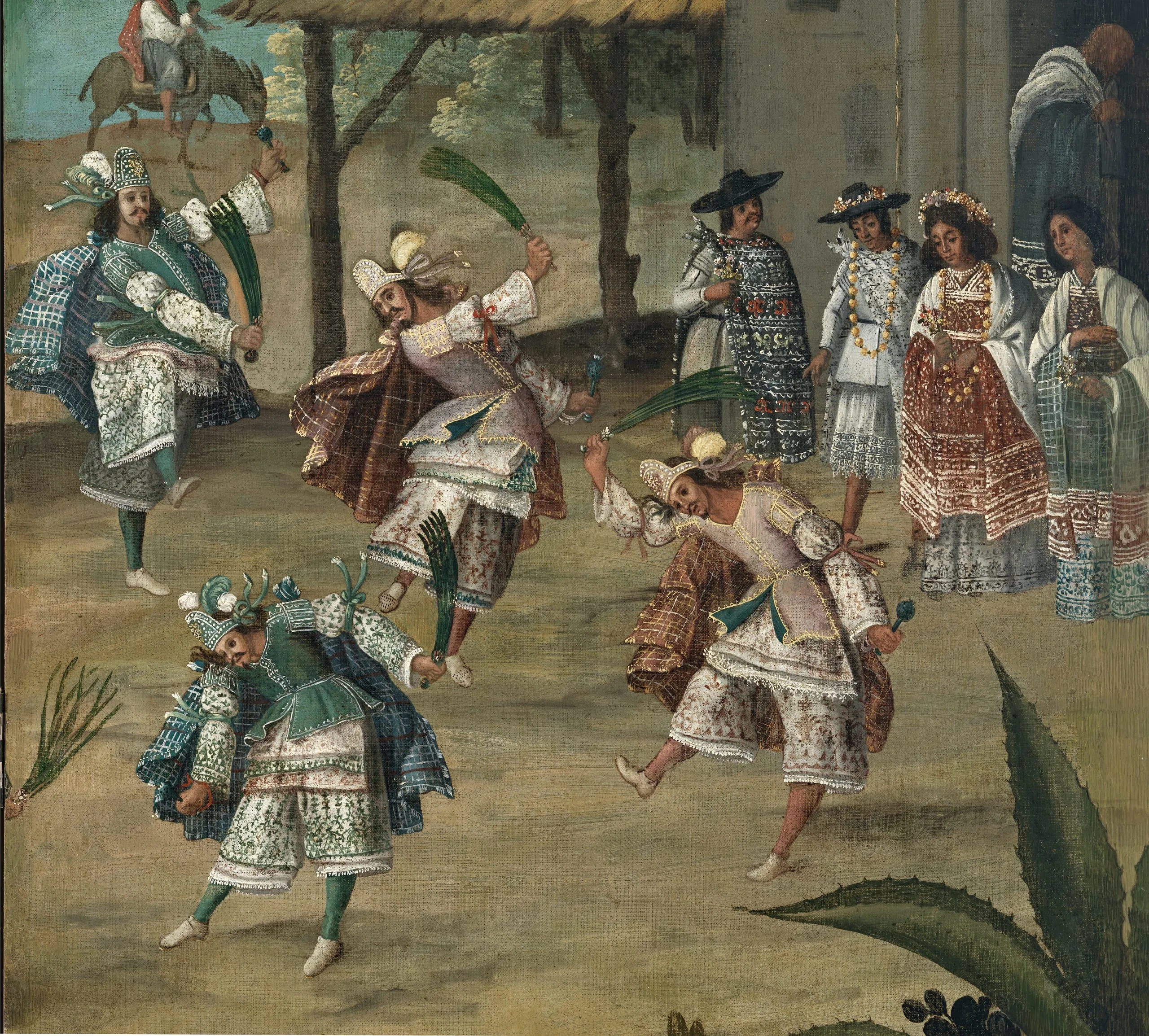
Oil painting of multiple figures in elaborate embroidered costumes dancing outdoors, holding green fronds, with onlookers in decorated dress at right and a horseman visible in the upper left background; flat, detailed brushwork with agave plants in the foreground.
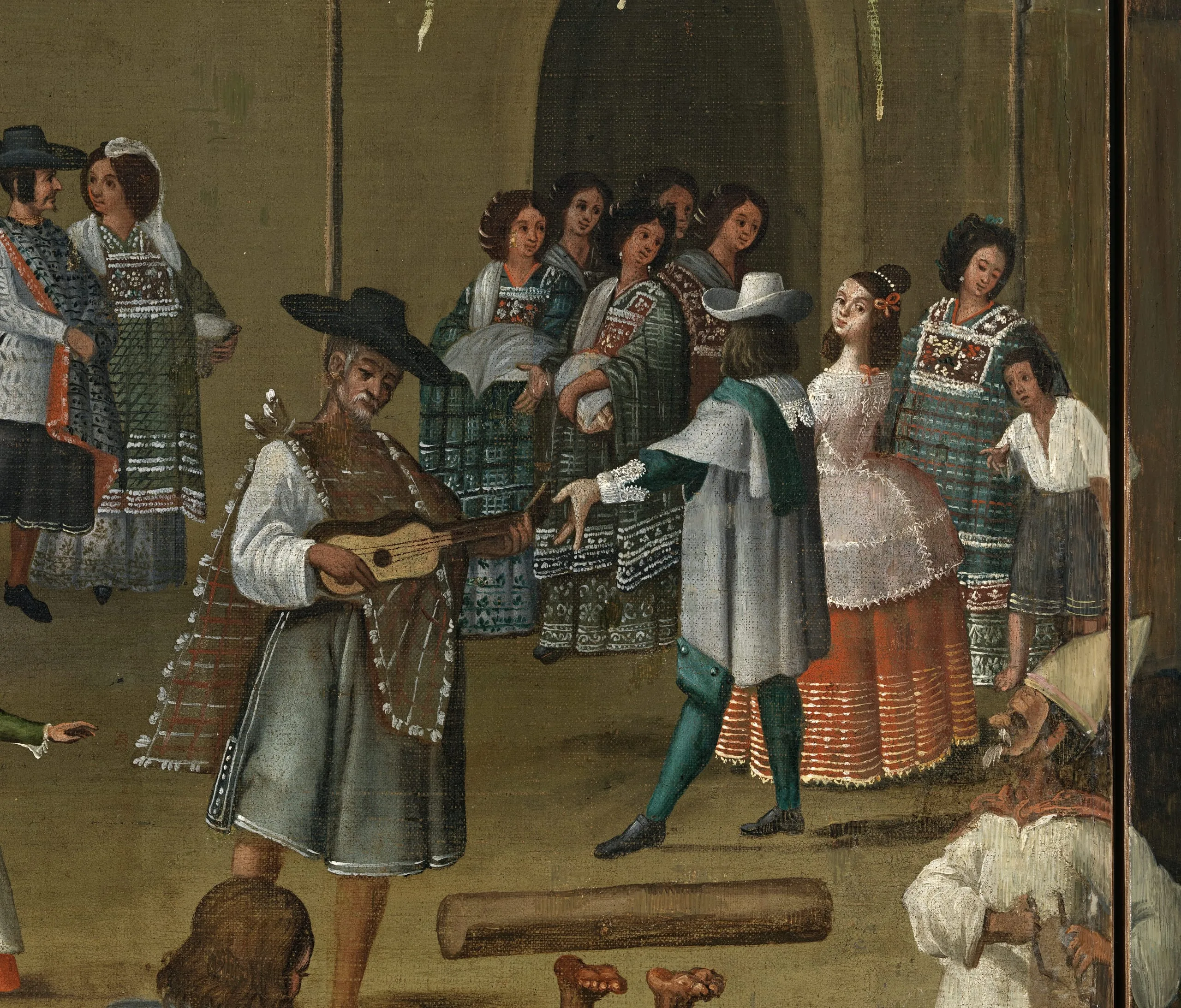
Oil painting depicting a group scene with figures in colonial-era dress; a man in a wide-brimmed hat plays a small guitar while another gestures toward a group of women wearing embroidered huipil-style garments in teal, orange, and white; muted ochre background with an arched doorway.
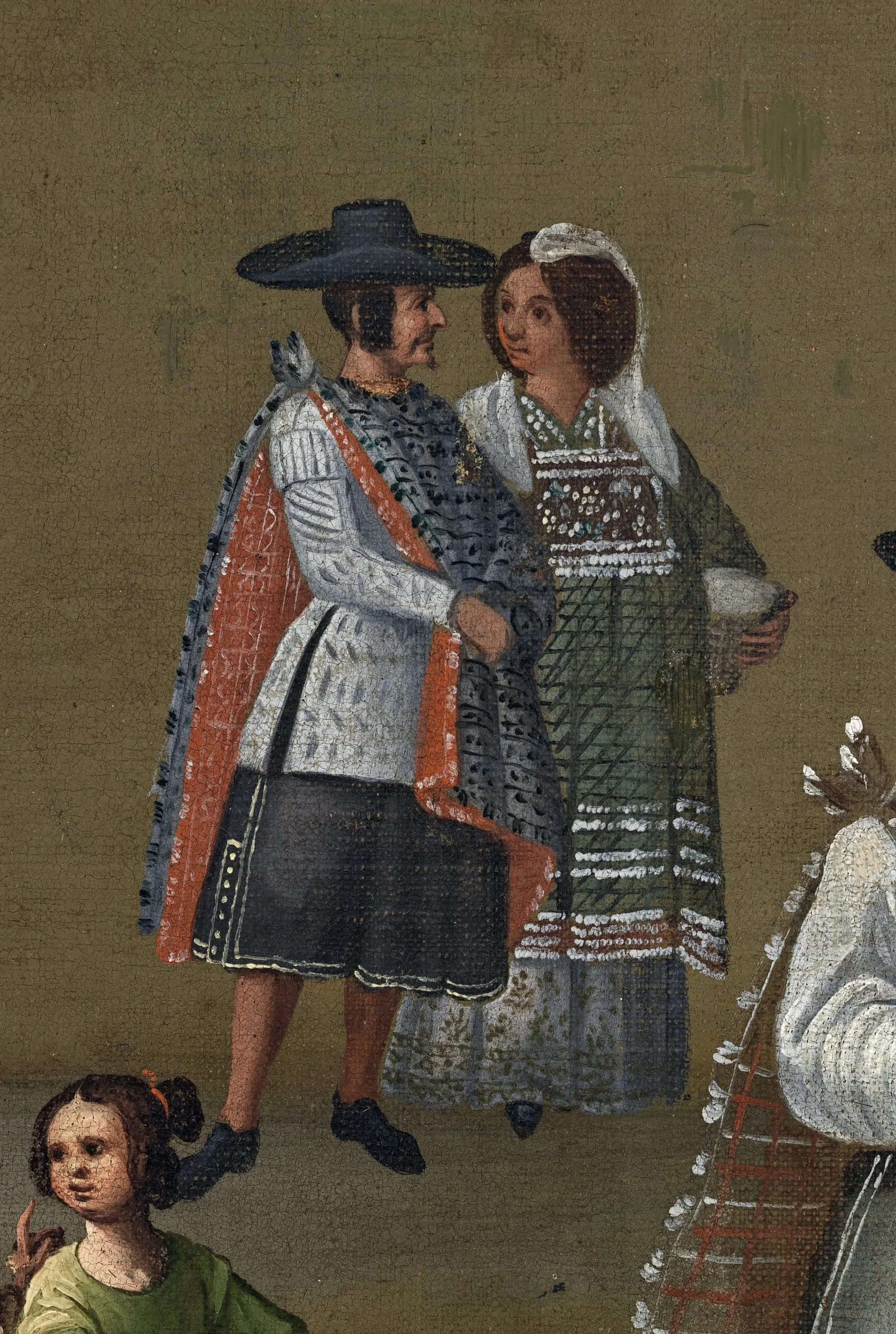
Oil painting detail of two standing figures in elaborate colonial-era dress; the figure at left wears a wide-brimmed hat and layered cape with red and dark patterned trim, while the figure at right wears an embroidered green and white dress with a head covering. A child's face appears in the lower left corner.
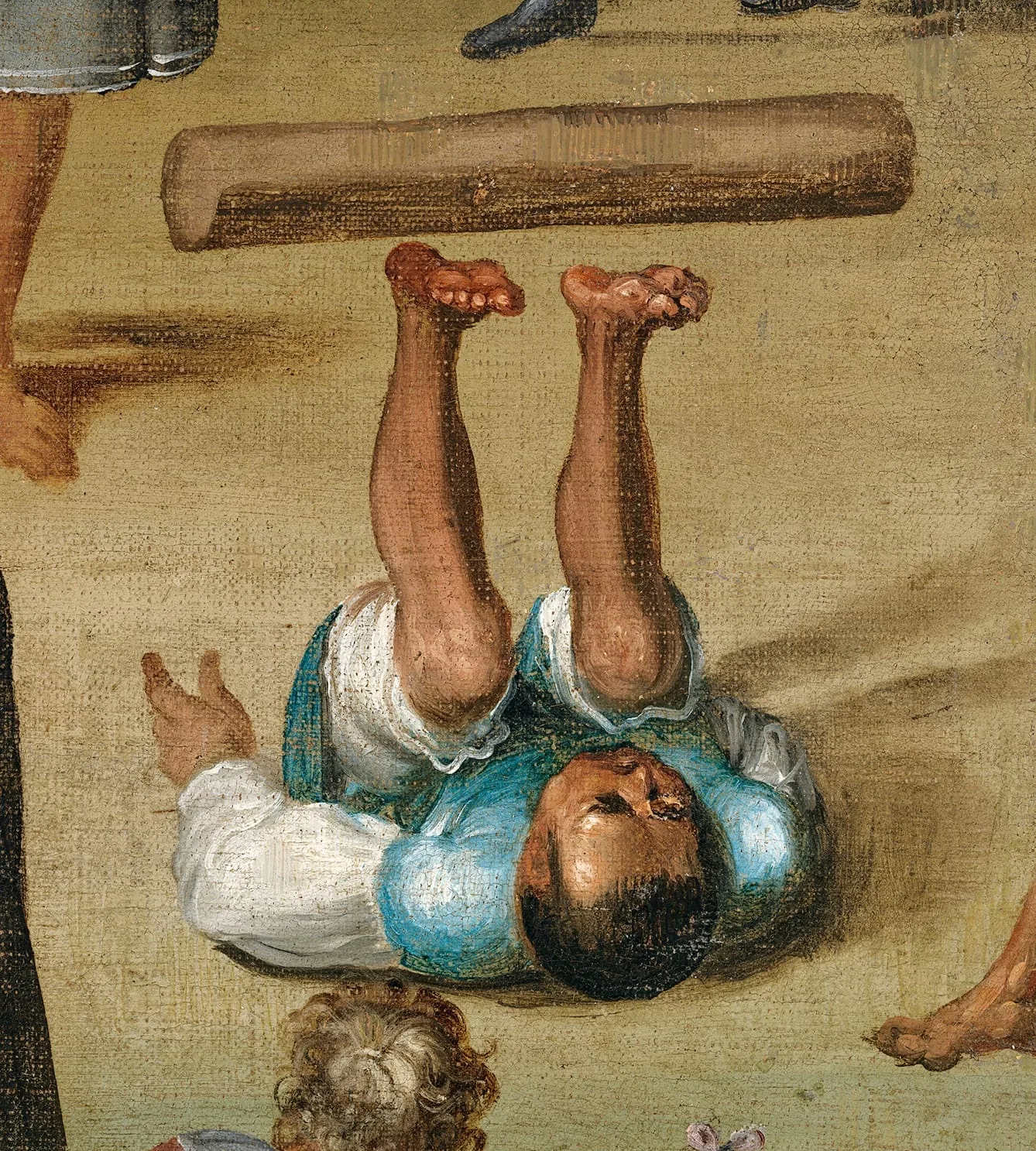
Oil painting detail of a figure in a blue and white garment lying on their back with legs raised, balancing a large wooden log with bare feet, surrounded by partial figures of other people on a sandy ground.
Artist or Maker
Unidentified artist
Title
Folding Screen with Indian Wedding, Mitote, and Flying Pole (Biombo con desposorio indígena, mitote y palo volador)
Place Made
Mexico
Date Made
circa 1660-1690
Medium
Oil on canvas
Dimensions
Overall (4 panels): 66 × 120 in. (167.6 × 304.8 cm)
Credit Line
Purchased with funds provided by the Bernard and Edith Lewin Collection of Mexican Art Deaccession Fund
Accession Number
M.2005.54a-d
Classification
Furnishings
Collecting Area
Latin American Art
Curatorial Notes

Folding screens, or biombos, were introduced in New Spain by the early seventeenth century. This example depicts an Indigenous wedding amid pre-Hispanic performances. On the right, the newlyweds leave the church, while participants on the left—including Spaniards in typical mid-seventeenth-century clothing—gather outside the bride’s house. Dancers in lavish costumes perform a mitote, a dance with a figure impersonating the Aztec emperor Moteuczoma. A juego de palo (in which a man tosses a log in the air) and an aerial palo volador (flying pole) also mark the festivities. The biombo was likely intended for export to Europe to provide a glimpse of local landmarks and traditions.


From exhibition Archive of the World, 2022 (for more information see the catalogue entry by Ilona Katzew in the accompanying publication, cat. no. 29, pp. 156–62)

Provenance
Possibly King Louis Philippe I of France, Duke of Orléans (r. 1830–48); as a wedding gift to his son François d’Orléans, Prince of Joinville (1818–1900), married to Princess Francisca of Brazil (1824–1898), daughter of Dom Pedro I (1798–1834), emperor of Brazil, c. 1843; by inheritance to François’s nephew Gastão d’Orléans, Count of Eu (1842–1922), married to Isabel Bragança, Princess Imperial of Brazil (1846–1921), niece of Francisca; by inheritance to their son Pedro de Alcântara de Orléans e Bragança, Prince of Grão-Pará (1875–1940), married to Countess Elisabeth Dobrezensky of Dobrzenicz (1875–1951); by inheritance to their son Pedro Gastão de Orléans e Bragança (1913–2007), married to Princess María de la Esperanza de Bourbon Dos Sicilias (1914–2005), Petrópolis, Brazil; by inheritance to their children Pedro Carlos de Orléans e Bragança (b. 1945), Manuel Álvaro de Orléans e Bragança (b. 1949), Cristina de Borbón de Orléans e Bragança (b. 1950), and Francisco de Orléans e Bragança (b. 1956), Rio de Janeiro; Rodrigo Rivero Lake Anticuario, 2002; LACMA, 2005.
Selected Bibliography
  • Katzew, Ilona, ed. Archive of the World: Art and Imagination in Spanish America, 1500–1800: Highlights from LACMA’s Collection. Exh. Cat. Los Angeles: Los Angeles County Museum of Art; New York: DelMonico Books/D.A.P., 2022.
  • Katzew, Ilona. Casta Painting: Images of Race in Eighteenth-Century Mexico. New Haven, CT: Yale University Press, 2004.
Selected Exhibition History
  • Contested Visions in the Spanish Colonial World. November 6, 2011 - January 29, 2012
  • Contested Visions in the Spanish Colonial World. November 6, 2011 - January 29, 2012
  • Archive of the World: Art and Imagination in Spanish America, 1500–1800. June 12, 2022 - October 30, 2022
  • Archive of the World: Art and Imagination in Spanish America, 1500–1800. June 12, 2022 - October 30, 2022
  • Archive of the World: Art and Imagination in Spanish America, 1500–1800. October 20, 2023 - January 28, 2024
  • Archive of the World: Art and Imagination in Spanish America, 1500–1800. October 20, 2023 - January 28, 2024
  • Inventing Race: Casta Painting and Eighteenth-Century Mexico; La invención del mestizaje. La pintura de castas y el siglo XVIII en México. June 22, 2024 - September 08, 2024
  • Inventing Race: Casta Painting and Eighteenth-Century Mexico; La invención del mestizaje. La pintura de castas y el siglo XVIII en México. June 22, 2024 - September 08, 2024