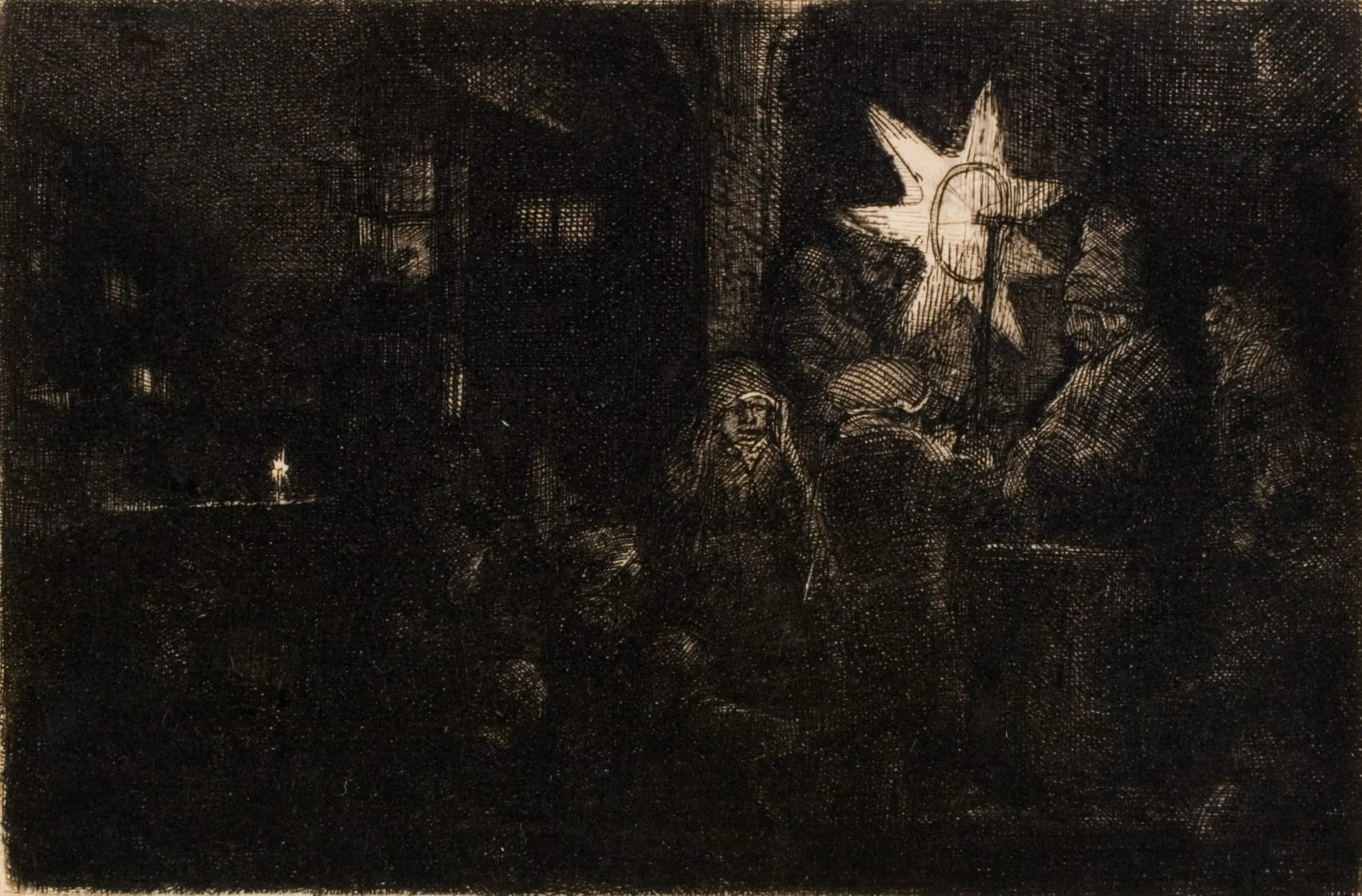
One of only a few of Rembrandt’s night pieces, this velvety etching depicts the celebration of the Christian holy day Epiphany as it was popularly observed in the seventeenth century. At dusk, children would travel door-to-door, singing carols and carrying glowing lanterns, the shape of which was meant to represent the star that guided the three kings to Bethlehem upon the birth of Jesus Christ. Though rooted in the Nativity story, “star singing” activities grew increasingly secular for seventeenth-century Dutch celebrants, who considered this holiday—known also as Twelfth Night—among the most important domestic festivals of the year, with feasting, singing, and drinking enjoyed by all strata of society.
The shining lantern at right is the primary source of light in this composition, illuminating a group of people gathered in front of the half-door of a house enveloped in darkness. Among them can be seen: three small figures, probably children, two with their backs turned, one holding aloft the light; two older figures shown in profile; and two more figures suggestive of a parent holding a small child. Just discernible in the background are windows glimmering with candlelight. Like an unlit street in the darkest hours of the night, it is challenging to make out the shadowy forms we see in this print, even when they are in front of us.
Rembrandt’s skillful representation of darkness, nearly tangible in its impenetrability, is a dominant theme of the work. Night pieces allowed the artist to show his unparalleled abilities as an etcher. He achieved this by scraping much of the plate’s surface, allowing it to print broad, velvety swathes of black. However, the areas of illumination remind the viewer that the etching is equally about light: the diverse gathering of celebrants under the glowing star underline the importance of these festivities to the Dutch populace.
Claire Spadafora Baes
2025