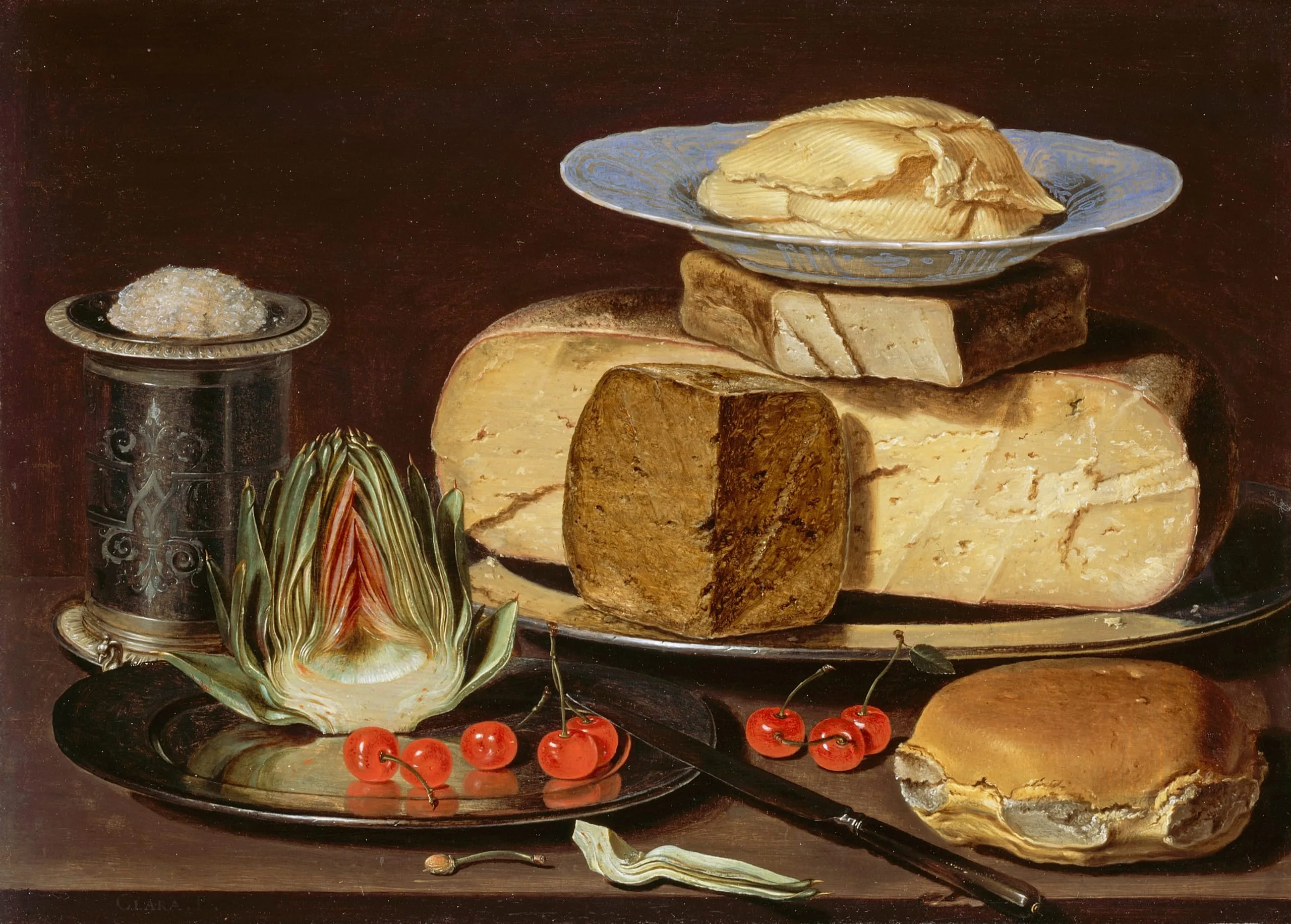
This still life both showcases the staples of the Dutch diet and reflects a global economy beyond the confines of its intimate domesticity. It depicts a spread of breakfast foods local to Haarlem. Cheese and fruit lay on silver platters; a Wanli plate—a type of Chinese export porcelain—holds soft, fluted butter shavings atop the cheese wedges. A white bread roll, or witte bolletjes, rests casually on the table, and an artichoke leans against an ornamented silver saltcellar. With a deft rendering of surfaces, animated by clear light, and an inventive arrangement of round, angular, and pointed shapes, Clara Peeters extracts remarkable variety from a few objects.
Salt and cheese were vital commodities in the Dutch economy. Raw salt, imported from France, Portugal, Spain, and the West Indies, was refined in Zeeland and exported on Dutch ships throughout Europe. Then, as now, the Netherlands was renowned for its cheese production. Dutch poets praised the country’s swift recovery from the long war with Spain, evidenced in the ability to lay a bounteous table with locally sourced foods. Within this context of nationalistic triumph, Peeters’s painting might be seen as a celebration of household prosperity and the land’s fertility. But such images may also be read as a critique of impious luxury. The perishability of cheese serves as a warning about transience and vanity. The butter shavings evoke the aphorism “zuivel op zuivel is’t werk van den duive” (dairy on dairy is the work of the devil), cautioning against the extravagance of consuming cheese with butter. Daily consumption of white bread signals affluence (the working class relied on rye or coarse wheat bread). The cherry pit and slice of artichoke in the foreground hint at someone’s presence just outside the picture frame—a stand-in for the viewer tempted to partake in the enticing display.
2024