- Title
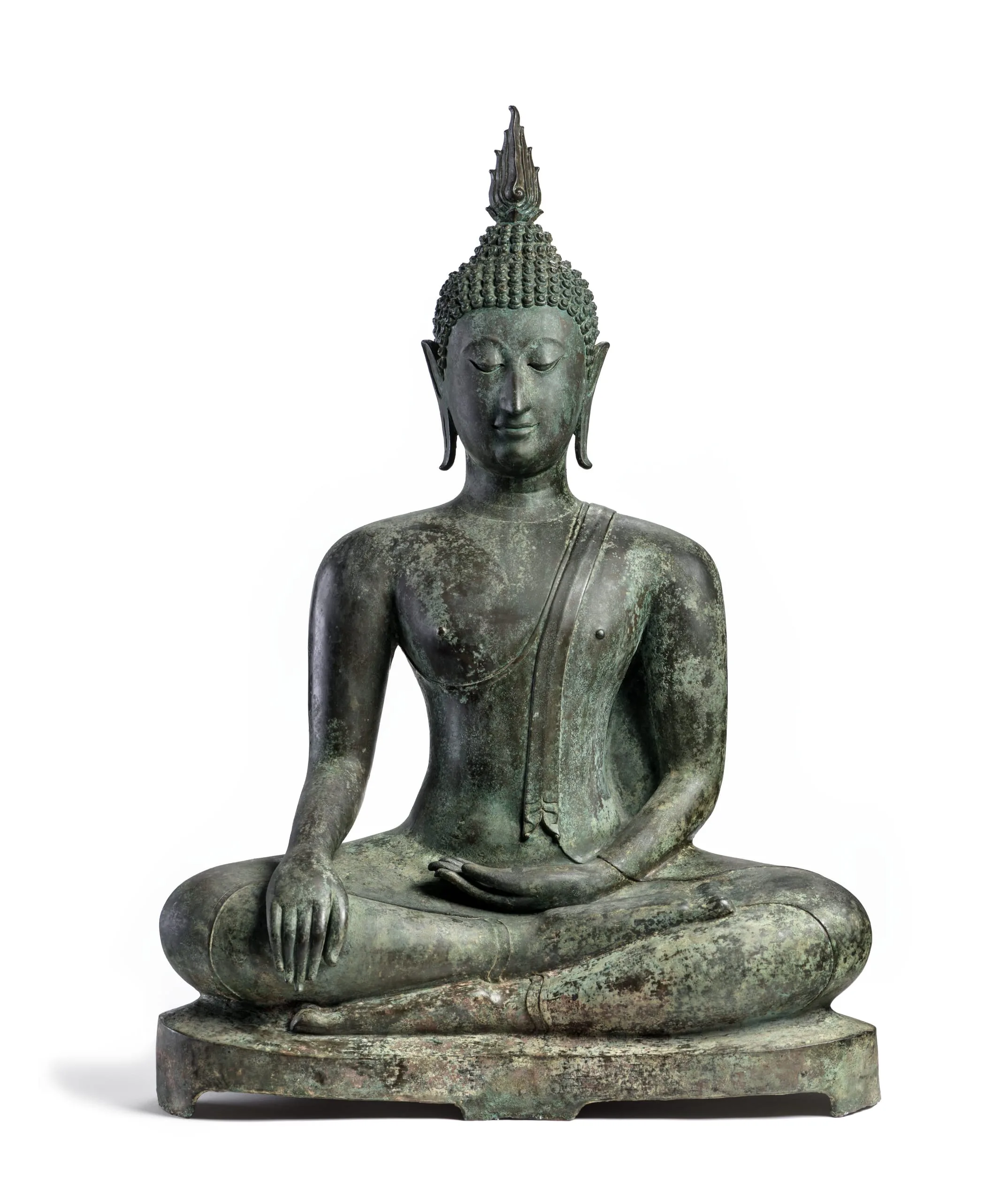
- Buddha Shakyamuni
- Date Made
- 14th-15th century
- Medium
- Copper alloy and leaded bronze
- Dimensions
- 28 3/4 x 21 x 10 in. (73.03 x 53.34 x 25.4 cm)
- Accession Number
- M.2004.12
- Curatorial Notes
This sculpture is one of the masterpieces in LACMA’s Southeast Asian art collection. It is in the style of a type of Buddha image that developed in Thailand in the 14th century and is associated with the site and kingdom of Sukhothai (1238–1438) in present-day north-central Thailand. The Sukhothai period was the beginning of the modern Thai nation and a golden period of tremendous cultural and artistic achievements. Perhaps one of the greatest accomplishments was the creation of this style of Buddha, still the most praised in Thailand and copied repeatedly.
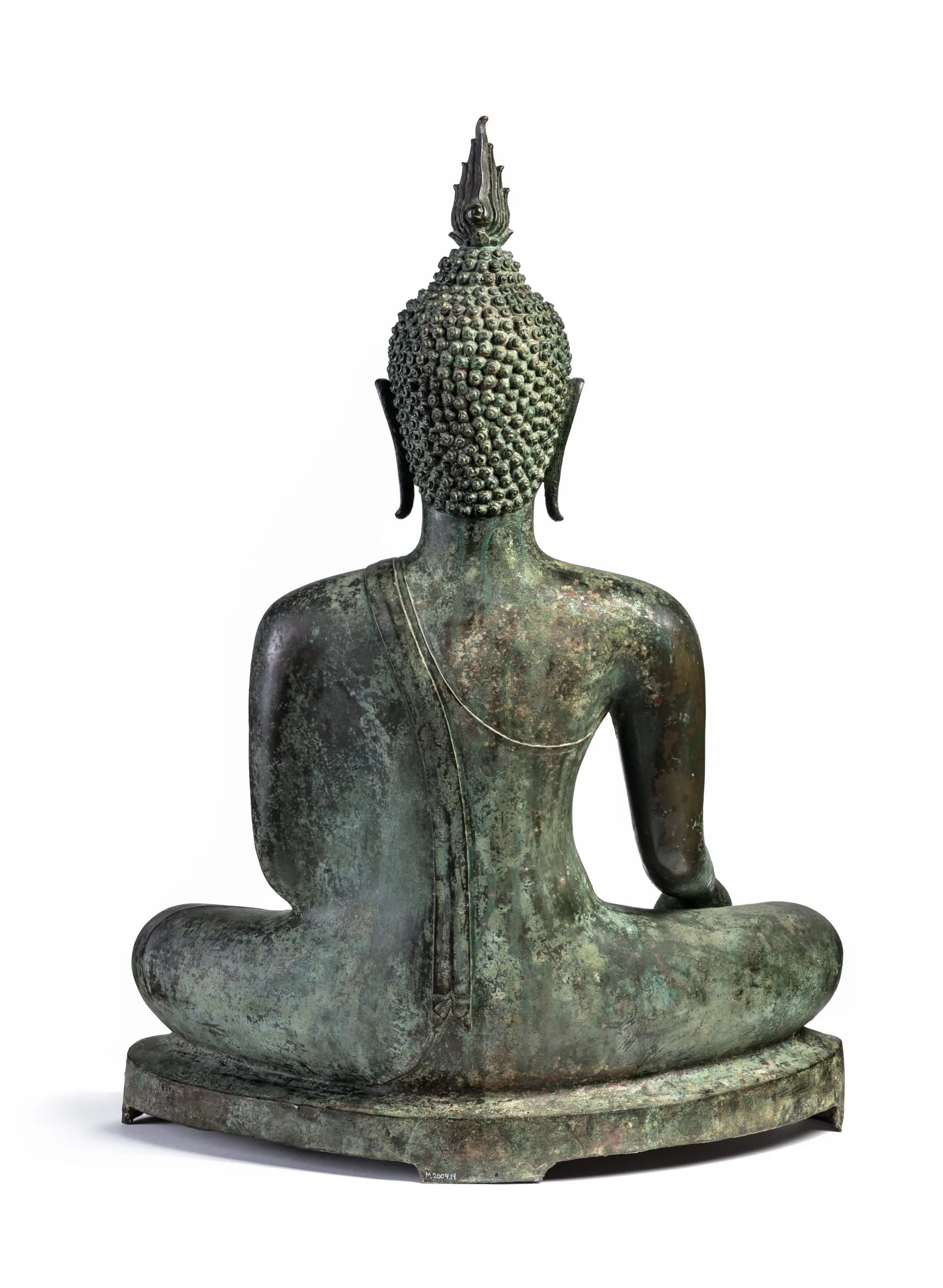
The Buddha displays several of the standard iconographic features. It has snail-curl hair, the cranial protuberance (ushnisha) emblematic of his omniscience, elongated earlobes symbolizing his renunciation of the material world, and heavily-lidded pensive eyes conveying his compassion for all sentient beings. There is no sacred forehead marking (urna). A large flame motif (ketumala) forms a finial on top of the head. He sits in the meditation posture (padma asana). His right hand is extended in the gesture of calling upon the earth to witness his right to achieve Enlightenment after his many lifetimes (bhumisparsha mudra). His robe is almost transparent, marked only by the hems. The outer robe is worn over his left shoulder only. The Sukhothai Buddha in general is an abstracted and idealized figure. The body of the Buddha appears inflated without any indication of muscles or skeleton. The head and face are articulated in rounded geometric shapes and full, expansive surfaces. The eyes, nose, mouth, and chin align in the center of the full-cheeked face. The facial features each have a distinct design: arched eyebrows; downward-cast eyes; a prominent, hooked nose; a small, outlined mouth; and a round, distinct chin. (Brown 2013)
- Selected Bibliography
- Pal, Pratapaditya; R. Brown; R. Fisher; G. Kuwayama; Amy G. Poster. Light of Asia: Buddha Sakyamuni in Asian Art. ed. Dean, Lynne. Los Angeles: Los Angeles County Museum of Art, 1984.
- Pal, Pratapaditya. The Sensuous Immortals: A Selection of Sculptures from the Pan-Asian Collection. Los Angeles: Los Angeles County Museum of Art, 1977.
Brown, Robert L. "Selections From the Southeast Asian Art Collection of the Los Angeles County Museum of Art." Arts of Asia 38 (3): 75-87 (May-June 2008)
Brown, Robert L. Southeast Asian Art at LACMA: An Online Scholarly Catalogue. Los Angeles: Los Angeles County Museum of Art, 2013. Accessed June 25, 2024. http://seasian.catalog.lacma.org/.
- Little, Stephen, Tushara Bindu Gude, Karina Romero Blanco, Silvia Seligson, Marco Antonio Karam. Las Huellas de Buda. Ciudad de México : Instituto Nacional de Antropología e Historia, 2018.
- Little, Stephen, and Tushara Bindu Gude. Realms of the Dharma: Buddhist Art across Asia. Los Angeles: Los Angeles County Museum of Art, 2025.