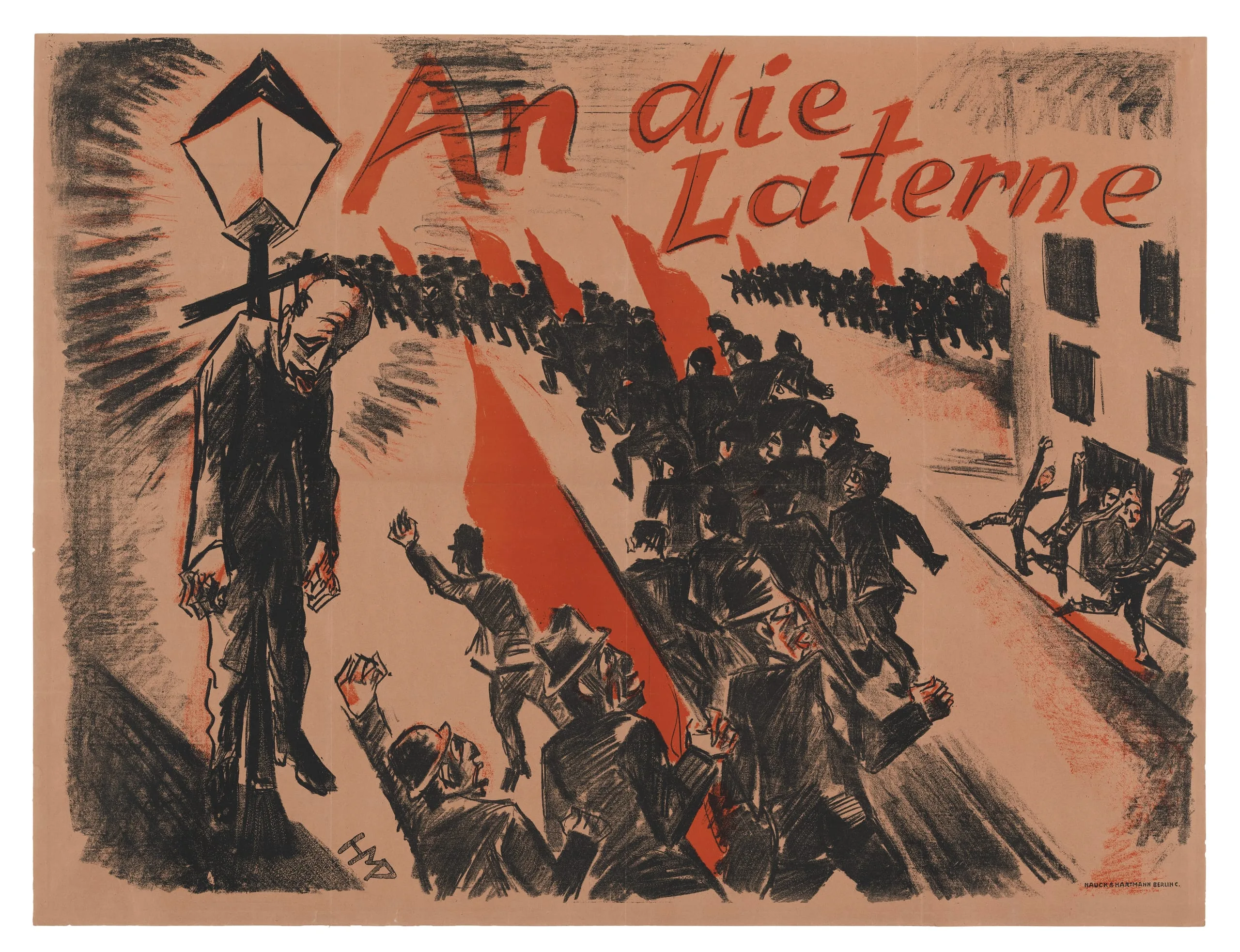
In his memoir, Max Pechstein wrote that during the early days of the revolution, he felt “a grand freedom, a human existence, was dawning” (quoted in Rigby 1983: 34). He decided to put his skills to work for the Social Democratic Party (SPD) by designing posters, becoming one of the most prolific artists for the government’s Werbedienst (Publicity Office). To the Lantern! (An die Laterne!) advertises a short-lived journal of the same name that promoted pro-government, pro-SPD views and warned against violence on the communist left. Pechstein also designed most of the journal’s covers. The cover for the first issue depicts a mob beating a man, while another man points to a lamppost in the distance. This poster shows the aftermath of that encounter: a man’s body hangs lifeless from the lamppost as the mob marches away. The snaking line of protesters is punctuated by red banners; although Pechstein had previously used these to show common cause with the worker’s movement, here they identify the mob as communist partisans.
Rather than invite the viewer’s participation, as he does in his 1919 poster The National Assembly: The Cornerstone of the German Socialist Republic (M.2003.115.46), Pechstein here tries to frighten his audience with the specter of left-wing violence. The image is tinged with racism. As Joan Weinstein has noted, the nose of the man in the bowler hat at bottom left is disconcertingly close to an anti-Semitic stereotype (Weinstein 1990: 53). Frequently cast as either arch-capitalists or communist revolutionaries, branded as destructive, disruptive, and “foreign,” Jews served as all-purpose scapegoats on both the right and the left.
Erin Sullivan Maynes
2022 (adapted from Pressing Politics: Revolutionary Graphics from Mexico and Germany, 70)
Bibliography
Rigby 1983. Ida Katherine Rigby. An Alle Künstler: War—Revolution—Weimar: German Expressionist Prints, Drawings, Posters, and Periodicals from the Robert Gore Rifkind Foundation. San Diego: San Diego State University Press, 1983.
Weinstein 1990. R. Joan Weinstein. The End of Expressionism: Art and the November Revolution in Germany, 1918-19. Chicago: University of Chicago, 1990.