LACMA

ShopMembershipMyLACMATickets
LACMA
Los Angeles County Museum of Art
5905 Wilshire Blvd.
Los Angeles, CA 90036
info@lacma.org
(323) 857-6000
Sign up to receive emails
Subscribe
© Museum Associates 2026
  • About LACMA
  • Jobs
  • Building LACMA
  • Host An Event
  • Unframed
  • Press
  • FAQs
  • Log in to MyLACMA
  • Privacy Policy
© Museum Associates 2026
Collections

Max Pechstein
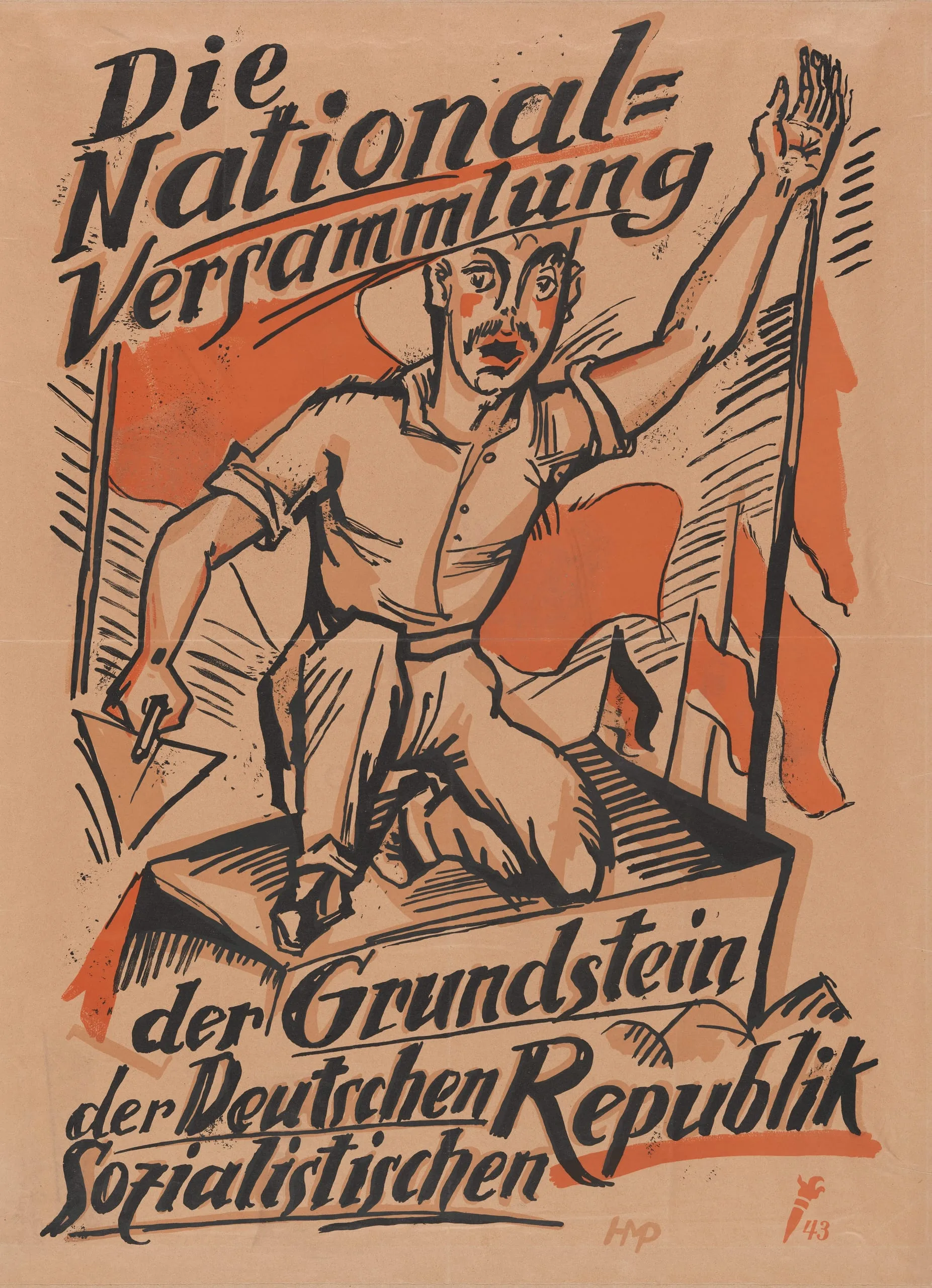
The National Assembly: The Cornerstone of the German Socialist Republic1919

Not on view
Lithograph poster with German text and a male worker figure in orange and black ink, raising a flag overhead against a radiating background

Max Pechstein, Werbedienst der deutschen Republik, The National Assembly: The Cornerstone of the German Socialist Republic, 1919, Los Angeles County Museum of Art, Gift of the Robert Gore Rifkind Collection, Beverly Hills, CA, photo © Museum Associates/LACMA

Artist or Maker
Max Pechstein
Germany, 1881-1955
Publisher
Werbedienst der deutschen Republik
Germany, 1918-1919
Title
The National Assembly: The Cornerstone of the German Socialist Republic
Place Made
Germany
Date Made
1919
Medium
Lithograph
Dimensions
Image: 25 × 17 in. (63.5 × 43.18 cm) Sheet: 26 7/8 × 19 11/16 in. (68.26 × 50.01 cm)
Credit Line
Gift of the Robert Gore Rifkind Collection, Beverly Hills, CA
Accession Number
M.2003.115.46
Classification
Prints
Collecting Area
Robert Gore Rifkind Center for German Expressionist Studies
Curatorial Notes

Expressionist artist Max Pechstein was one of the most prolific designers of posters and graphics for the government’s Werbedienst (Publicity Office). This was its earliest “educational” poster, designed to raise awareness of the first election of members to the Weimar National Assembly in January 1919. Pechstein draws on familiar iconography to visualize the government’s message, depicting the National Assembly as the literal and figurative foundation of the new German Republic, tasked with writing its constitution. The man crouched in the foreground, trowel in hand, is a stand-in for the viewer; he is ready to build, not bring down, the new government. Pechstein incorporates the red flag of the workers’ movement, signaling the government’s sympathy with the working class, as does the inclusion of “Sozialistischen” (socialist) in the text. The black, red, and yellow flag of the German nation makes its first public appearance above the cornerstone. The man raises his arm, not to incite but to invite the viewer to join his call for collective action.

In a Werbedienst pamphlet titled Das Politische Plakat (The Political Poster), author Adolf Behne described the intended effects of these government graphics, which he called “socialist advertising posters.” These constituted, he argued, a wholly new kind of poster, charged with advertising ideas, not products, to an audience of citizens, not consumers. “Therefore,” he noted, “they must use new forms—and thus bring us new men.” The upcoming election, it was hoped, would do just that, with a dramatically expanded franchise extended to women and the voting age lowered from twenty-five to twenty.

Erin Sullivan Maynes

2022 (adapted from Pressing Politics: Revolutionary Graphics from Mexico and Germany, 66)
Selected Bibliography
  • Kaplan, Rachel, and Erin Sullivan Maynes. Pressing Politics: Revolutionary Graphics from Mexico and Germany. Los Angeles: Los Angeles County Museum of Art, 2022.
Selected Exhibition History
  • Pressing Politics: Revolutionary Graphics from Mexico and Germany. October 29, 2022 - July 22, 2023
Copyright
© Artists Rights Society (ARS), New York / Pechstein Hamburg / Toekendorf / VG Bild-Kunst, Bonn

Related Exhibitions