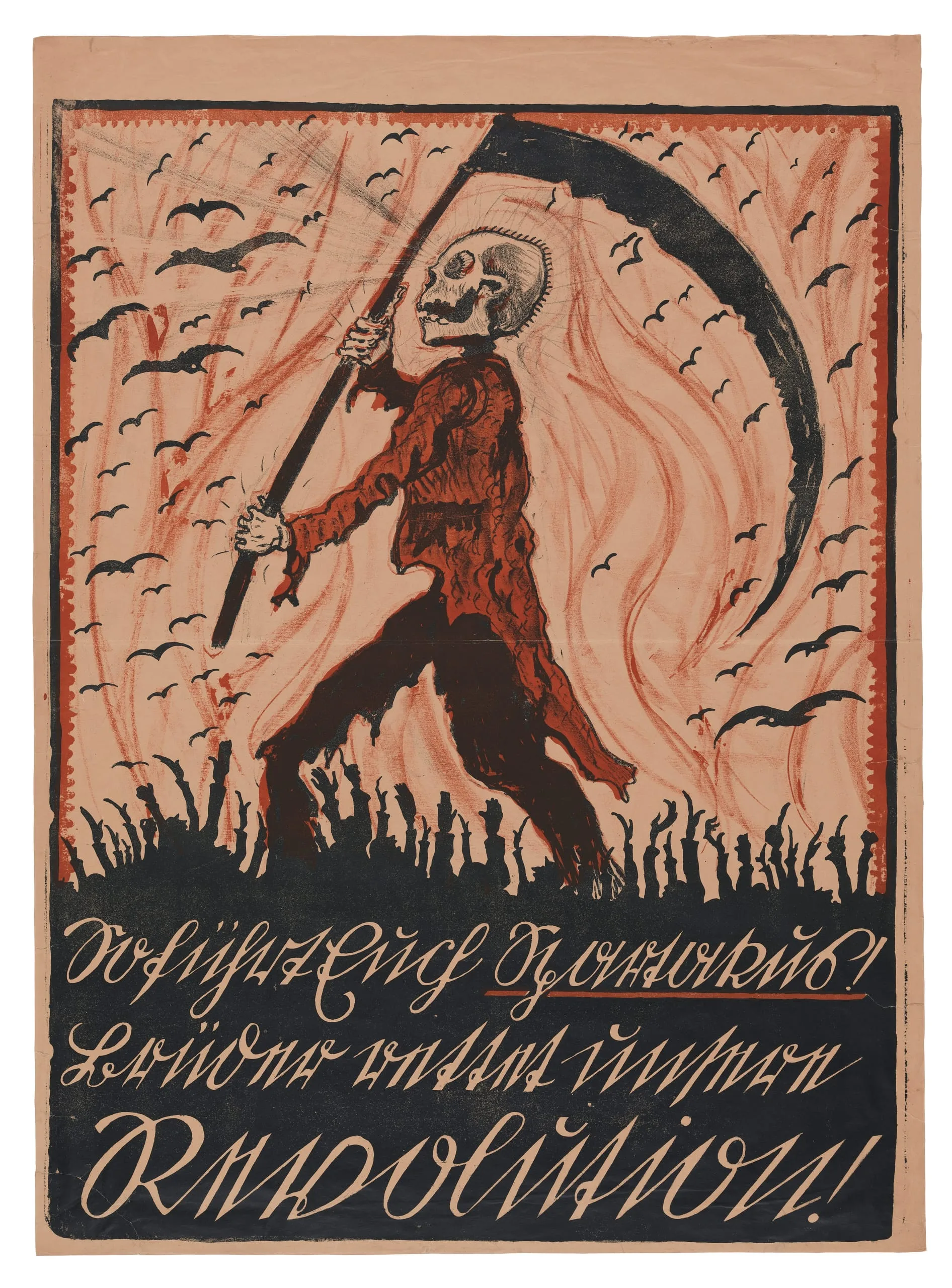
In late 1918 and early 1919, government-sanctioned graphics commissioned by Germany’s Werbedienst (Publicity Office) competed for public attention with posters made by political parties. In this poster, produced by an anti-Bolshevik group, a giant, scythe-wielding skeleton swarmed by a conspiracy of ravens strides across the sheet. Below him, silhouettes of the upraised arms of a frenzied mob create a jagged horizon line. The text is written in Kurrent, a distinctly German form of cursive script used in the early twentieth century. The poster shares the reduced black-and-red color palette of other revolutionary graphics and is similar in tone and ideological function to anti-Communist graphics such as Max Pechstein’s 1919 To the Lantern! (M.2003.115.44). Yet this image has more visual coherence and clarity of message; although the artist is unknown, the poster was likely executed by an experienced designer who repurposed revolutionary iconography to combat its appeal.
The Spartacus that supposedly turns its followers into agents of destruction is the Spartacus League. Founded by Karl Liebknecht, Rosa Luxemburg, and others, the league sought to push the German Revolution toward an international revolution of the proletariat. In December 1918, the group formally renamed itself the Communist Party of Germany (KPD), and initiated the Spartacist uprising, a general strike, in the early weeks of January 1919. This poster may reference those events, during which bloody street battles took place in Berlin, and the government called in Freikorps troops to crush the revolt.
Erin Sullivan Maynes
2022 (adapted from Pressing Politics: Revolutionary Graphics from Mexico and Germany, 50)