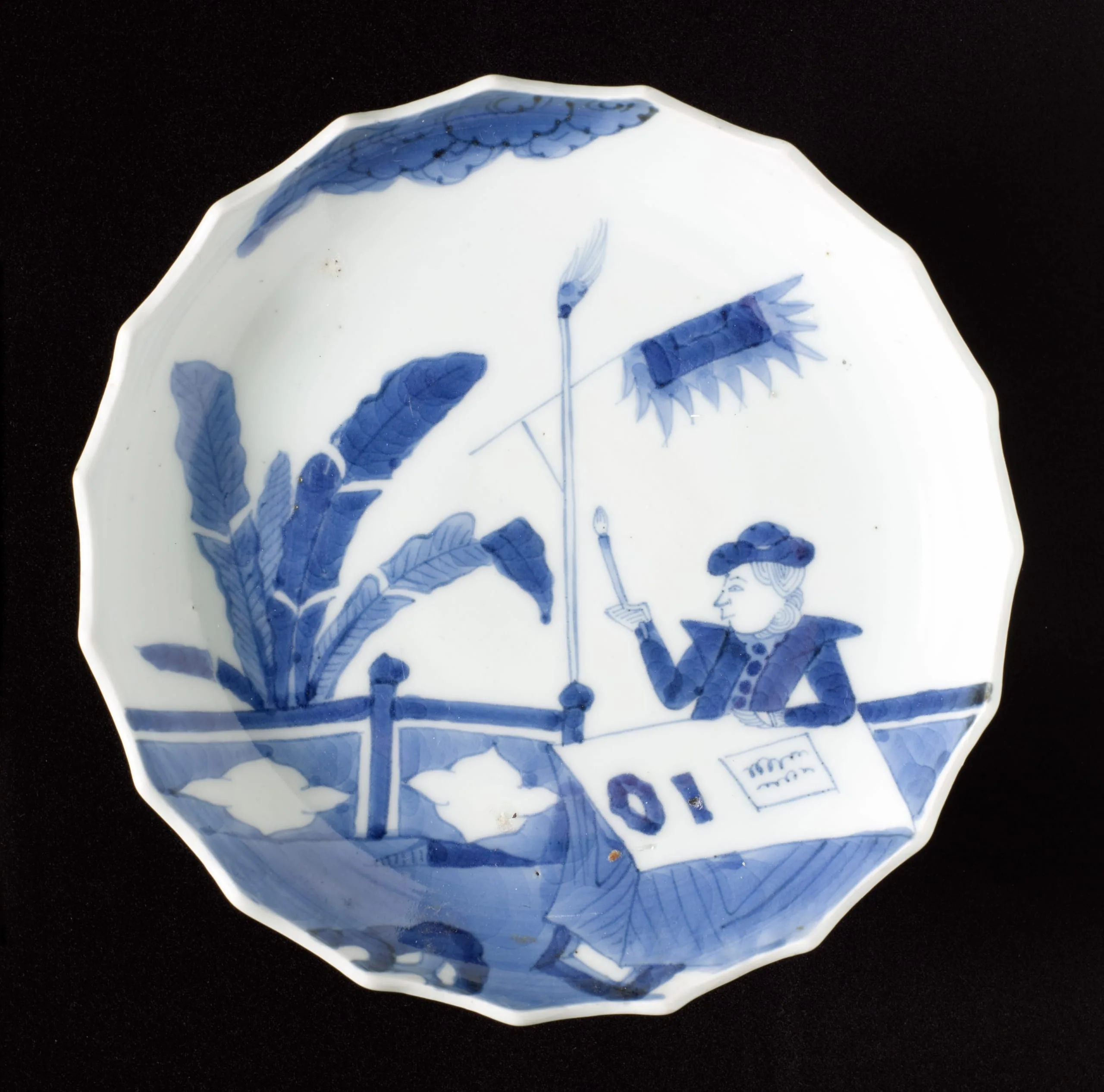
During the Edo period (1615−1868), the Japanese had a great fascination with all things foreign. In 1639, the shogunate cut off all relations with other nations, a policy of self-imposed isolation (sakoku) that severely limited Japan’s exposure to the outside world. The sole Westerners permitted to trade with Japan were the Dutch, who were confined to the small man-made island of Deshima in Nagasaki Bay. These exotic foreigners and their strange ways became a favorite motif in the arts of Japan. However, with little opportunity for first-hand observation of their behaviors and habits, artists resorted to often fanciful interpretations.
Here, a Dutchman is placed in a setting much like that of a Chinese scholar. Writing brush in hand, he is seated at a table that holds a sheet of paper, an ink stick, and an ink stone. The elaborate railing, the tall banana plant, the mass of clouds on the top edge of the dish, and the small pine branch in the foreground suggest a garden scene. All of these elements are commonly found in portrayals of Chinese literati (see AC1992.159.1). Beginning in the seventeenth century, Japanese scholars became increasingly interested in gaining knowledge from the West, a period known as rangaku (“Dutch studies”). Materials that came into Japan via exchanges with the Dutch included prints, drawings, scientific instruments, and books on medicine, anatomy, cartography, technology, politics, and the natural sciences. Here, the Dutchman’s placement in a scholar’s setting may allude to this context of cross-cultural scholarly pursuits.
2024