Throughout history, Japanese artists and artisans have made much use of animals, plants, flowers, and a variety of other motifs that were considered lucky or conveyed auspicious meaning. Rats were abundant where rice was stored and therefore represented prosperity or a plentiful harvest. Carps denoted perseverance because they swim against the current and as a decorative motif were often depicted swimming up a waterfall. Dragonflies were thought to never fly backwards, a trait that made them favored symbols of courageous samurai for whom retreat was unthinkable. Auspicious motifs were favored decorative designs on all kinds of wares, including ceramics, lacquers, and sword fittings, as well as garments and textiles. Traditionally, gifts commemorating a particular occasion or celebration were carefully selected to convey appropriate good wishes. Subjects associated with long life were common designs on birthday gifts.
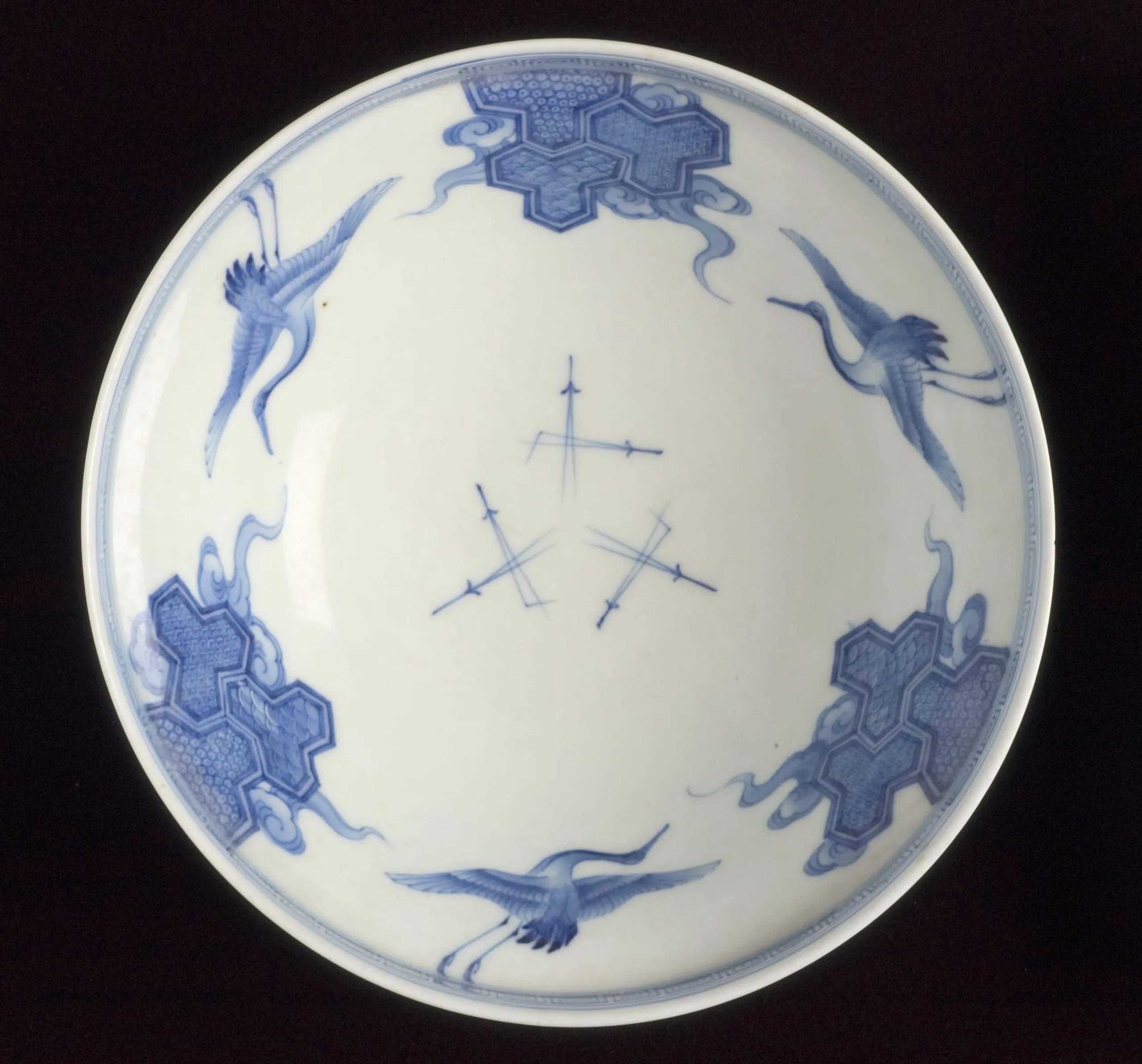
Wishes for long life are represented by many designs, including deer, peaches, and the plants and animals pictured on this bowl. The crane has been associated with a host of auspicious meanings, including longevity. While many plants appear to die off in the winter, pines remain green, a trait that led to their association with long life. Here, rather than the more common use of pine boughs or clusters of pine needles, the tree is represented by three pairs of crossed pine needles. Minogame—mythical long-tailed turtles—are said to live for a thousand years. The turtle is represented here by groupings of three adjoining shapes that mimic the angular sections of a turtle carapace. Each shape is filled with small repeating designs known as diaper patterns.
A different design decorates the outer surface of the bowl: clusters of pine needles, bamboo leaves, and plum blossoms. Sho-chiku-bai (pine-bamboo-plum) is a plant grouping known as the Three Friends of Winter. The theme originated in China, where it became popular in painting, and was introduced to Japan in the Heian period (794−1185). All three plants endure long winters, the end of which is signaled by the blossoming plum. Chinese scholars found the plants’ perseverance and resilience akin to the qualities of the ideal Confucian scholar-gentleman.
2025