- Title
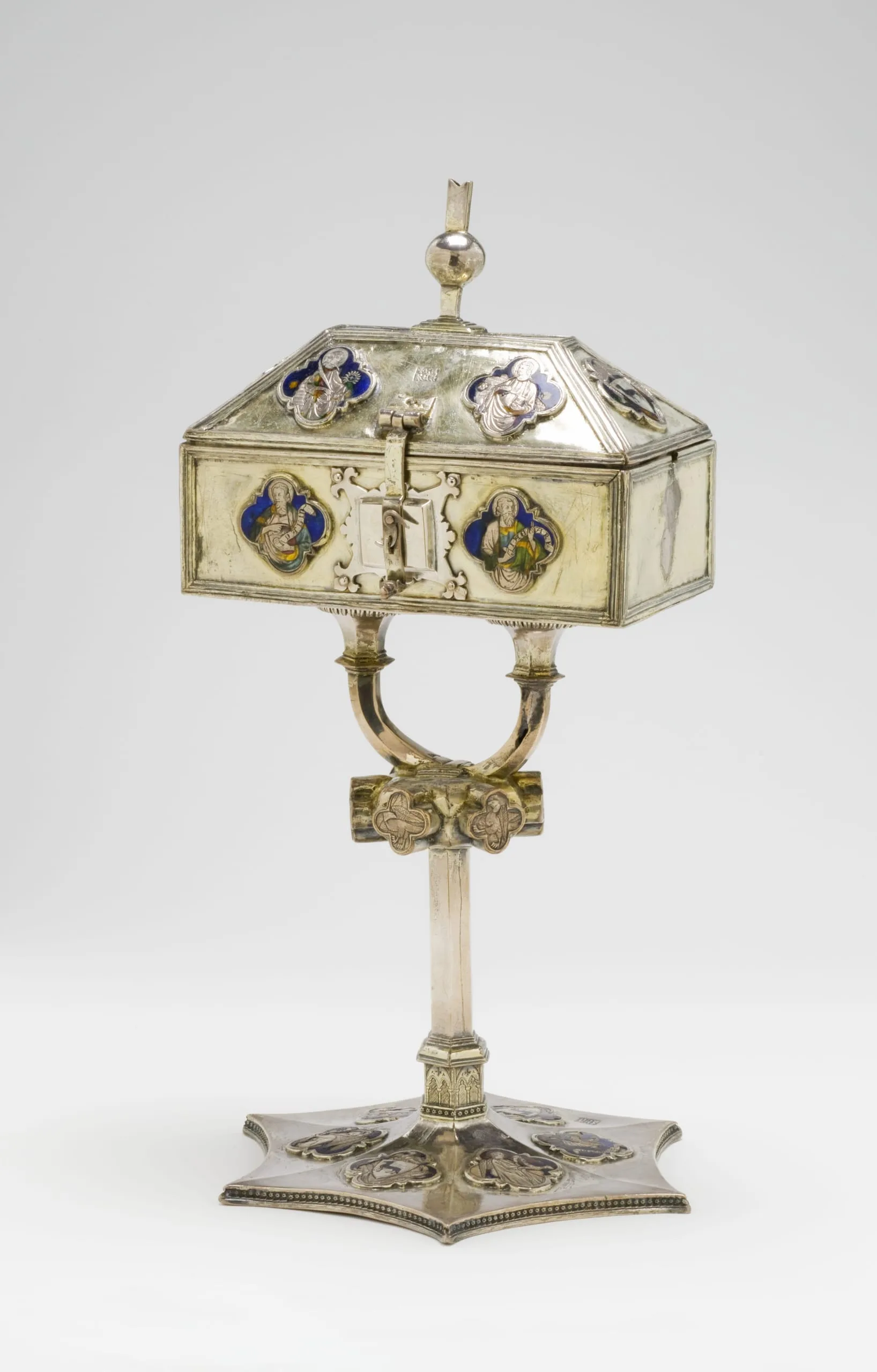
- Standing Pyx
- Date Made
- circa 1400
- Medium
- Silver, enamel
- Dimensions
- Height: 7 3/4 x 7 in. (19.69 x 17.78 cm)
- Accession Number
- 46.4.7
- Curatorial Notes
A pyx is the container that holds the consecrated bread symbolizing the body of Christ in a Roman Catholic Mass and the Protestant service of Holy Communion. A silver pyx like this one standing on a tall stem was visible to the congregation and added splendor to the altar furnishings. Even when closed, a pyx was an object of veneration. Aspects of its design were purely practical, such as a broad foot to provide stability and a central knop that made it easier to grasp when carried. Variations of this design were produced throughout Catalonia. Here, the container, in the form of a rectangular coffer with a truncated pyramidal top, resembles older medieval reliquary caskets. It opens with a hinged lid that is secured by a hasp and fastened with a small silver hook. The hasp’s elaborately shaped backplate resembles secular iron hardware of the period. The surface is embellished with colorful enamel plaques showing the four apostles (on the lid) and the four prophets (on the sides). On the lid’s ends and alternating with the plaques on the foot are enameled armorial shields. These may relate to the original (unidentified) patron, or perhaps this pyx was intended for use in a private family chapel.
- Selected Bibliography
- Levkoff, Mary L., ed. Hearst the collector. Exh. Cat. New York: Abrams and Los Angeles: Los Angeles County Museum of Art, 2008.