- Title
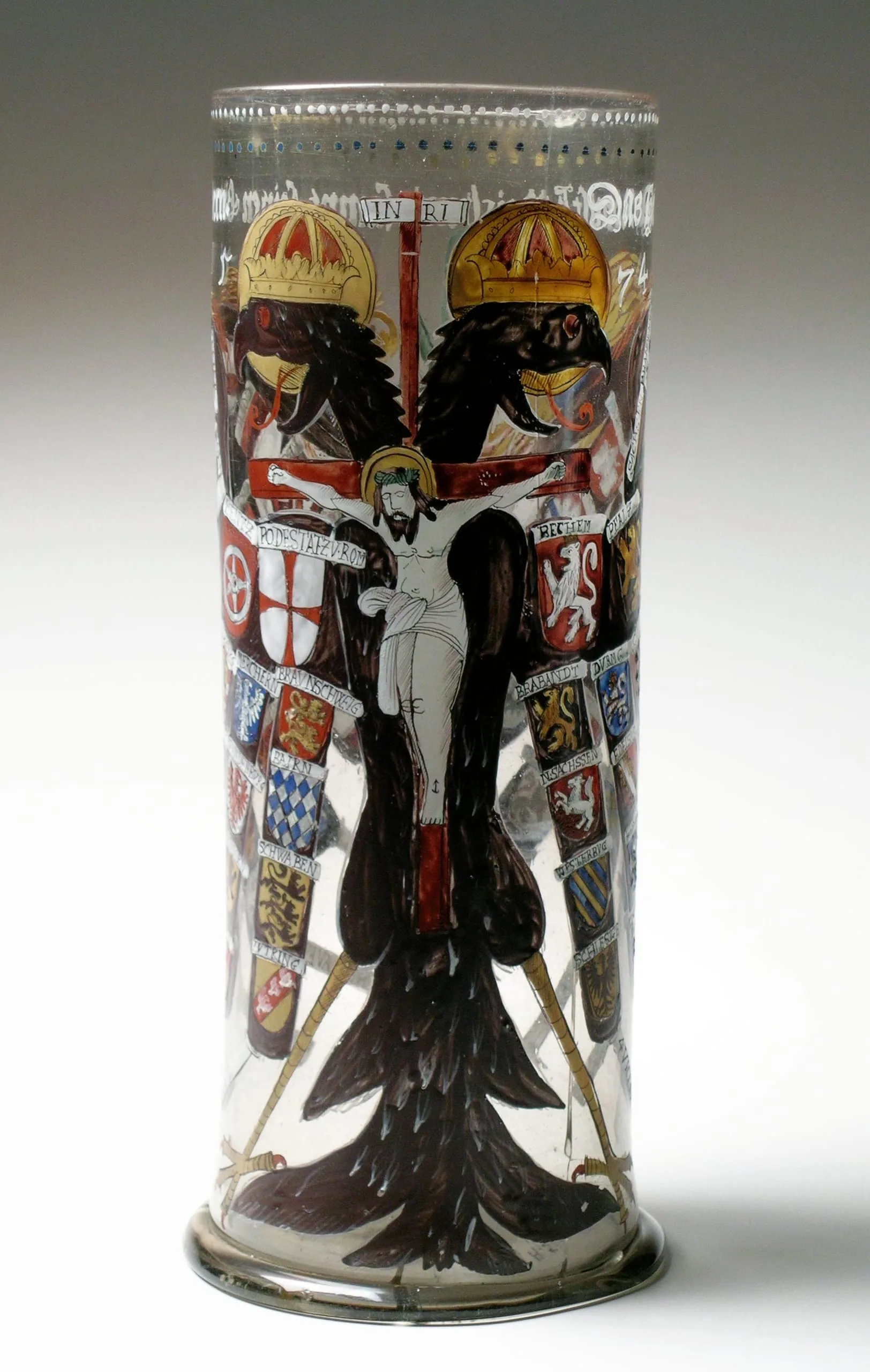
- Beaker with Arms of the Holy Roman Empire (Reichsadler Humpen)
- Date Made
- 1574
- Medium
- Glass, enamel
- Dimensions
- Height: 12 1/2 in. (31.75 cm); Diameter of rim: 4 1/2 in. (11.43 cm); Diameter of base: 5 1/4 in. (13.34 cm)
- Accession Number
- 48.24.229
- Curatorial Notes
Large drinking glasses (Humpen) were a specialty of German glassblowers. This example is decorated in enamel colors with a double-headed eagle, the symbol of the Holy Roman Empire, a federation of separate states and kingdoms that ruled most of Europe for centuries, between the fall of the Roman Empire and the rise of Napoleon in the early nineteenth century. The beaker’s slender shape requires the decoration to be very dense, but it nevertheless incorporates the shields of the many territories that comprised the empire. Their arrangement reflects a hierarchy, with the most powerful states at the top of the eagle’s wings. Those states were led by either secular or ecclesiastical leaders known as “electors” because they had the power to elect the emperor.
This and other examples of German enameled glass were given to LACMA in 1948 by William Randolph Hearst. After inheriting the collection of glass assembled by his mother, Phoebe Apperson Hearst, he went on to form one of the largest collections of its kind before donating a selection to LACMA toward the end of his life.