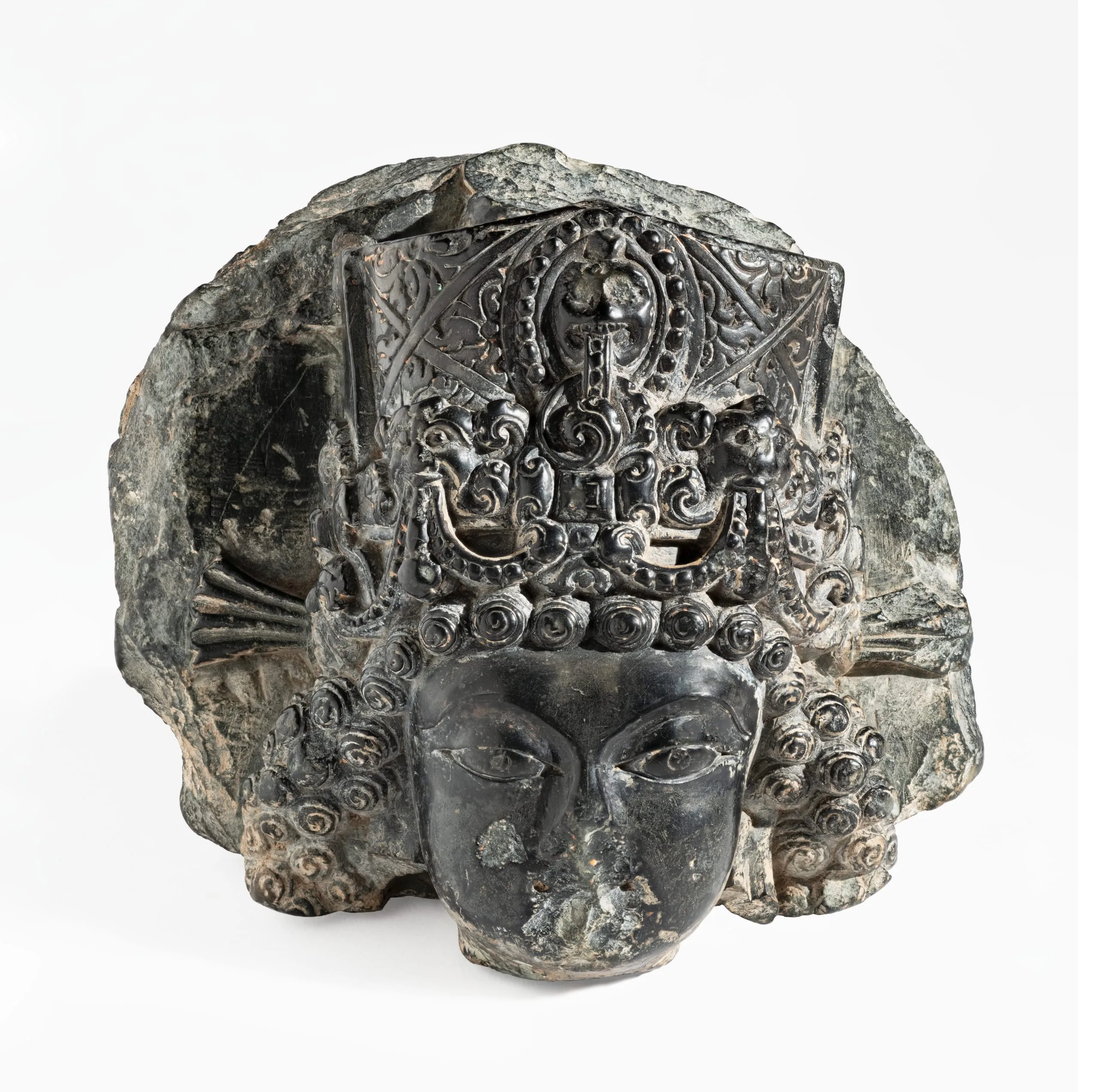
Vishnu, the Hindu god of preservation, can assume many iconological aspects. His supreme manifestation is considered to be the cosmic form known as Vishvarupa (Universal Form). In chapters 10-11 of the Bhagavad Gita (Song of God) dating from the 2nd century BCE,
Krishna reveals to Arjuna his omniscient form with innumerable heads and arms that encompassed all the creatures in the infinite universe. In the earliest extant artistic representations of Vishvarupa dating from the Gupta period (late 4th-early 6th century CE), the deity is often shown with four heads: human, demonic, porcine, and leonine. In portrayals made during the second millennium, Vishvarupa is typically envisioned with multiple heads and arms. In contrast, this image may be a rare depiction of Vishnu as Vishvarupa with only a single human head. The iconographic basis for this identification is the remnant of a seated figure on top of Vishnu’s jeweled crown, which can be identified as a diminutive image (bimba) of Yogasana Vishnu on the basis of an analogous seated crown figure on a single-headed Vishvarupa from Lakshmankati, West Bengal. (See J. N. Banerjea, Development of Hindu Iconography, 1974 reprint, p. 405 and N.K. Bhattasali, Iconography of Buddhist and Brahmanical Sculptures (in the Dacca Museum), 2001 reprint, p. 86, pl. 32.)
Stylistically, this Head of Vishnu Vishvarupa compares closely with a 7th-century Surya image from Gujarat now in the Chhatrapati Shivaji Maharaj Vastu Sangrahalaya, Mumbai.