- Title
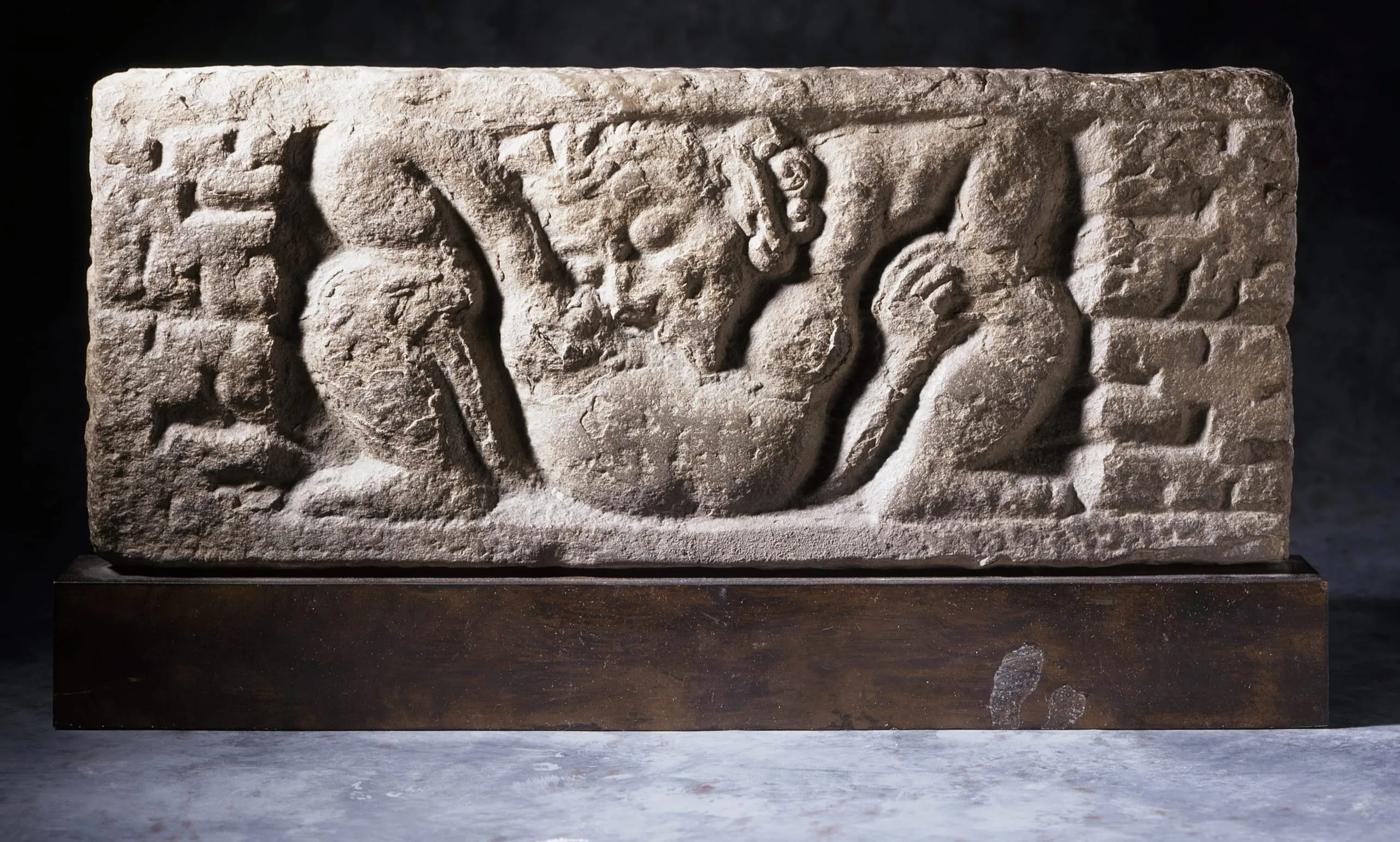
- Architectural Support with Squatting Dwarf
- Date Made
- circa 7th century
- Medium
- Stone
- Dimensions
- 8 3/4 x 21 1/8 x 2 1/4 in. (22.23 x 53.66 x 5.72 cm)
- Accession Number
- M.2002.215
- Curatorial Notes
The carved base of the columns (adhishthana) in Nepalese temple and palatial architecture are often graced with an image of a squatting dwarf (see also M.86.247.3). Known as ganas (troop or multitude), they are a class of demigods who principally serve as attendants for the Hindu god Shiva, as well as some Buddhist deities (see M.69.13.10, M.73.4.1, and M.75.4.14). They are envisioned as rotund gnomes, often rambunctious and full of zest. They dance and play music for Shiva and his wife Parvati. Their leader is Ganesha/Ganapati (lord of the ganas). When used in an architectural context such as here, ganas represent the lower echelons of cosmic existence that support the higher spiritual realms (see also M.86.184).
This expressive gana is squatting with his hands on his knees to bear the column shaft on his shoulders with his large belly providing an additional foundation. He has bulging eyes and his head is cocked to one side. The sides of the relief are carved with stylized rocks that evoke the mountainous terrain of the Himalayas.