LACMA

ShopMembershipMyLACMATickets
LACMA
Los Angeles County Museum of Art
5905 Wilshire Blvd.
Los Angeles, CA 90036
info@lacma.org
(323) 857-6000
Sign up to receive emails
Subscribe
© Museum Associates 2025

Museum Hours

Monday

11 am–6 pm

Tuesday

11 am–6 pm

Wednesday

Closed

Thursday

11 am–6 pm

Friday

11 am–8 pm

Saturday

10 am–7 pm

Sunday

10 am–7 pm


  • About LACMA
  • Jobs
  • Building LACMA
  • Host An Event
  • Unframed
  • Press
  • FAQs
  • Log in to MyLACMA
  • Privacy Policy
© Museum Associates 2025
Collections

Unknown
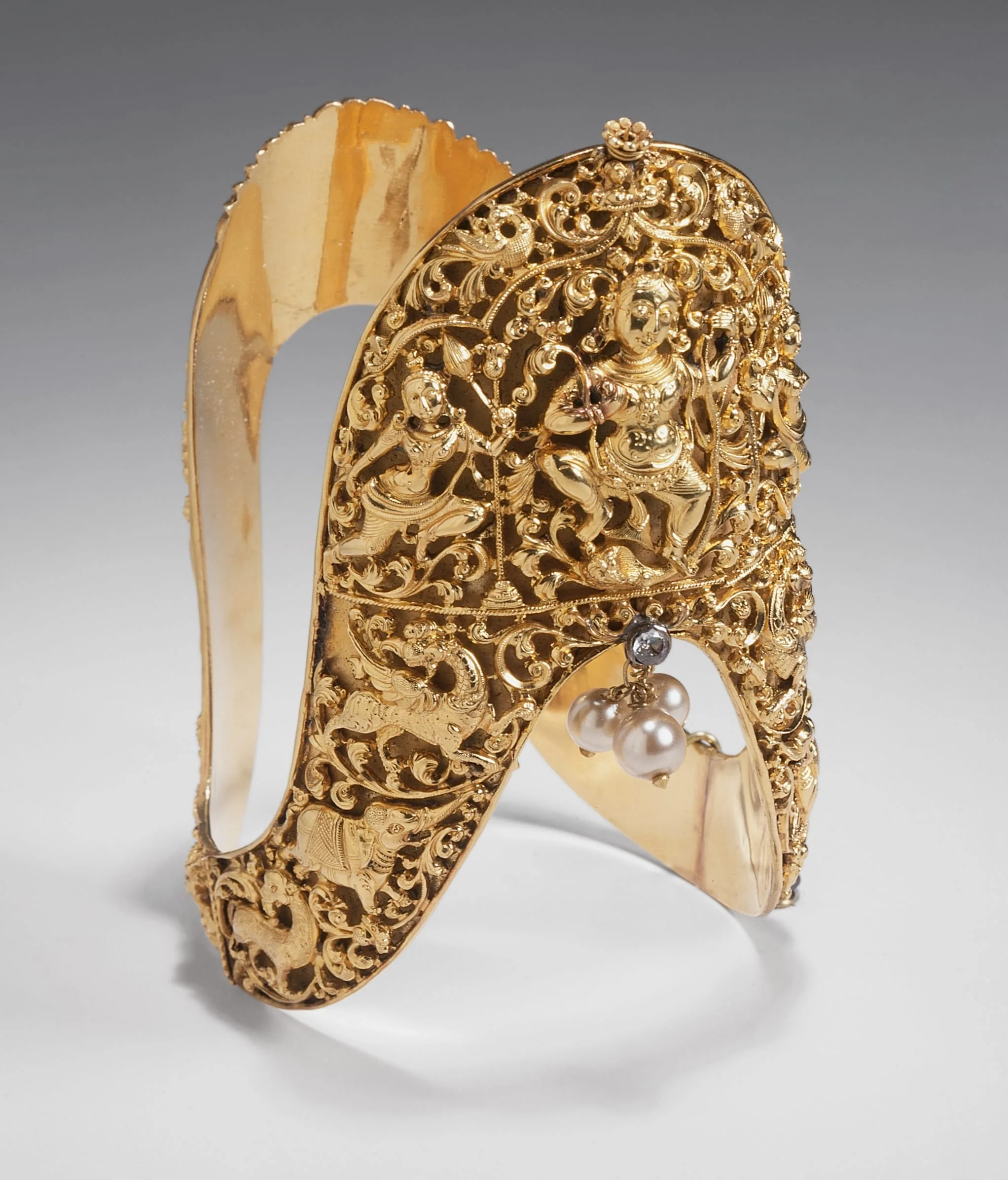
Armlet with Krishna Dancing Triumphantly on the Serpent King, Kaliyacirca 1850-1900

Not on view
Gold repoussé cuff or armlet with filigree deity figures, scrolling vines, and three pearl and gemstone pendants, on an amber horn-like base
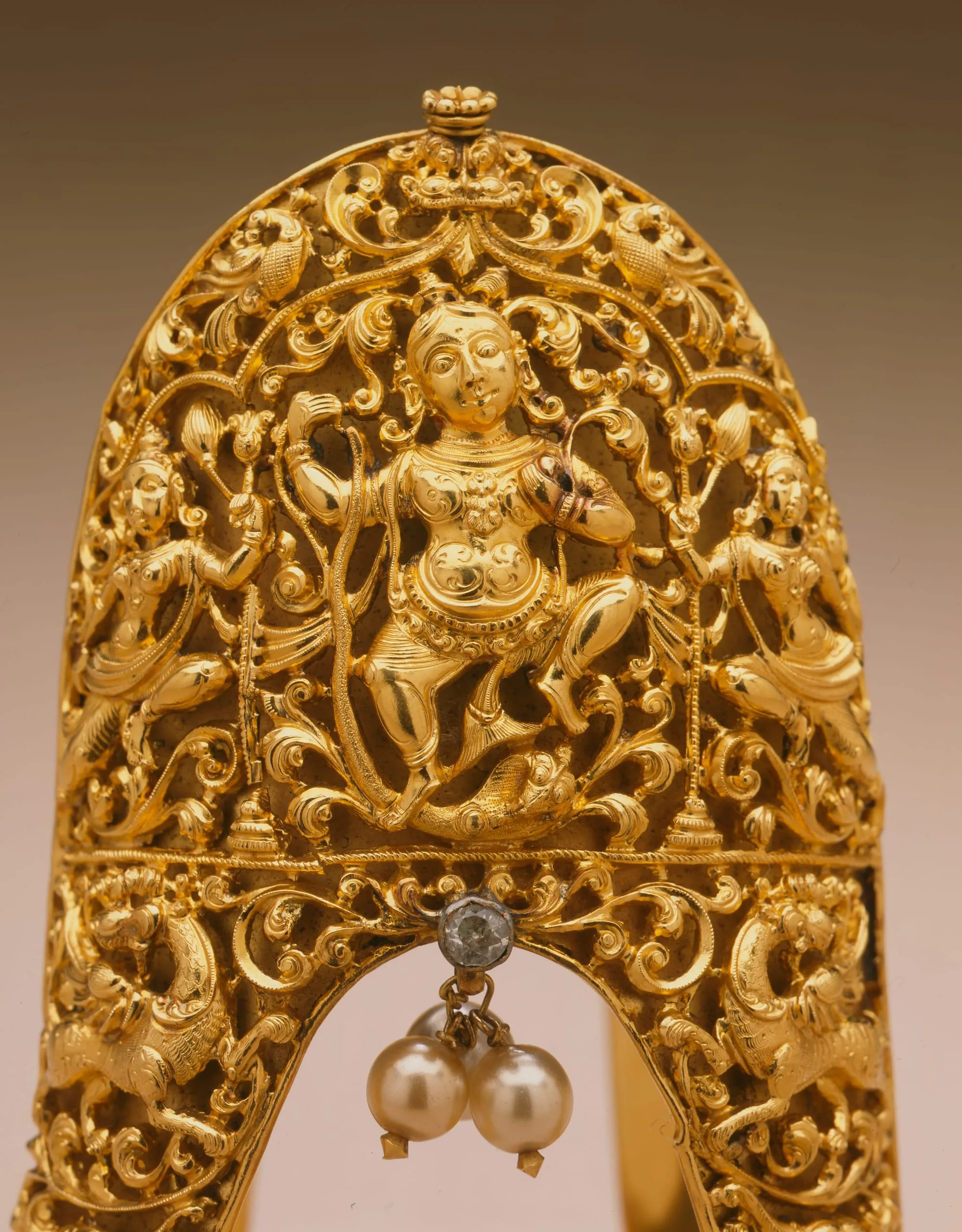
Gold repoussé ear ornament with arched openwork frame; central deity figure seated in ornate niche, flanked by attendant figures and scrolling foliage; pearl drops suspended from a diamond-set fitting at base.
Artist or Maker
Unknown
Title
Armlet with Krishna Dancing Triumphantly on the Serpent King, Kaliya
Place Made
India, Tamil Nadu, Chennai (Madras)
Date Made
circa 1850-1900
Medium
Repoussé and chased gold, opalescent glass beads, and an inset gray topaz
Dimensions
4 1/4 x 2 3/4 x 3 1/8 in. (10.8 x 6.99 x 7.94 cm)
Credit Line
Purchased with funds provided by the Nasli and Alice Heeramaneck Collection, Museum Associates Purchase
Accession Number
M.2002.83
Classification
Jewelry and Adornments
Collecting Area
South and Southeast Asian Art
Curatorial Notes

Distinguished by its intricate workmanship, this extraordinary armlet (vanki) is made of repoussé and chased gold, opalescent glass beads, and an inset gray topaz. Attributed to Chennai, circa 1850–1900, it epitomizes a traditional type of ornament worn by southern Indian Hindu women on their upper arms. The armlet features delicate openwork panels of micro-repoussé and chased gold filigree images of human, animal, and mythological figures. They are set in horizontal registers defined by arches with pearl borders for the primary figural row and, for the subsidiary figures, amidst a lace-like background of scrolling vines. Plain sheet gold is used as the support backing for the figural matrix.

The armlet’s design program consists of various inhabitants drawn primarily from India’s rich corpus of mythology. The central image on the front depicts the Hindu god Krishna dancing triumphantly on Kaliya, a serpent king who had terrorized the countryside before being vanquished by Krishna and converted to his worship. Krishna and Kaliya are flanked by female attendants waving honorific fly whisks symbolic of Krishna’s divine status. Additional figures include, at the top of the armlet, a "face of glory" (kirtimukha) paired with peacocks and, along its sides, winged griffins, elephants, tigers, and rearing lions.

The traditional jewelry of southern India differs in material, technique, form, and cultural meaning from the better-known northern Indian jewelry of the Mughal era. Gold and silver ornaments abound in both traditions in diverse manifestations. Gemstones are often incorporated in southern Indian jewelry for their perceived astrological effects and to embody Hindu divinities and sacred animals. In Mughal works, gemstones are used primarily for decorative purposes and to proclaim the status of the wearer. The backs of southern Indian jewelry pieces are generally not embellished with enameled designs, as is frequently the case with Mughal and northern Indian jewelry.
Selected Bibliography
  • Markel, Stephen. Mughal and Early Modern Metalware from South Asia at LACMA: An Online Scholarly Catalogue. Los Angeles: Los Angeles County Museum of Art, 2020. https://archive.org/details/mughal-metalware (accessed September 7, 2021).
  • McGill, Forrest, editor. Beyond Bollywood: 2000 Years of Dance in the Arts of South Asia, Southeast Asia, and the Himalayan Region. San Francisco, CA: Asian Art Museum, 2022.