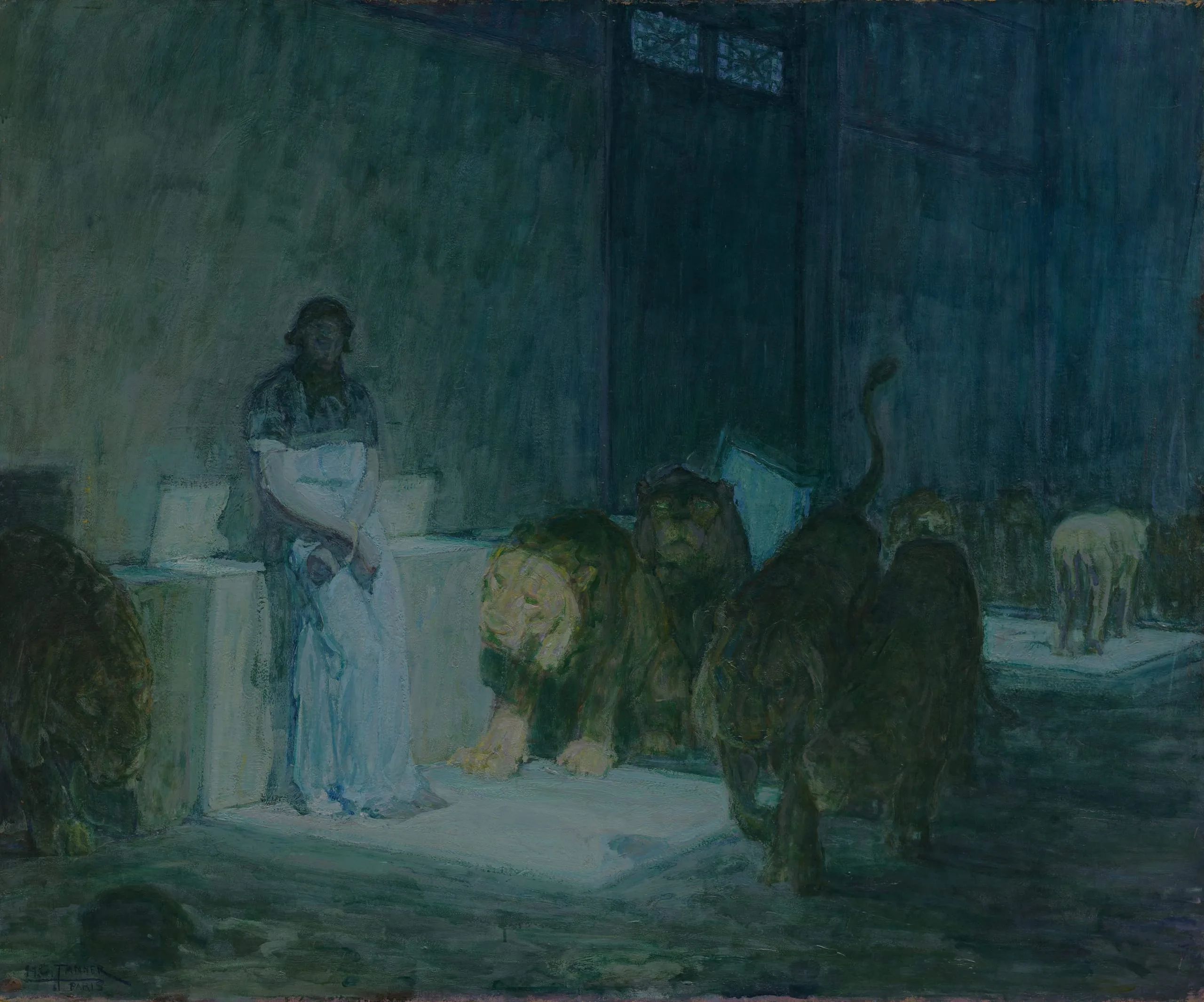
Tanner first achieved recognition at the Paris Salon of 1896 with his painting Daniel in the Lions’ Den. Although the museum’s painting of the same title has been often mistaken for the painting shown in the 1896 Salon, it is a similar, but later version. In both paintings Tanner delineated an Old Testament story set during the reign of King Darius in ancient Persia (Dan. 6:16-24). Tanner infused the drama of Daniel’s unjust imprisonment with a quiet spirituality. The earlier canvas was Tanner’s first major religious painting and indicated the direction that his art would take. The choice of a religious subject may have been inspired initially by his teacher Laurens, who was noted for dramatic biblical paintings. Tanner’s depiction of a dark prison cell, dramatically lit by evening light streaming through a high window, may have also come from Laurens, whose Le Grand Inquisiteur chez les rois catholiques, 1886 (Philadelphia Museum of Art) -- a painting also about an unjust imprisonment -- is similar in composition and lighting. It is probably not coincidental that Tanner owned a reproduction of the Laurens painting and kept it throughout his career (it is among the Tanner Papers). The decision to select a narrative in which animals play a major role may have been determined by Tanner’s previous success with animal paintings; he had sold Lions at Home, by 1885 (unlocated), when it was exhibited in 1885 at the National Academy of Design. When he decided to paint this subject he prepared himself by sketching the lions at the Jardins des Plants and by studying with the noted animalier Emmanuel Frémiet.
Tanner often painted variations on the same theme. The museum’s version was probably executed in the years before the First World War, possibly as early as 1907. Tanner exhibited a painting entitled Daniel in the Lions’ Den at the annual of the Pennsylvania Academy in 1896-97, at the 1901 Pan-American Exposition in Buffalo, the Louisiana Purchase Exposition of 1904 in Saint Louis, his 1908 show at the American Art Galleries in New York, and the Anglo-American Exposition in London in 1914. It was probably the second version that was exhibited in the last two, however, none of the descriptions in the reviews of any of these exhibitions is specific enough for determining which version was shown. Although the museum’s painting is on paper, it probably was not intended as a sketch but as an independent, second version. (In 1976 the canvas used to back the museum’s painting was found to have on it an unfinished oil possibly illustrating a scene from the life of Job and able to be dated on stylistic grounds to the late 1890s or early years of the 1900s.)
The museum’s painting is a recapitulation of the scene as Tanner depicted it in his 1896 Salon painting, but he changed the format and modified details. The earlier Daniel in the Lions’ Den was a vertical painting in which half the composition was taken up by the shadowy, high-ceilinged structure above the head of Daniel. In the second version, Tanner eliminated the ceiling to focus more on the figure. Both paintings emphasized shadows, with a brilliant light illuminating the lower half of Daniel’s figure, especially his bound hands. While the shape and size of the illuminated area were altered in the second version -- to show more of the prisoner’s figure -- the change was not significant. The first version included an elaborate Assyrian frieze. Although such details were in keeping with the late nineteenth-century academic taste for archaeological accuracy and narration, they did not accord with Tanner’s mature painting style.
During the first decade of this century Tanner developed a poetic style in which he used color and light to evoke the essence of a religious story. In the museum’s painting Daniel appears calm, strengthened by his inner spiritual belief, and Tanner’s use of a bluegreen palette heightened this meditative mood. Experiments with pigments and glazing begun around 1907 enabled him to infuse his art with a soft, glowing light and shimmering color. While the overall color scheme of Daniel in the Lions’ Den is tonal -- typical of Tanner’s mature canvases -- the painting actually is much more varied in color than it initially appears, for the lions are sketched in brilliant shades of yellow, green, and lavender.