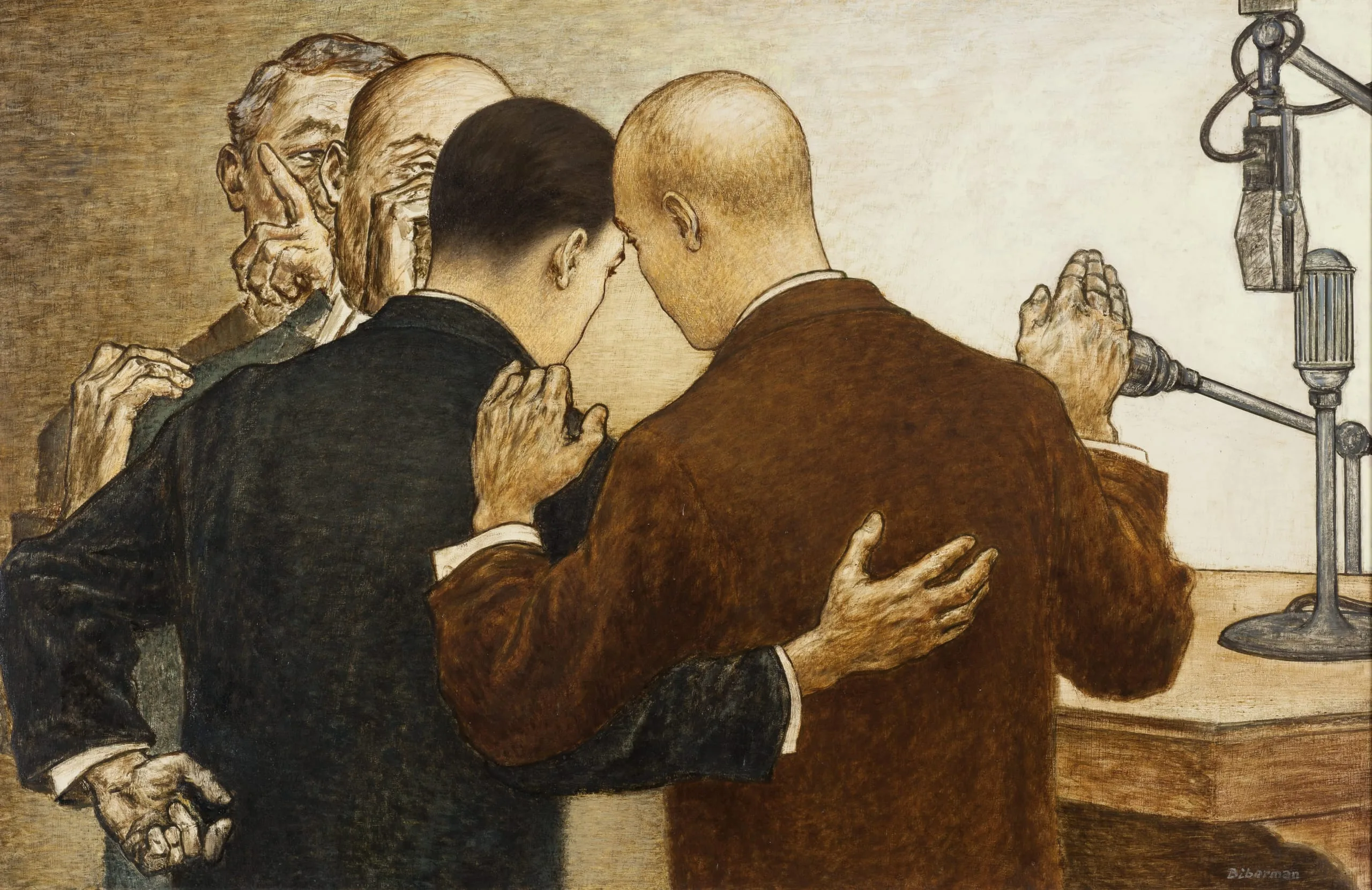
- Title
- Conspiracy
- Date Made
- circa 1955
- Medium
- Oil on board
- Dimensions
- Canvas: 26 1/2 × 41 1/2 in. (67.31 × 105.41 cm)
Frame: 28 1/2 × 43 1/4 × 2 1/2 in. (72.39 × 109.86 × 6.35 cm)
- Accession Number
- M.2002.86
- Curatorial Notes
Edward Biberman’s career was put on hold for five months in the early 1950s when his brother Herbert, one of the “Hollywood Ten,” was imprisoned for his refusal to cooperate with the House Un-American Activities Committee. The experience of living in Los Angeles during this politically charged period profoundly influenced Biberman, whose work of these years—including Conspiracy—clearly reflects the political realities of the day. Although he resigned from his position at the Art Center School (in anticipation of dismissal for his political beliefs), he continued to teach throughout Southern California. The painter lived and worked in Los Angeles, known locally but largely ignored on the national art scene, until his death in 1986.
Carol Eliel
- Selected Bibliography
Barron, Stephanie, S. Bernstein and I. S. Fort, with essays by Stephanie Barron, Sherri Bernstein, M. Dear, Howard N. Fox and Richard Rodriguez. Made in California: Art, Image, and Identity, 1900-2000. Los Angeles: Los Angeles County Museum of Art and Berkeley: University of California Press, Berkeley, 2000.
- LACMA: Obras Maestras 1750-1950: Pintura Estadounidense Del Museo De Arte Del Condado De Los Angeles. Mexico, D.F.: Museo Nacional de Arte, 2006.
- Kim, Woollin, Jinmyung Kim, and Songhyuk Yang, eds. Art Across America. Seoul: National Museum of Korea, 2013.
- Miller, Angela, and Chris McAuliffe, eds. America: Painting a Nation. Sydney: Art Gallery of New South Wales, 2013.
Blondet, José Luis. Six Scripts for Not I: Throwing Voices (1500 BCE-2020 CE). Los Angeles: Los Angeles County Museum of Art, 2020.
- Copyright
- © Edward Biberman Estate