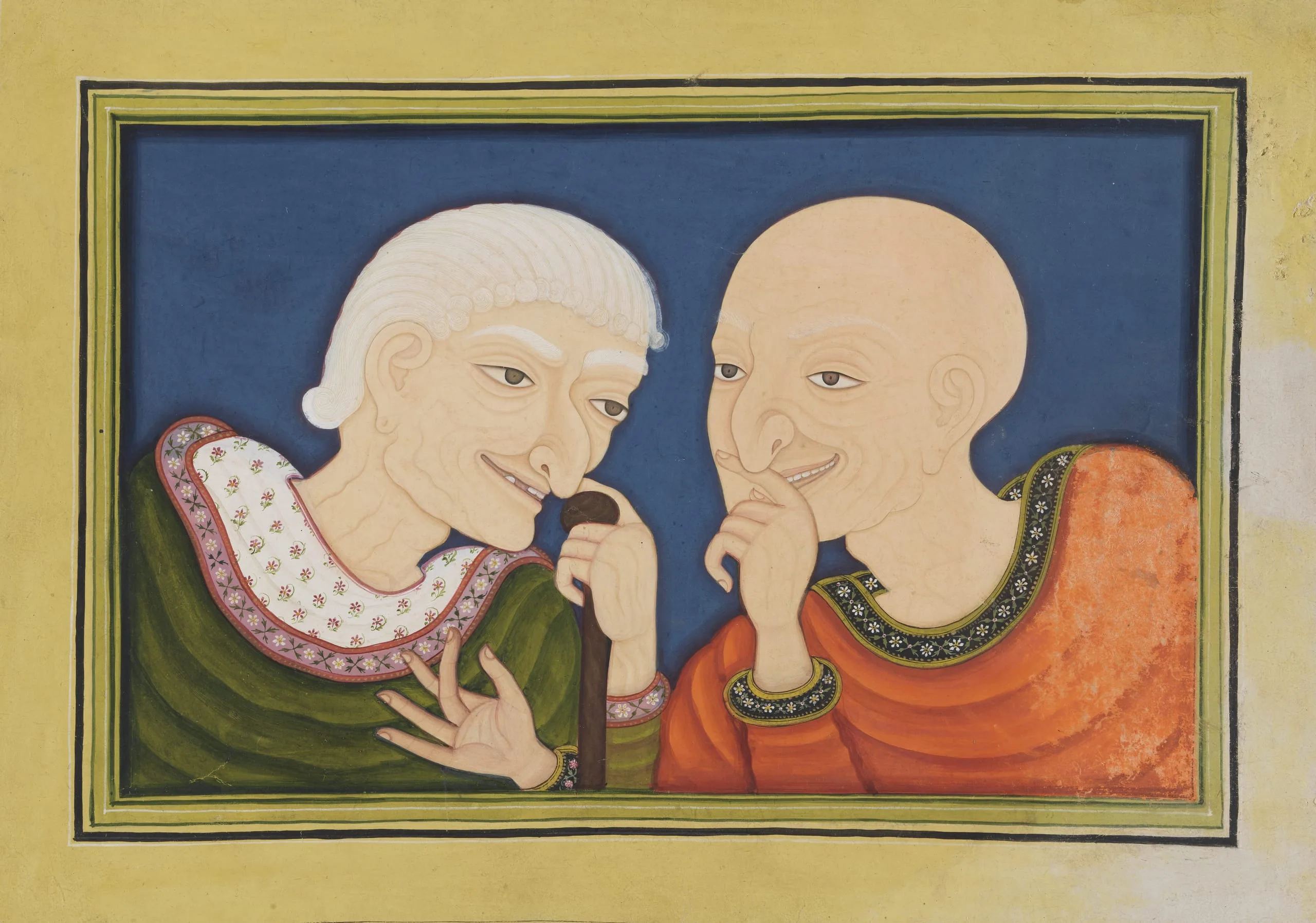
- Title
- Parodies of Europeans
- Date Made
- circa 1760-1800
- Medium
- Opaque watercolor and gold on paper
- Dimensions
- Image: 7 x 11 in. (17.78 x 27.94 cm); Sheet: 9 5/8 x 13 3/4 in. (24.45 x 34.93 cm)
- Accession Number
- M.2001.229.3
- Curatorial Notes
The Indian interest in portraying exotic foreigners during the Mughal period in the late 16th and early 17th centuries was reinvigorated in the painting traditions of the Rajasthan courts of Mewar and Bundi in the early 18th century. A genre of Indian court paintings developed that portrayed exotic Europeans (farangis) as isolated subjects, which due to their exaggerated features and loss of historical context may have come to be viewed as parodies.
A peculiar subset of the farangi genre features a pair of grinning buffoons, as depicted in this double portrait, in M.85.147, and in a painting in the Philadelphia Museum of Art (2004-149-59). The visual source of these enigmatic expressive figures was apparently the representation of fools in 16th- and 17th-century northern European paintings and prints that illustrated the Dutch proverb, “the world feeds many fools.” The figures’ gesticulation of touching their nose with their forefinger has been said to suggest the use of snuff, but the gesture may have also found resonance in the Indian cultural context from its resemblance to the well-known hand position expressing astonishment where the index finger and sometimes the middle finger are held touching the chin or lips. The appeal of these eccentric figures was such that they were often repeated as stock motifs with minor variations, including being shown individually rather than as a pair, and with sundry changes of gender, clothing, hand positions, and objects held.