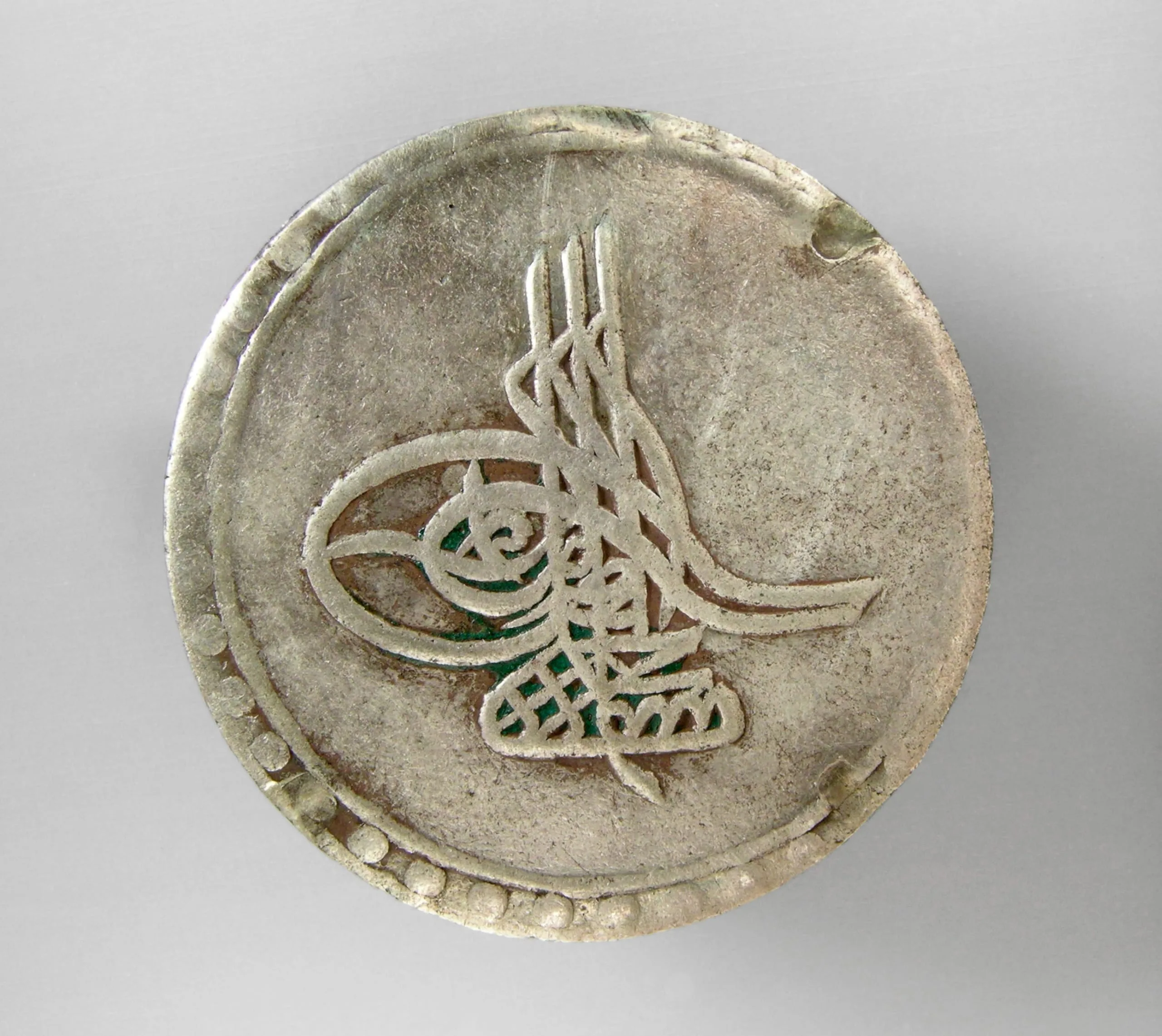
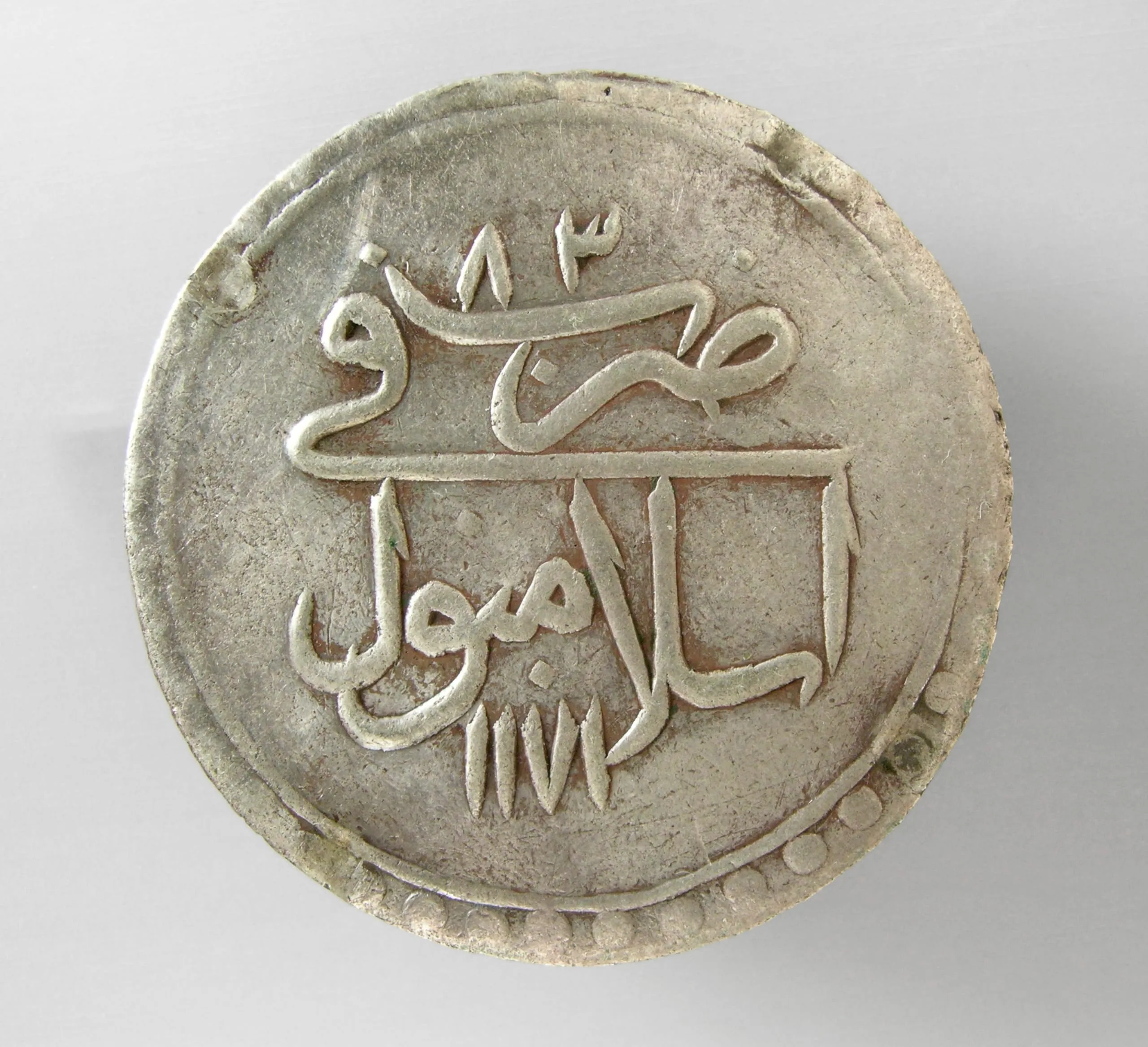
The akçe, or silver coin, was the primary monetary unit of the Ottoman Empire. Like most coinage from Islamic lands, its sole decoration is writing, of which its most recognizable feature, on the face or obverse, is the tuğra, the calligraphic emblem of the Ottoman sultan, as here. Each reigning sultan possessed his own tuğra drawn by the court calligrapher and used for all his official documents, court decrees, and coinage. The tuğra transforms the sultan’s name and titles and the formula “ever victorious” into a uniform and harmonious series of curved and vertical lines, while the actual letters are stacked close together in the lower portion (see M.85.237.17).
In this instance, the tuğra belongs to Sultan Mustafa III (r. 1757−74). As is typical, the reverse of the coin is inscribed with the mint name and the date. It reads: “Struck in Islambol 1171 AH [1757 CE].” Islambol is one of several names for Istanbul, which became the Ottoman capital in 1453. Once known as Constantinople, Islambol (literally, “full of Islam”) expressed the new faith of the once Christian city.
2024