- Title
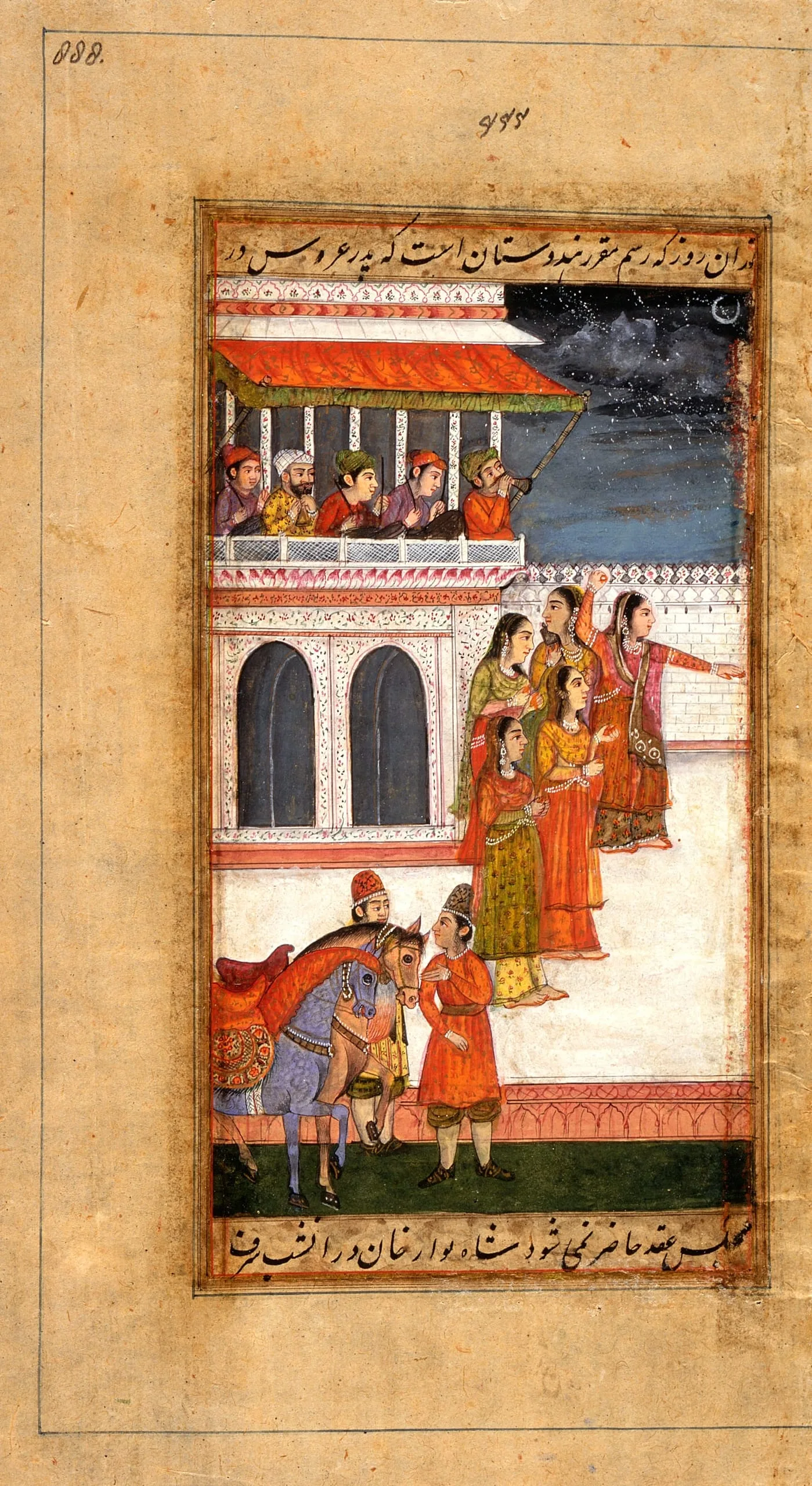
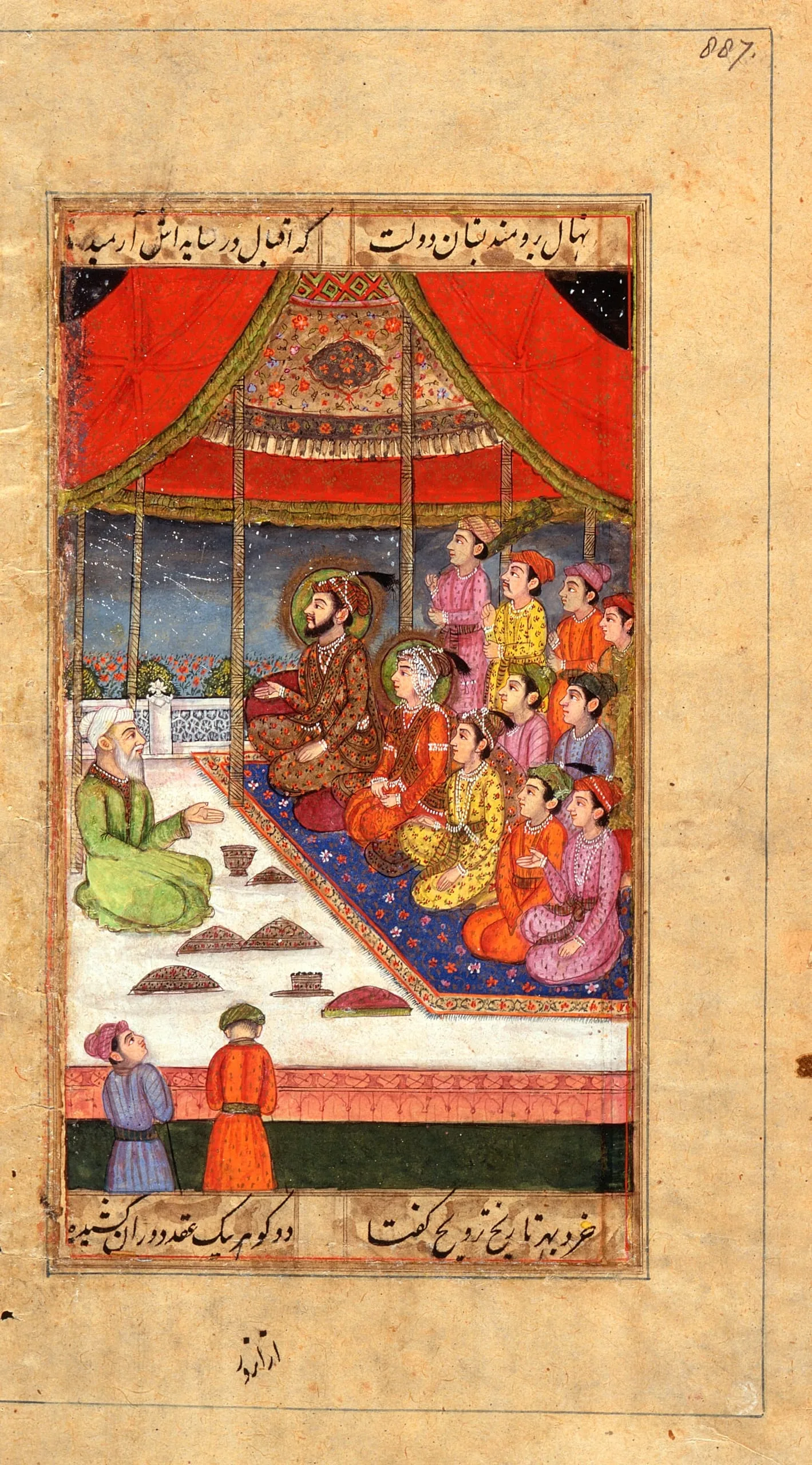
- Marriage of Prince Aurangzeb in 1637: a) Emperor Shah Jahan and Prince Aurangzeb Meeting an Elder of the Bride's party; b) Bride's Party with Dancers and Drummers, Folios from a Padshahnama (Chronicle of the King of the World)
- Date Made
- circa 1800
- Medium
- Opaque watercolor, gold, and ink on paper
- Dimensions
- Both: Sheet: 11 1/2 x 6 1/2 in. ( 29.21 x 16.51 cm), Image: 7 x 4 in. (17.78 x 10.16 cm)
- Accession Number
- M.45.3.543a-b
- Curatorial Notes
The Padshahnama (Chronicle of the King of the World) was written by Abdul Hamid Lahawri (or Lahori, d. 1654). In 1648 he completed the first two decades of the reign of Emperor Shah Jahan (r. 1628-1658). The original album, the Padshahnama of 1656-1657 now in The Royal Library, Windsor Castle (RCIN 1005025), narrates only the first decade of Shah Jahan’s reign. The colophon states that the text was copied by the scribe Muhammed-Amin of Mashhad in AH 1067 (1657-1658 CE). Presumably due to the usurpation of Prince Aurangzeb (1618-1707) in 1658, the album was likely never assembled in Shah Jahan’s lifetime. Milo Beach (1997) hypothesizes that it was assembled between the death of Emperor Aurangzeb (r. 1658-1707) in 1707 and the sack of Delhi in 1739 by the Iranian King Nadir Shah (r. 1736-1747). LACMA’s six double-paged folios are from a manuscript attributed to circa 1800 during the reign of Emperor Shah Alam II (r. 1760-1806). Rather than the earlier individualized realistic representations being copied, this later manuscript has new illustrations with generic figures and settings.
This double-page folio illustrates the marriage of Prince Aurangzeb in 1637: On the right (a), Emperor Shah Jahan and Prince Aurangzeb receive an elder of the bride's party. In the facing page on the left (b), the bride's party celebrates on a palace terrace with female dancers and singers, musicians on an overlooking balcony, and nearby grooms tending horses.
See also M.45.3.542a-b and M.45.3.545a-b.