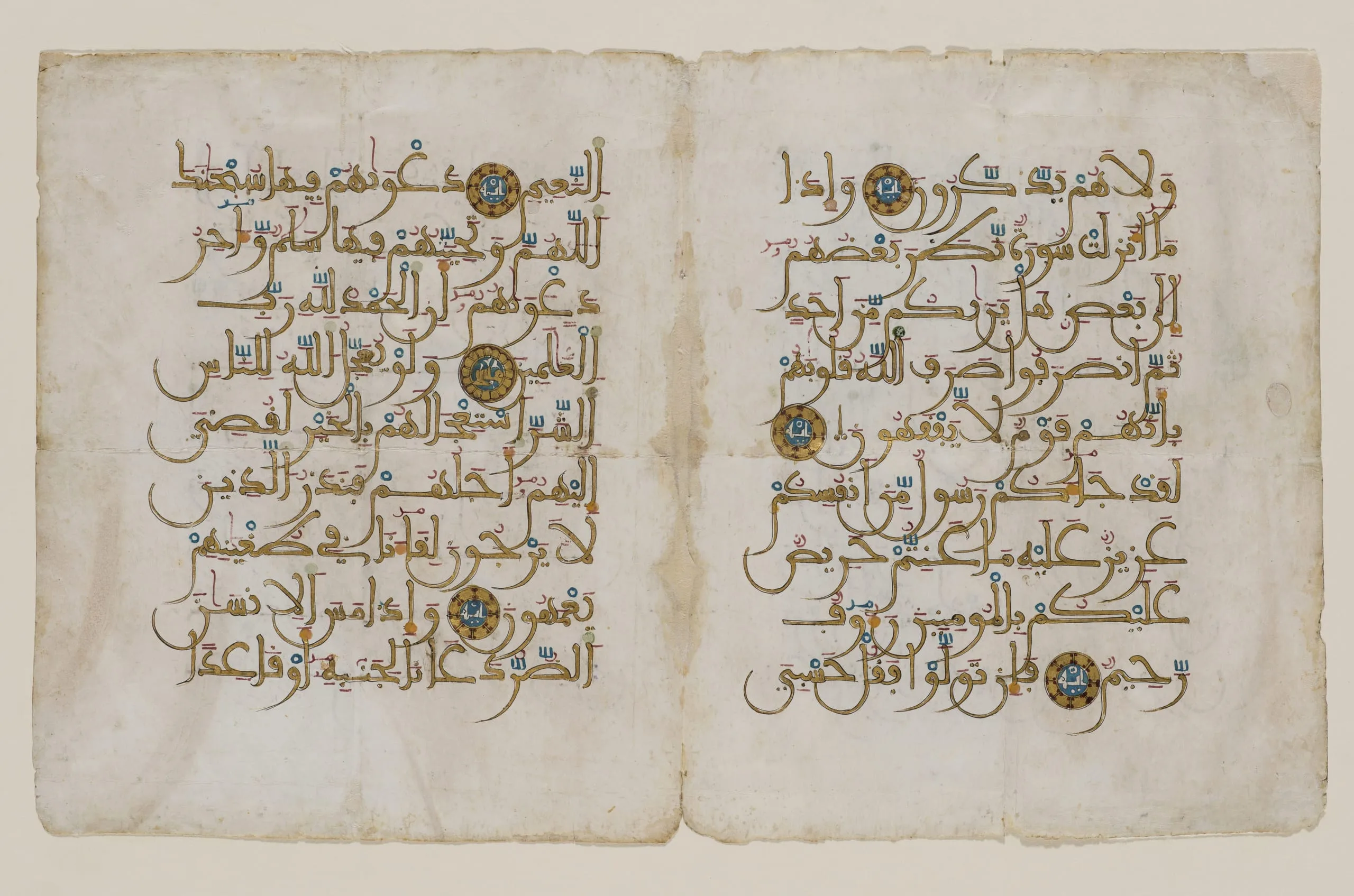
The art of writing in Arabic has been, and is, a signifier and shaper of both Muslim and Arab identity. It became central to all aspects of daily life in the Islamic world on account of the language-specific nature of the faith: the language of divine revelation is Arabic, preserved and transmitted in writing through the Qur’an. As Islam spread outward from Arabia, so too was Arabic writing brought to new lands, where the script was modified and beautified so that it might be worthy of the holy scripture, while the practice of calligraphy transformed and evolved specifically for copying the Qur’anic text.
Although parchment had already begun to pass out of vogue elsewhere in the Islamic world, its use in this double folio from a manuscript of the Qur’an reflects the conservative nature of Spain at this time, as does its distinctive script. Known as maghribi, after the region of North Africa that roughly encompasses modern Morocco, this graceful cursive script developed in the twelfth century in both Spain and North Africa, and its use is restricted to these regions. The lavish use of gold ink for the text, and the marking of each verse—instead of every five or ten verses—with a golden rosette, while the vocalization and recitation marks are added in red, yellow, green, and blue inks, indicates that this was a costly and labor-intensive manuscript.
2025