- Title
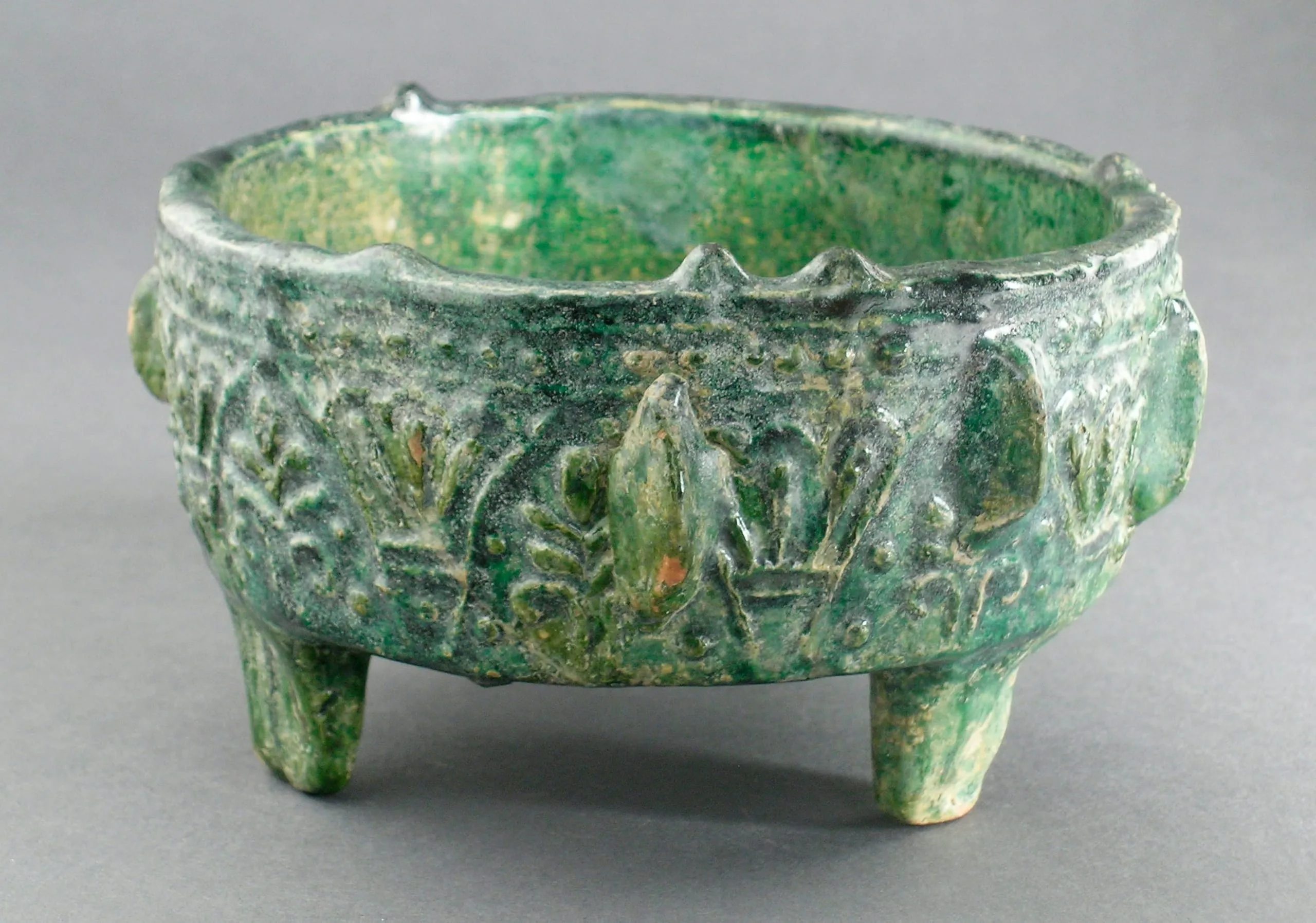
- Footed vessel
- Date Made
- 8th century
- Medium
- Earthenware, molded, with applied decoration, and glazed
- Dimensions
- Height: 3 in. (7.62 cm); Diameter: 5 1/8 in. (13.02 cm)
- Accession Number
- M.2002.1.134
- Curatorial Notes
Monochrome green glazed wares are a hallmark of ceramics produced during the Umayyad dynasty (661−750). Prior to the Islamic era, there is little evidence of glazed ceramic tableware in Sasanian Iran; rather, the predominant materials seem to have been glass, high-tin bronze, and—for the elite—silver. Glazed ceramics have a practical advantage over unglazed wares, as glazing reduces a vessel’s porosity, making it less permeable to liquids and oils, and thus easier to clean. Beyond function, glazes also emulate the glossy appearance of glass or metal wares, from which many of the green-glazed vessels, like this tripod bowl, derive their shapes and decoration. Such wares were likely a more affordable form of tableware than their metal equivalents. Even if these goods were intended for a less affluent consumer, by adding color to a surface, glazing opened up a vast range of decorative possibilities, a feature that potters exploited and experimented with in the centuries to come.
2024
- Selected Bibliography
- Evans, Helen C. and Brandie Ratliff, ed. Byzantium and Islam: Age of Transition, 7th-9th Century. New York: Metropolitan Museum of Art, 2012.