- Title
- Bowl
- Date Made
- 10th century
- Medium
- Earthenware, overglaze luster-painted
- Dimensions
- Height: 1 3/8 in. (3.49 cm); Diameter: 4 3/4 in. (12.06 cm)
- Accession Number
- M.2002.1.175
- Curatorial Notes
The spectacular technique of luster painting was introduced in the ninth century, probably by Egyptian artists familiar with the secret of luster-painted glass who had perhaps immigrated to Basra, in southern Iraq, where a new ceramic industry developed under the ‘Abbasid dynasty (750–1258). Lusterwares were luxury ceramics that required two firings. In the first firing, an opaque, generally white glaze was applied, and in the second, the design was rendered over the glaze with a paste of silver and copper compounds ground with sulfur. The second firing took place in a special kiln that restricted the flow of oxygen; this reducing atmosphere forced the metals to give up their oxygen, thereby creating a thin, lustrous film that fused with the glazed surface.
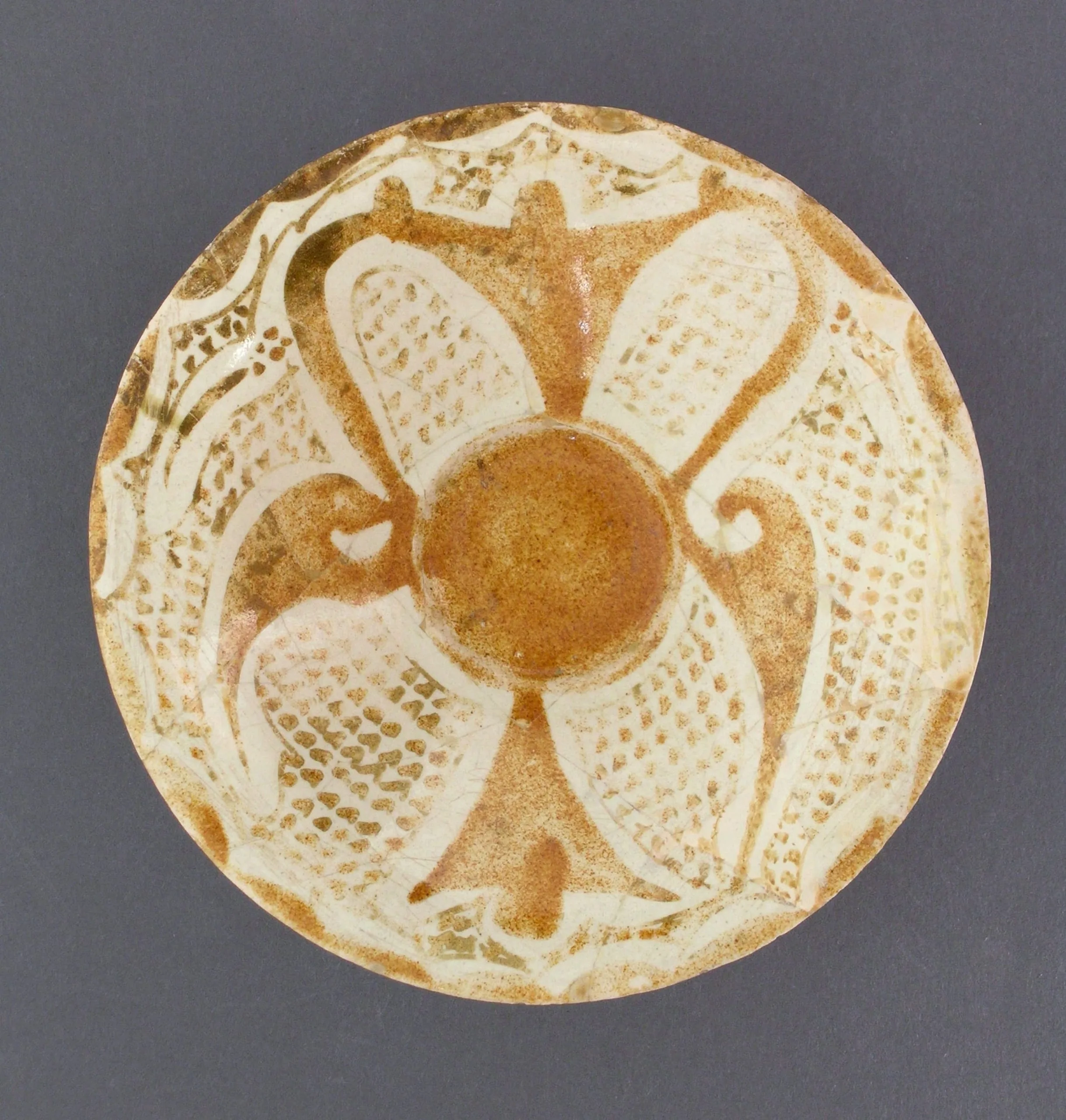
In keeping with related lusterware and other arts of the ninth and tenth centuries (see M.2002.1.338), the central interior design of this petite bowl can be read as a lamp or some kind of footed vessel transformed into stylized leaves or more abstract motifs. The ambiguity here is intentional and would have added to the appeal of the bowl once whatever food it held had been consumed.
Linda Komaroff
2025
- Selected Bibliography
Pope, Arthur Upham, and Phyllis Ackerman, eds. A Survey of Persian Art from Prehistoric Times to the Present. Vol. 5, Plates 511-980: Architectural Ornament; Pottery and Faience; The Art of the Book. London: Oxford University Press, 1938.