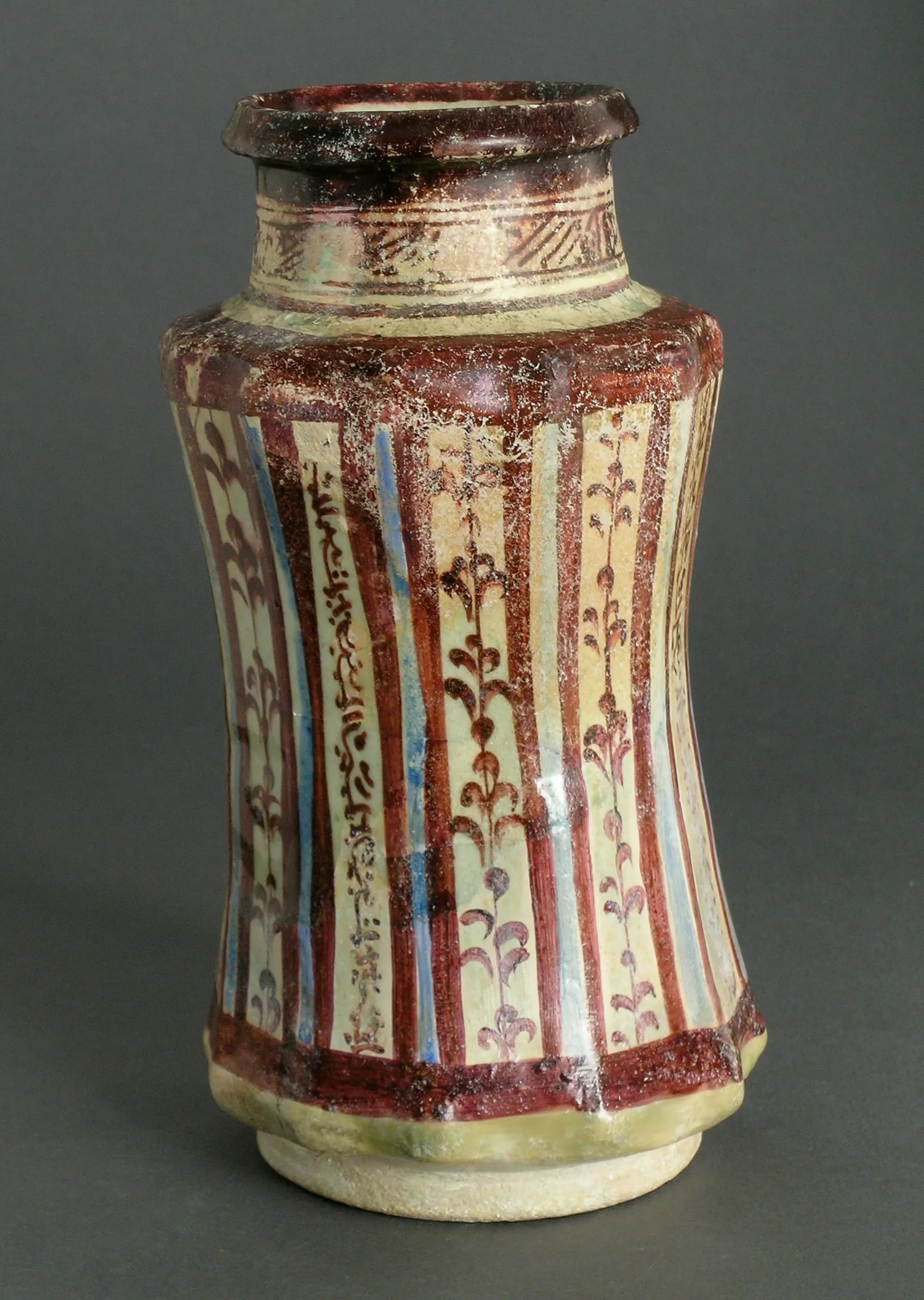
The albarello, as demonstrated here, has a characteristic form combining an elongated cylinder and concave waist, which would have enabled such storage jars to be closely packed on shelves but easy to retrieve when grabbed around the middle. Its distinctive neck with everted rim allowed for securely tying a cover made of some ephemeral material such as cloth, paper, or parchment. Either its presumed contents—probably spices and herbs—or its perception as a luxury ware led to the albarello’s widespread export to Europe, where it must have been admired even when empty to judge by the large number that have survived in fine condition. This albarello is decorated in the costly and complex overglaze-painting technique known as luster. Its faceted body bears bands of stylized leaves and pseudo calligraphy.
The same shape was reproduced by potters in Syria, Egypt, Iran, and other Islamic lands, and was also emulated in Spain, where it was decorated in the luster technique. It was subsequently copied in Italy in maiolica, a colorful type of pottery inspired by imported Spanish lusterware. The albarello became one of the most frequently produced maiolica wares in Renaissance Italy, where it continued to serve as a storage jar, especially in apothecary shops (see 46.16.3).
2025