- Title
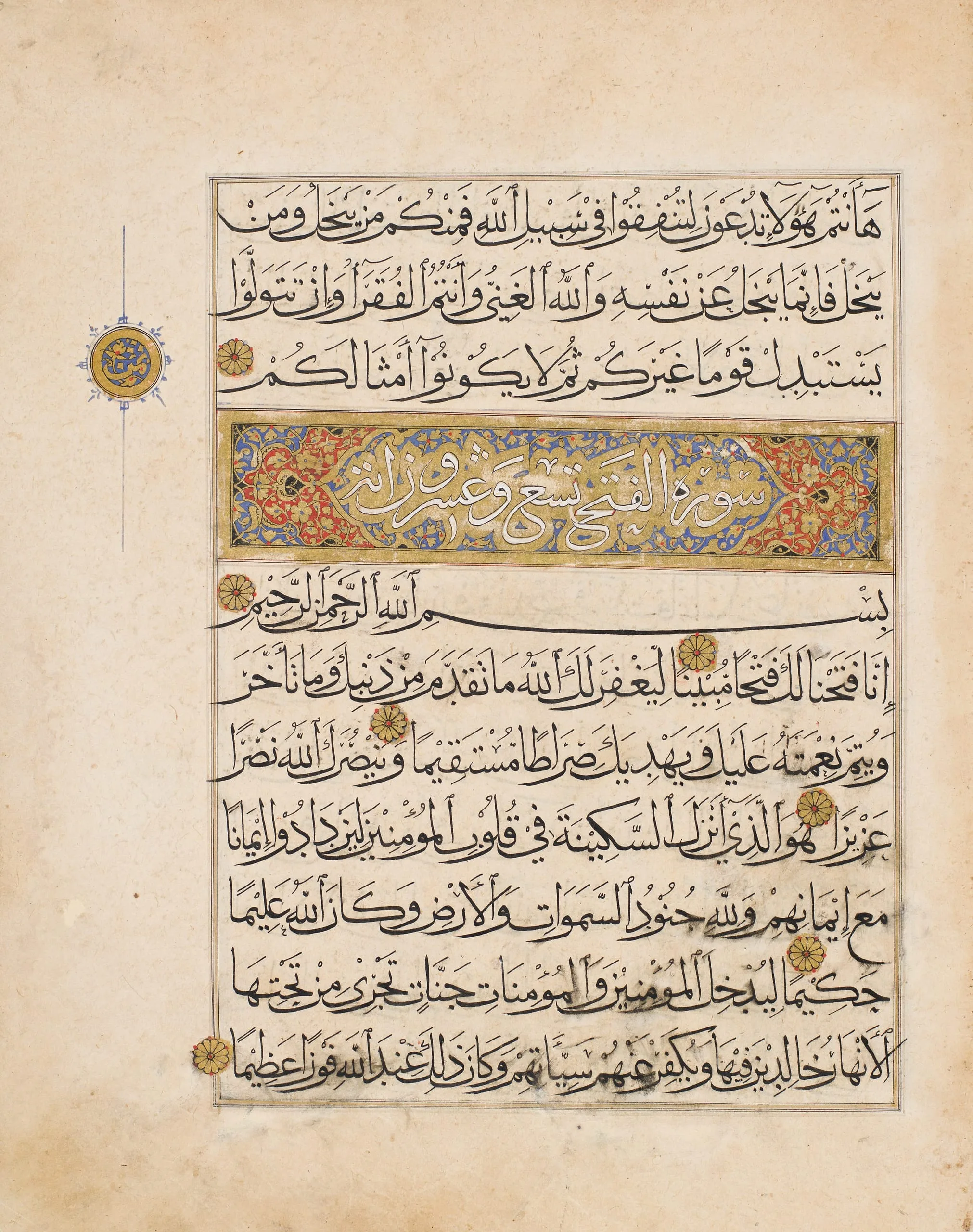
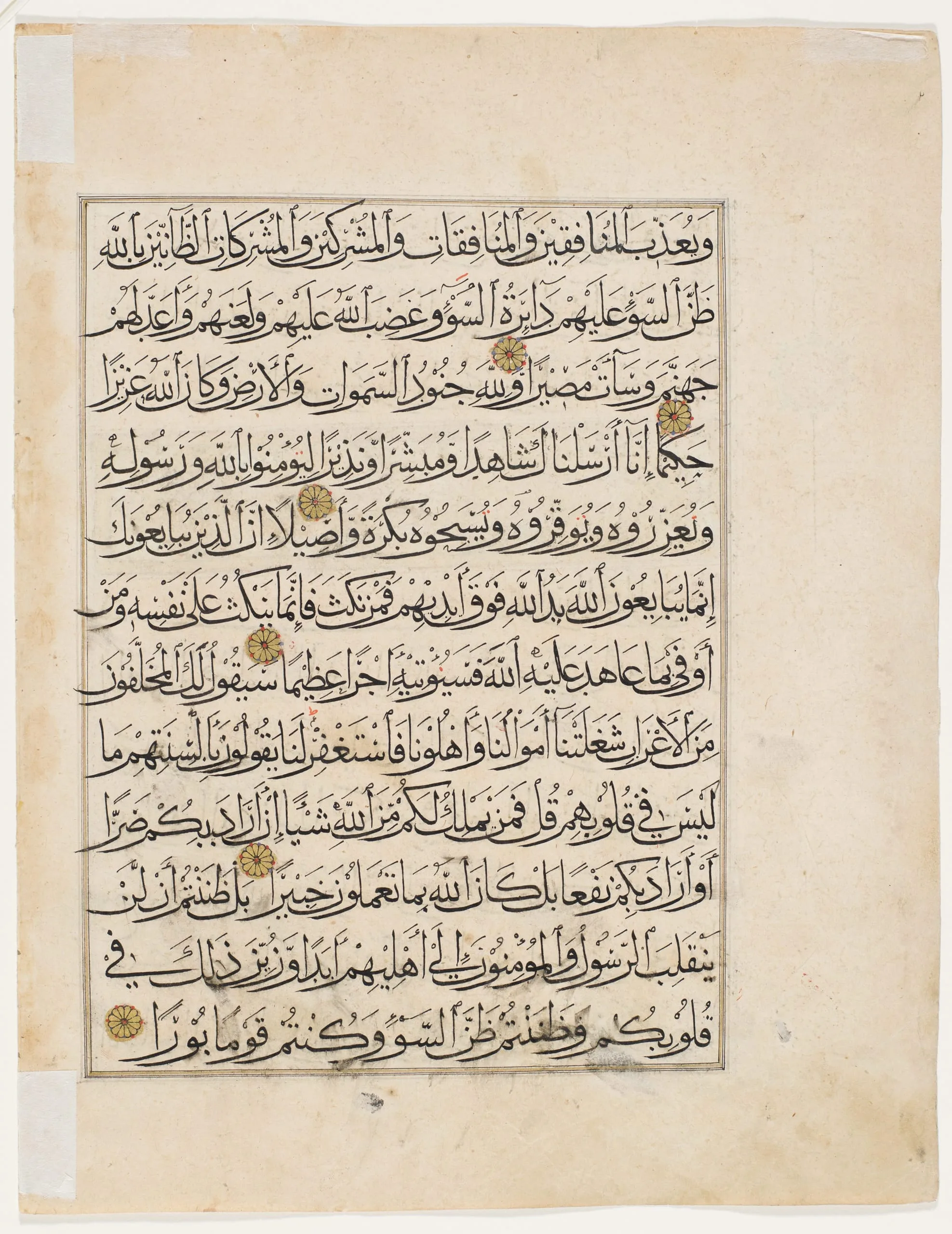
- Page from a Manuscript of the Qur'an (47:38, 48:1-5; 48:6-12)
- Date Made
- 14th century
- Medium
- Ink, opaque watercolor, and gold on paper
- Dimensions
- Folio, overall: 16 × 12 5/8 × 12 × 8 3/4 in. (40.64 × 32.07 × 30.48 × 22.23 cm)
Textblock: 12 × 8 3/4 in. (30.48 × 22.23 cm)
Frame: 29 × 23 × 1 1/2 in. (73.66 × 58.42 × 3.81 cm)
- Accession Number
- M.2002.1.354
- Curatorial Notes
From the tenth to the thirteenth century in most regions of the Islamic world, manuscripts of the Qur’an underwent a series of significant changes that radically transformed their appearance: the use of paper instead of parchment pages, a switch from a horizontal to a vertical format, and the adoption of round cursive scripts, instead of the rectilinear Kufic scripts. A comparison of this page from a fourteenth-century Egyptian Qur’an manuscript with earlier examples, such as a tenth-century Iranian folio (see http://collections.lacma.org/node/240037">M.73.5.502), visually documents the major shifts that occurred. The new format continued well into the late Islamic period, and its impact is still felt in Qur’an manuscripts produced today. Also see M.83.249https://collections.lacma.org/node/248291">M.83.249.