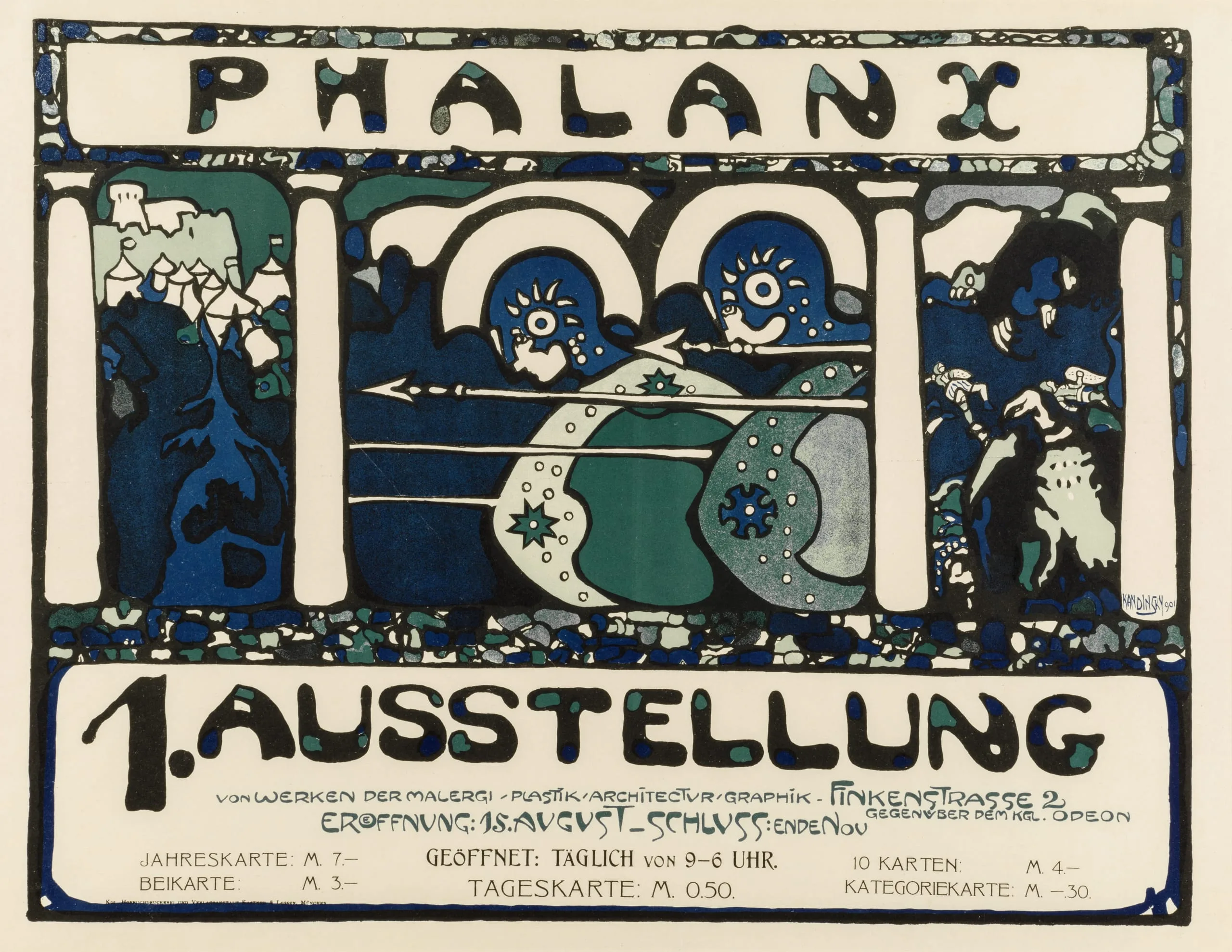
- Title
- Phalanx first exhibition
- Date Made
- 1901
- Medium
- Lithograph printed in black, green and blue on satin finish wove paper
- Dimensions
- Sheet: 19 1/2 × 26 3/8 in. (49.53 × 66.99 cm)
Image: 18 × 23 1/4 in. (45.72 × 59.06 cm)
Mat: 23 1/2 × 29 1/2 in. (59.69 × 74.93 cm)
Frame: 25 × 30 3/4 × 1 1/4 in. (63.5 × 78.11 × 3.18 cm)
- Accession Number
- M.2003.114.6
- Curatorial Notes
Wassily Kandinsky is best known as a pioneer of abstract art in the 1910s and as a professor at the Bauhaus in the 1920s. Yet these later developments are much indebted to his involvement in Jugendstil, the German variant of Art Nouveau that swept across Europe around 1900. Munich was a major center of this artistic movement, and the magazine Jugend (Youth) published there gave the movement its name. Kandinsky had been living in Munich for five years when, in 1901, he co-founded Phalanx, an exhibition society. The name evokes early nineteenth-century French philosopher Charles Fourier’s utopian concept of the phalanx, a type of communal building he named after the Greek term for a body of troops standing in close formation. Phalanx was an important manifestation of Jugendstil until its dissolution in 1904.
Kandinsky’s poster for the First Phalanx Exhibition (Phalanx 1. Ausstellung) depicts a phalanx of heavily armed Greek soldiers and demonstrates his absorption with Jugendstil as well as with Russian and Bavarian folk art. He had doubtless encountered the motif of a helmeted Greek head while studying under Frantz von Stuck at Munich’s Academy of Fine Arts the year before creating this poster. The decorative abstract forms seen here also recall the Symbolist movement in art and literature that originated in France in the late nineteenth century; it held that art should represent absolute truths best described indirectly rather than through pure representation.
Timothy Benson
2017
- Selected Bibliography
- Benson, Timothy O. and Andrea Gyorody. A New Generation of Creators: Selections from The Robert Gore Rifkind Center for German Expressionist Studies. Los Angeles: Los Angeles County Museum of Art, 2017.
- Copyright
- © Artists Rights Society (ARS), New York / ADAGP, Paris