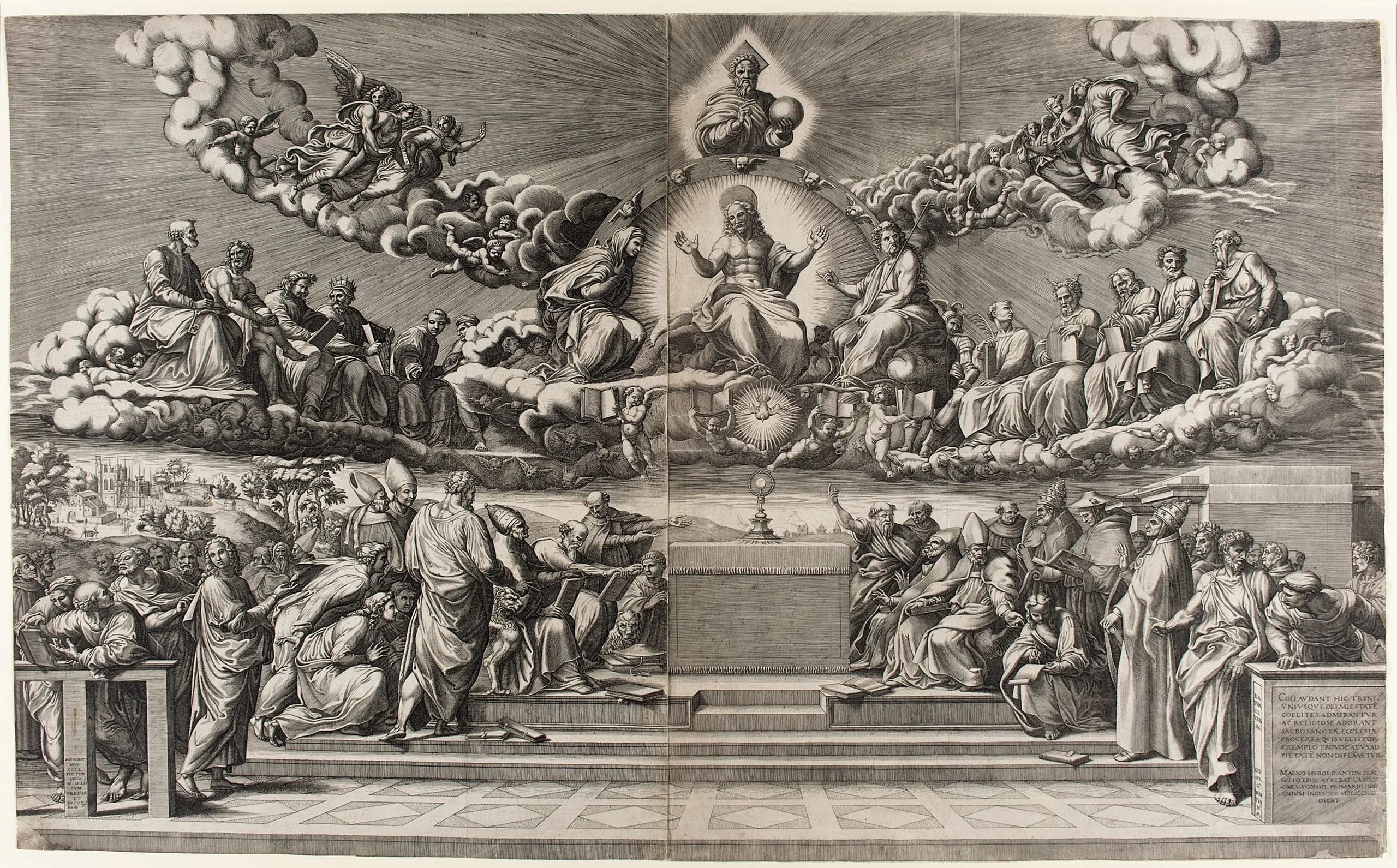
- Title
- Disputation over the Most Holy Sacrament, or The Disputa
- Date Made
- 1552
- Medium
- Engraving on two sheets
- Dimensions
- Sheet: 20 1/4 x 15 3/4 in. (51.43 x 40.00 cm)
- Accession Number
- M.88.91.210a-b
- Curatorial Notes
This engraving reproduces in print one of the major commissions completed by Raphael at the apex of his career: the Disputation of the Holy Sacrament, a fresco decorating one wall of the Stanza della Segnatura in the papal residences at the Vatican, completed between 1509 and 1510. The two-tier composition shows Christ flanked by the Virgin, John the Baptist, and other biblical figures in the heavenly realm above, and the four Doctors of the Church along with other saints and popes who surround a monstrance on an altar below. The work considers the theological debate on the topic of transubstantiation, or Christ’s presence in the Eucharist. Subtle changes between the fresco and this engraving suggest that Ghisi reorganized elements of Raphael’s arched composition to more evenly fit the rectangular format of the print; he may have worked from a drawing, although the artist did also spend time in Rome. Completed over forty years after Raphael’s fresco, this two-plate engraving was first printed by Hieronymus Cock in Antwerp, thus spreading Raphael’s designs beyond the Italian peninsula.
Claire Spadafora Baes
2024