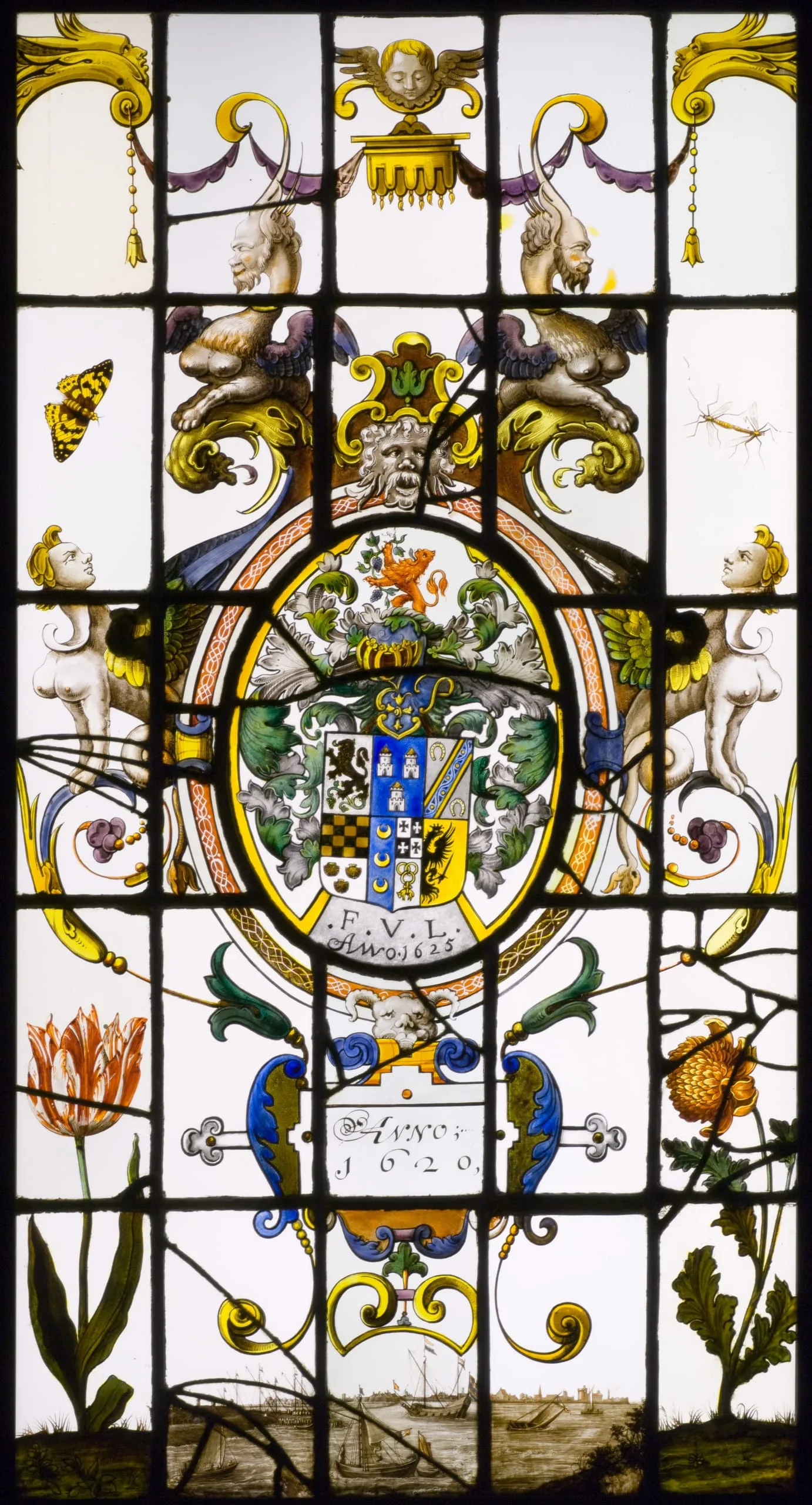
This stained-glass panel belongs to a series of six produced in 1620, likely for a professional organization (see also 45.21.56, .58, .59). Several of the central cartouches were left blank to be filled in with a corporate or family crest at a later date as the organization’s membership changed. In this panel, the central coat of arms and the inscription “F.V.L.” were added in 1625.
Its style of ornamentation, featuring figures with human female torsos, wings, and hybrid animal bodies—referred to as grotesque—derives from ancient Roman fresco decoration. Especially popular in Europe in the sixteenth and early seventeenth centuries, grotesque decoration could be found on everything from silver pitchers to the backs of chairs. The panels were likely produced in a workshop with multiple painters, accounting for variation in shading and line in the ornamental frame.
The panel is framed in the lower left corner by a red-and-white Semper Augustus tulip (a species originally imported from Turkey) and at the lower right by a golden chrysanthemum (originally sourced from China). A yellow-and-black moth and pair of mosquitoes fly in the negative spaces above each grotesque figure. The distinctively naturalistic and jewel-like style of the flowers and insects, along with the inclusion of grotesque decoration, indicate that the panels were likely produced in Middelburg, a major port for the Dutch East India Company (VOC). The influx of living specimens, seeds, and flower bulbs arriving from the Asian continent to the harbor allowed the city to host a thriving horticultural network that included botanical artists, gardens, and collector’s cabinets.
Occupying the lower half of the glass panel, a seascape painted in grisaille—tones of gray—represents sailing ships flying Dutch tricolor flags. The skyline in the distance likely depicts Veere, another coastal city four miles north of Middelburg. Particularly when paired with this seascape, the two flowers signify the accessibility of such global goods to Dutch merchants for import. This mercantile imagery suggests that the patron who had his coat of arms placed in the central oval likely held some affiliation with Middelburg’s chapter of the VOC.
Cynthia Kok
April 2025, adapted from Diva Zumaya, The World Made Wondrous (2023)