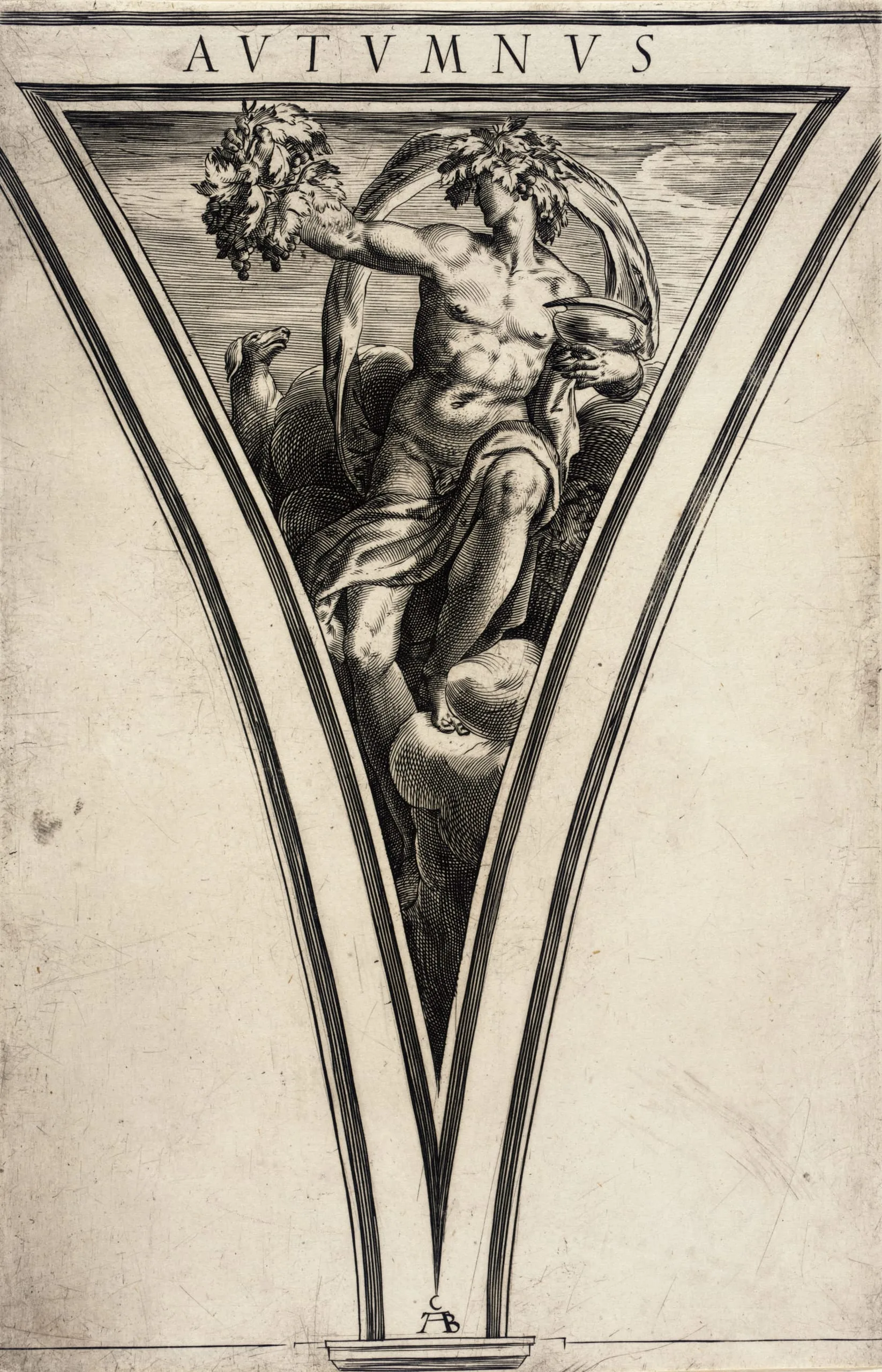
Early in his career, Cherubino Alberti produced engravings after important sixteenth-century paintings by Raphael and his followers, notably Polidoro da Caravaggio, who specialized in decorations that once adorned the facades of Roman houses. Cherubino’s prints are thus valuable documents of works that might otherwise be lost to time. This series of four prints (see also M.88.91.85a, b, and d) probably dates to the first half of the 1580s, when his primary concern was in making engravings that reproduced Mannerist fresco paintings. By the beginning of the seventeenth century, he was receiving decorative commissions of his own, and the prints that can be dated to that period include dedications to powerful families like the Medici not seen in the present series.
The unique form of these four engravings indicates that they are meant to depict decorations on spandrels, the curved arches that join wall and ceiling. Each spandrel features a personification of one of the four seasons. Here, Autumnus (Autumn) is shown as Bacchus, the Roman god of wine, fertility, and agriculture. From his right hand sprouts a bunch of grapes, while in his left he holds a lidded vessel. Head turned to the animal behind him, obscuring his face, the god is shown among the clouds, a drape and a wreath of grapes billowing behind him.
Claire Spadafora Baes
2024