- Title
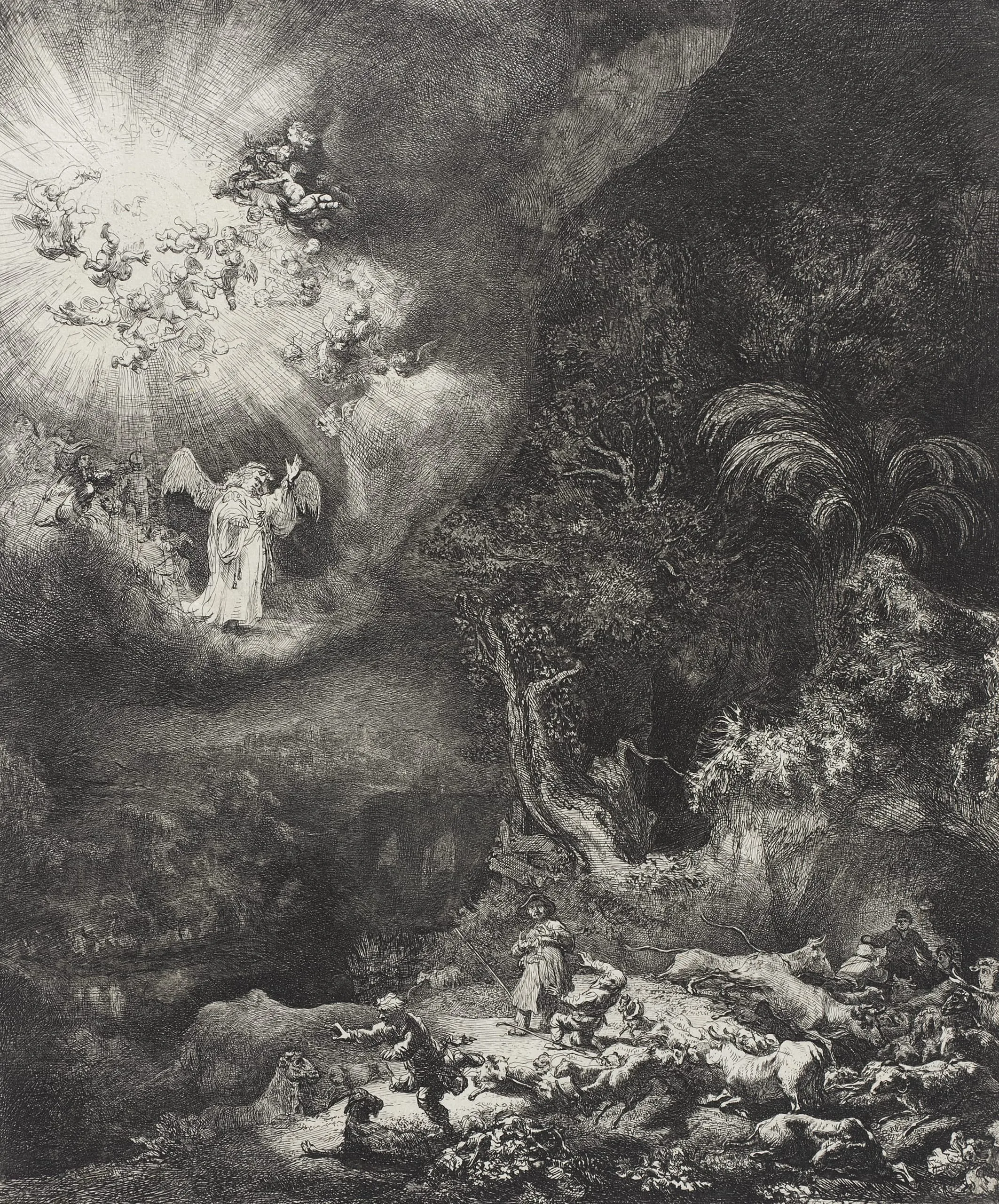
- The Angel Appearing to the Shepherds
- Date Made
- 1634
- Medium
- Etching, engraving, and drypoint
- Dimensions
- Sheet: 10 1/2 × 8 7/8 in. (26.67 × 22.54 cm)
Image: 10 3/8 × 8 5/8 in. (26.35 × 21.91 cm)
- Accession Number
- M.2000.120
- Curatorial Notes
This dramatic night piece serves as Rembrandt’s initial experiment in rendering shadow in print with the same depth and weight that he was able to achieve in paint. It depicts an angel announcing the birth of Jesus Christ to nearby shepherds keeping watch over their flocks, as described in the Gospel of Luke in the New Testament. At upper left, an angel appears before a shining celestial vortex, with a dove representing the Holy Spirit at the center of this divine aura. In the earthly realm, the herdsmen and their animals show alarm at the heavenly visitor. Rembrandt’s artistic genius is apparent in his ability to convey the distinct reactions—surprise and fear—of both man and animal.
The artist achieved this dazzling coming together of heaven and earth by scratching a thorough compositional outline onto the plate and then etching the lines with a burin, building a layered range of tone from gray to deep black by hatching lines of varying widths. Like the spontaneity of his brushwork in oil paintings from the mid-1630s, in print Rembrandt used a fine netting of shadow to convey a rich, convincing nighttime atmosphere, demonstrating his sophisticated understanding of the relationship between technique and meaning in his compositions.
Claire Spadafora Baes
2025
- Selected Bibliography
- Hollstein, F. W. H. Dutch and Flemish Etchings, Engravings, and Woodcuts, ca. 1450-1700. Amsterdam: M. Hertzberger, 1949.
- Bartsch, Adam von. The Illustrated Bartsch. New York: Abaris Books, 1978.