- Title
- Water Pitcher
- Date Made
- circa 1710
- Medium
- Earthenware with tin glaze and enamel (grand feu faience)
- Dimensions
- 11 × 9 × 7 in. (27.94 × 22.86 × 17.78 cm)
- Accession Number
- M.2010.51.1
- Curatorial Notes
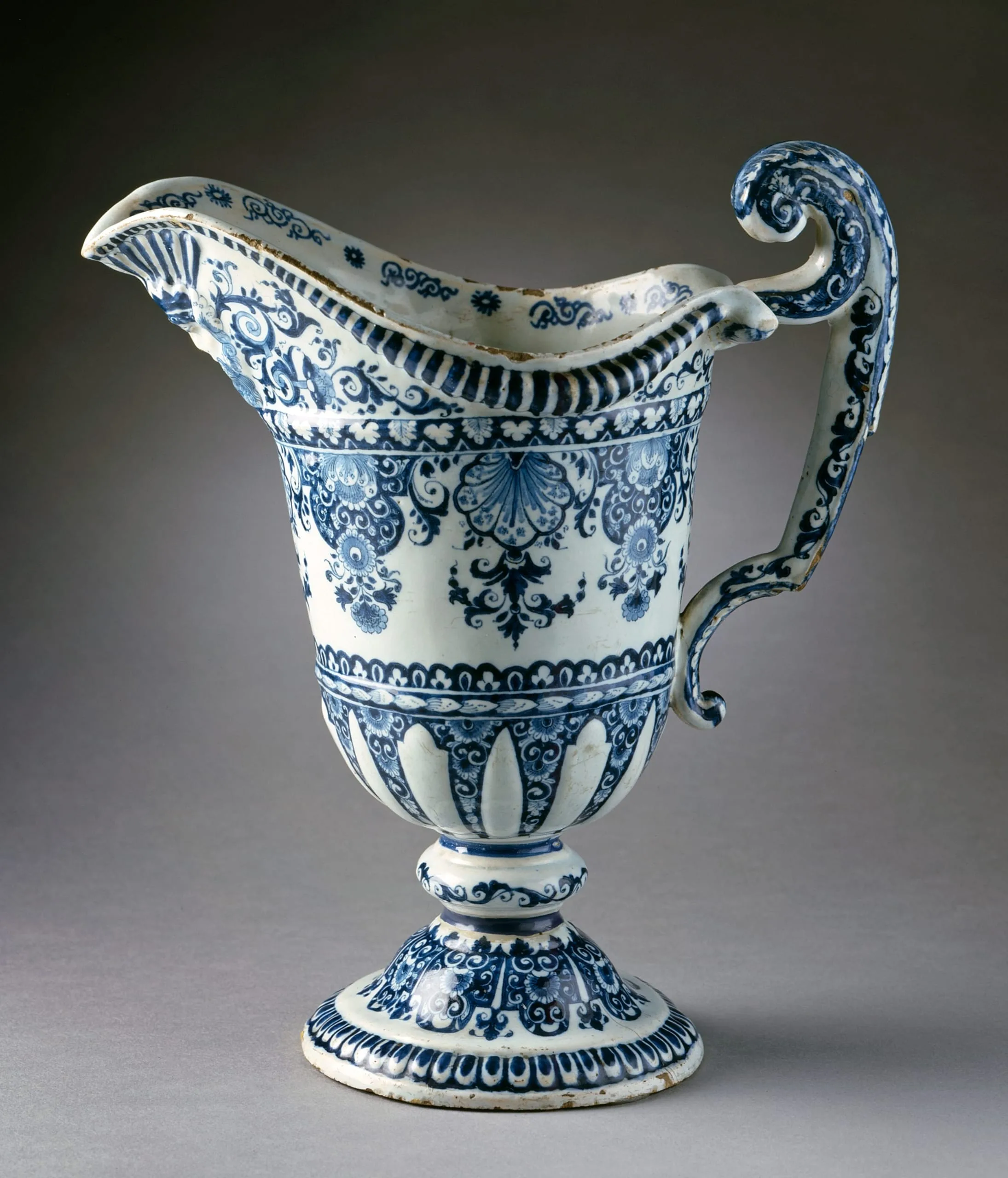
In the eighteenth century, as European ceramic production improved and factories proliferated, earthenware and porcelain gradually began to replace silver on fashionable dining tables. An unprecedented frost that devastated French agriculture in 1708 and the mounting costs of waging the War of Spanish Succession prompted Louis XIV to seek an infusion of cash for the royal treasury. His “suggestion” in 1709 that all silver owned by members of the French court be donated to the crown was difficult to ignore. As a result, at least at Versailles, earthenware became fashionable almost overnight, and a pitcher like this one served as a faithful substitute for silver versions that were melted down to pay royal debts. The inverted helmet shape, scroll handle, blue-and-white ornament, and bands imitating gadrooning around the base and lip are all features found on chased and cast decoration of contemporaneous silver counterparts. For those who could not afford silver, setting a table with a pottery dinner service could still be an elaborate affair requiring multiple dishes and serving pieces. Rouen factories led the way in creating the first complete ceramic table services. By 1720, there were as many as eight different ceramic factories operating in Rouen to meet popular demand.
- Selected Bibliography
- Williams, Elizabeth A. Daily Pleasures: French Ceramics from the MaryLou Boone Collection. Los Angeles: Los Angeles County Museum of Art, 2012.