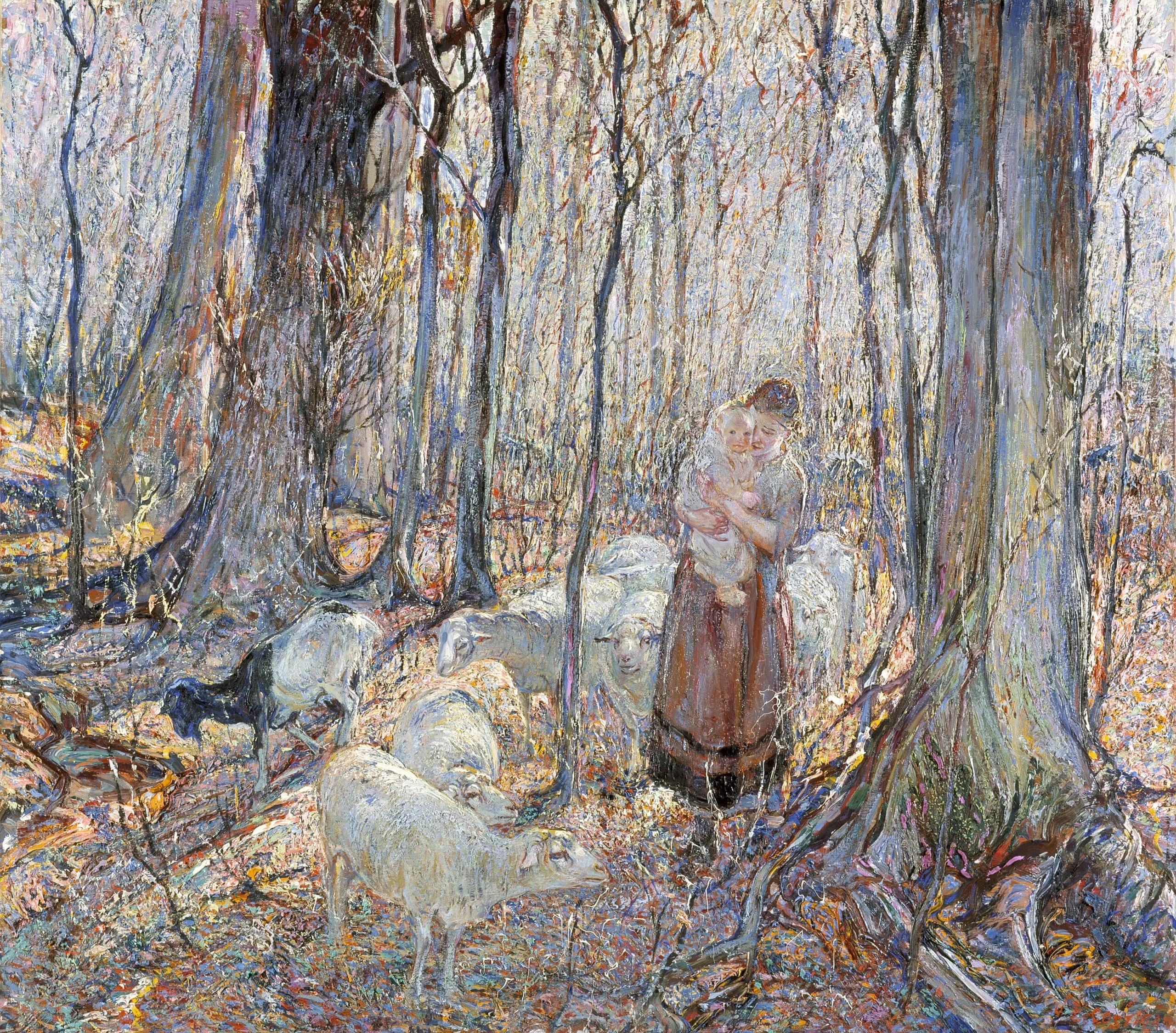
During the early 1920s Costigan’s characteristic themes and painting style emerged. In his most important canvases of this decade, such as Landscape with Figures, he depicted a peasant mother with a child and goats or other farm animals walking through a forest glade. Costigan used his wife, Ida Blessin (b. 1894), an accomplished sculptress, and their five children as models. Despite financial problems, which must have made life on the farm difficult, Costigan idealized rural life, conveying in his pictures a quiet, pastoral peacefulness. Removed from nearby New York City, Orangeburg became Costigan’s Barbizon.
Despite the calm, soothing quality of his subjects, Costigan’s paintings of the 1920s were alive with energy, created by his almost incessant movement of pigment and flickering color. Landscape with Figures is a superb example of Costigan’s work with its heavily encrusted surfaces, at times almost one-eighth inch thick. With a palette knife and the fullest of brushes he created impastoed passages that appear to be woven skeins of dripped pigment. His palette is equally charged: flecks of brilliant white, red, orange, magenta, yellow, green, dark blue, and brown emerge from a generally pale blue tonality. While the overall palette of Landscape with Figures is slightly sweeter than usual for this period, his paintings of the 1920s always glow with a variety of intense, warm hues. Costigan’s treatment is a late and extreme manifestation of American impressionism, characterized not only by a decorative quality but by a vigor of paint and light.
This flickering of light and paint suggests an atmosphere alive with the movement and spirit of nature. The source for this transcendental mood-as well as a decorative quality-may have been one of Costigan’s favorite paintings, The Hermit, 1908, by JOHN S. SARGENT, which Costigan often studied at the Metropolitan Museum of Art in New York. Both artists presented alandscape in which rich foliage and sunlight animate the scene and make it difficult to distinguish the figures from their setting. The figures literally as well as metaphorically become one with nature.