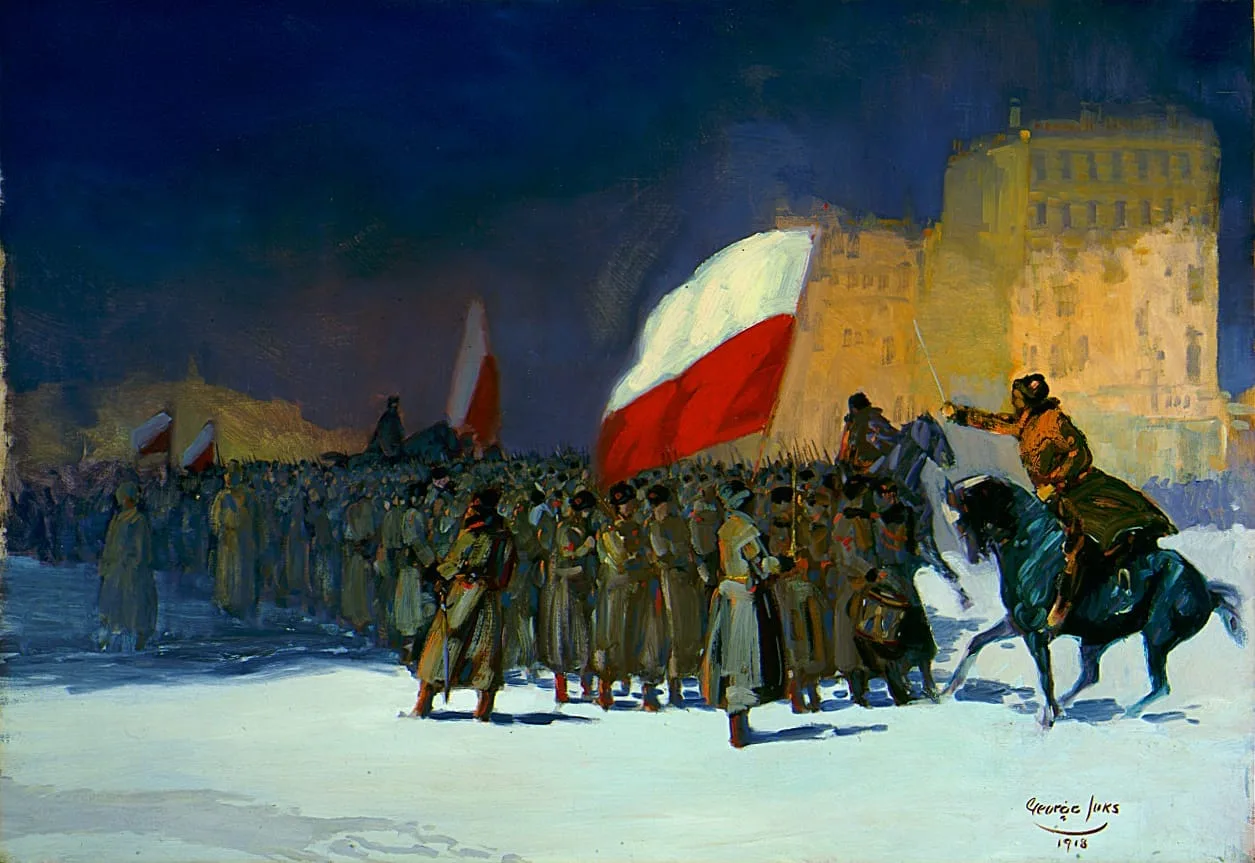
Artists actively participated in the numerous efforts to raise money for the Allied cause during World War I. As part of the Fourth Liberty Loan Drive, New York’s Fifth Avenue was transformed into an art gallery during October 1918. Paintings devoted to the different Allied nations were displayed in shop windows. During this period Luks was inspired to paint a series of war-related compositions.
The Czechoslovakian march through Siberia and the Czechoslovakian drive for independence during the war were causes célèbres that were repeatedly headlined in the newspapers. During the war Czech troops joined the Russians to fight on the side of the Allies. With the withdrawal of Russia from fighting after the signing of the Treaty of Brest-Litowsk in 1918, the Czechs were forced to leave Russia. They marched through Siberia and despite many impediments caused by poor weather and adverse political conditions reached Vladivostok in May 1918. There they boarded ships to journey to France, where they were to join other Allied forces. Luks depicted these soldiers arriving in Vladivostok.
Luks no doubt became involved in the Czech cause through his friendship with the sculptor Gutzon Borglum (1871-1941), who had became closely involved in the Czech cause and even permitted his home in Stamford, Connecticut, to be used as a military base for the training of American-born Czech volunteers. Luks visited Borglum during this time and once joined him in painting posters to raise funds for the camp. Although Luks did not see the Czech army advancing in Siberia, he may have observed new soldiers practicing marching and attacking. He depicted the camp in Connecticut at least once, in Czechoslovakians in American Camp Celebrating Their Recognition as a Country, 1918 (unlocated; exhibited Allied War Salon, American Art Association Galleries, New York, 1918). Such an experience enabled Luks to become familiar with the Czech uniforms as depicted in Czech-slovak Chieftain, 1919 (Newark [N.J.] Museum), and also the new country’s flag. Although the red-andwhite striped flag Luks delineated in the museum’s painting is not the design eventually selected for the national flag, it is the one depicted by Henry Rittenberg (1879-1969) in his painting of the Czech army that was carried down Fifth Avenue during the celebrations in October 1918.
This is the only major war scene Luks painted that he could not have witnessed firsthand. He based his painting on a photograph and description of the actual event told to him by a Lieutenant Frank Danielovsky. Danielovsky was one of the select dignitaries asked to participate in the Czechoslovak Day celebrations along Fifth Avenue on October 3, 1918. Luks inscribed in the lower-left corner of the painting that Danielovsky was his source, but at some unknown time the inscription was painted over. Although Luks could have painted Czechoslovakian Army Entering Vladivostok, Siberia, in 1918 as early as May, he may have painted it as late as October, after the Czech Day celebrations of the Fourth Liberty Loan Drive. It certainly was finished by the time of the Allied War Salon in December.
In his usual bold brushwork Luks depicted the long column of Czech soldiers marching behind their leader on a cold winter day. The scene is simple, reduced to a central horizontal band of figures on a slight diagonal, with the background consisting of a few buildings. The composition of the scene relates to Luks’s other war paintings of marching figures, The Blue Devils on Fifth Avenue, 1917 (Phillips Collection, Washington, D.C.), and The Bersaglieri, 1918 (National Gallery of Art, Washington, D.C.). The overall impression is less agitated, however, due to the larger and broader areas of color. The palette is intense, with a cool, white, snowy foreground against a brilliant blue sky and touches of flaming oranges in the flag and distant buildings.