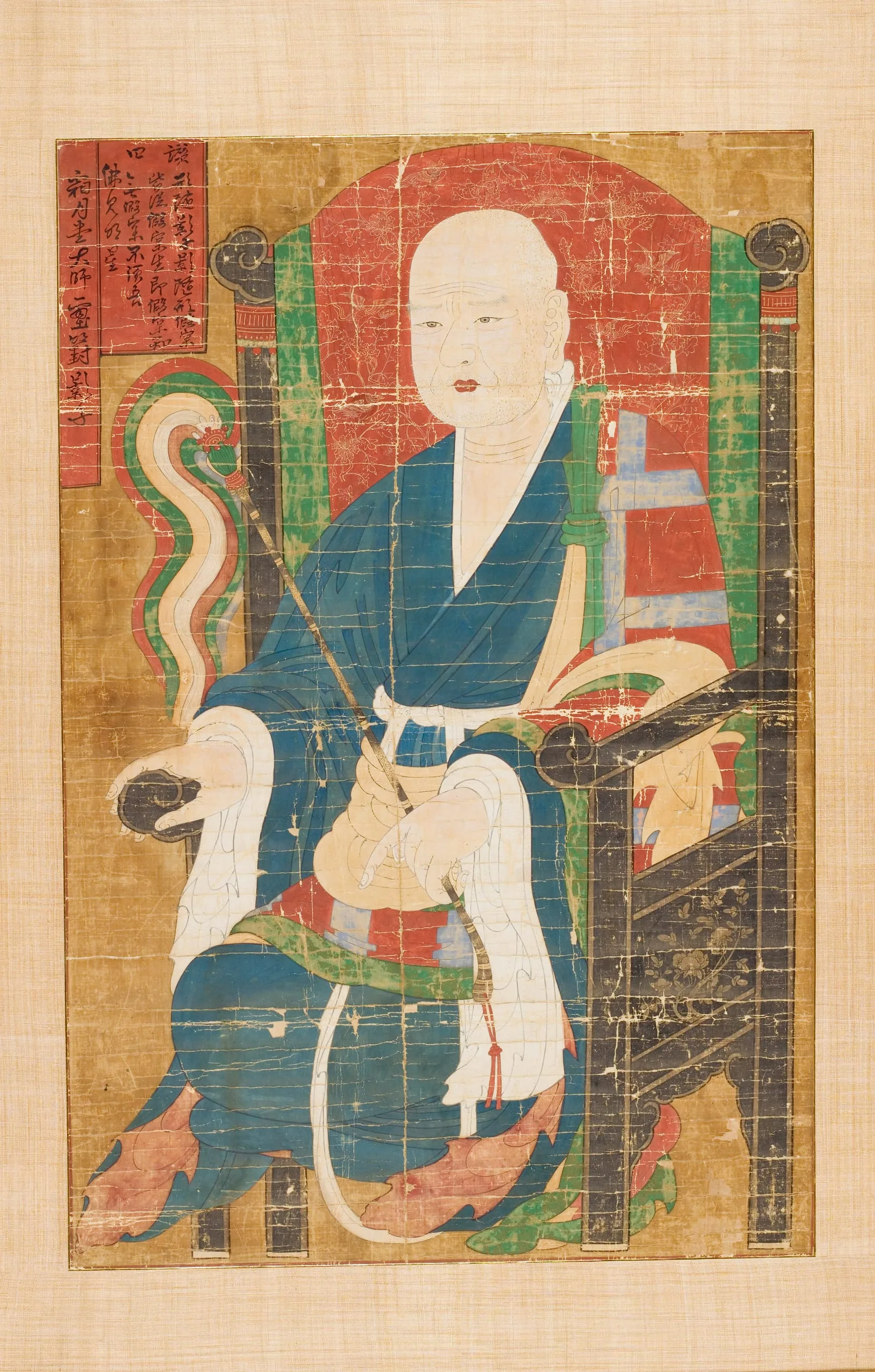
After the death of a Buddhist patriarch, his portrait was often painted to pay tribute to him. These portraits, called jinyeong, also symbolized the long history of succession within the sect, thus strengthening the legitimacy and authority among followers. Often, the portraits themselves became subjects of worship. Many temples housed portraits of the first patriarch of the different schools of Buddhism, well-known monks familiar with the doctrinal studies of Buddhism, and monks who benefited the country.
The inscription in the upper left corner of this painting gives the name of the subject, Sangweoldang Saebong. Sangweoldang (1687-1767) was active mainly in Jeolla province, and he was a renowned scholar of the Avatamska (Hwa’eomhak) Sutra. Around 1750, he worked on a restoration project at Seonam Temple in the city of Suncheon in South Jeolla province, especially focused on architecture and paintings restoration.
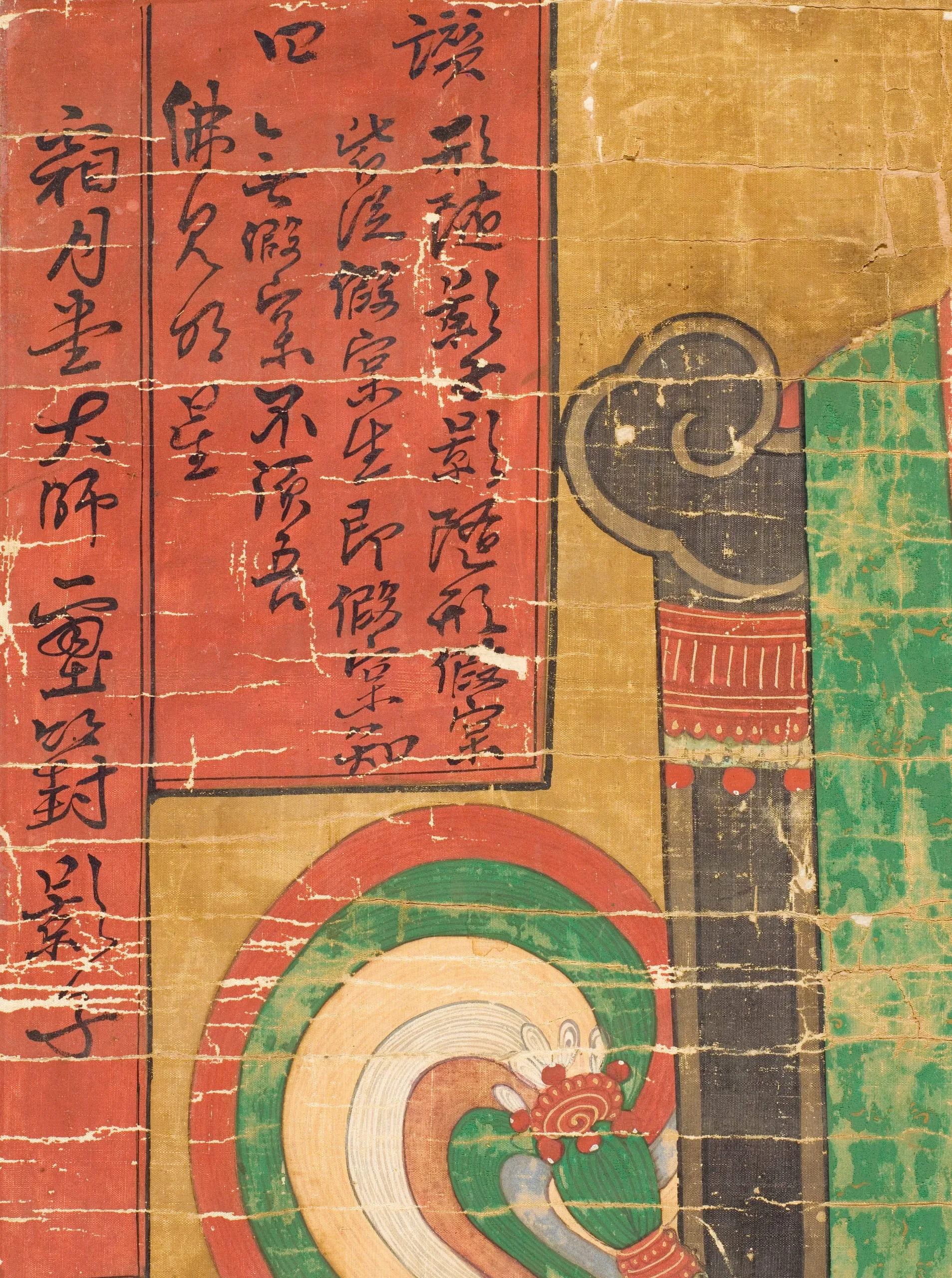
Next to the inscription with the patriarch’s name is an inscription praising and commemorating him (det. 1). It is unclear whether the praise was written when the portrait was painted, or added later. There is another portrait of Sangweoldang Saebong at Seonam Temple, South Jeolla province (fig. 1). While the pose and costume in the Seonam Temple portrait are almost identical to the LACMA painting, the patterns of the costume in the Seonam Temple painting are simpler and the creases on the robe are more formalized. For that reason, the Portrait of the Great Monk Sangwoldang Sebong at Seonam Temple was probably created at a later date, following the style of the LACMA painting.[1]
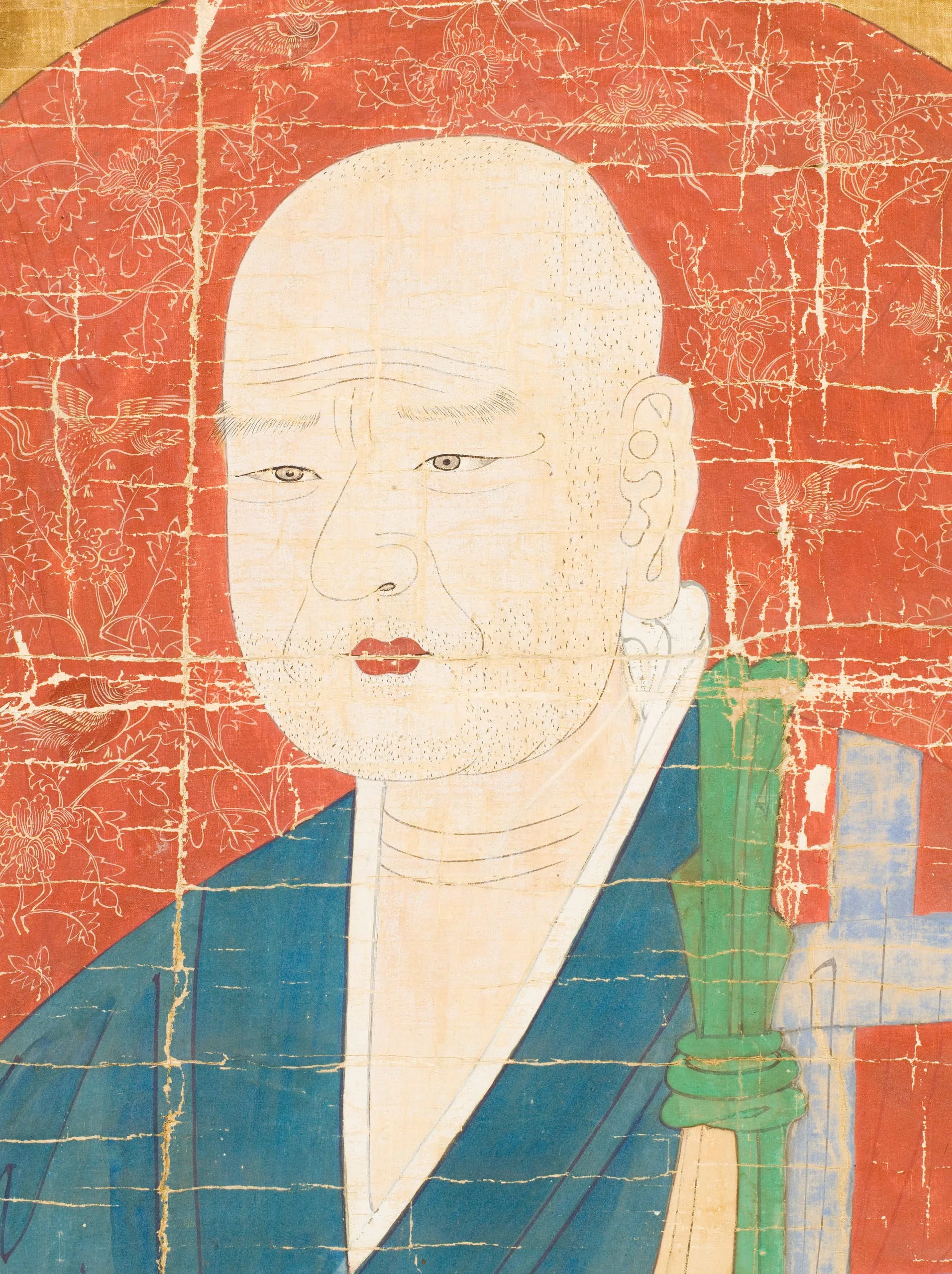
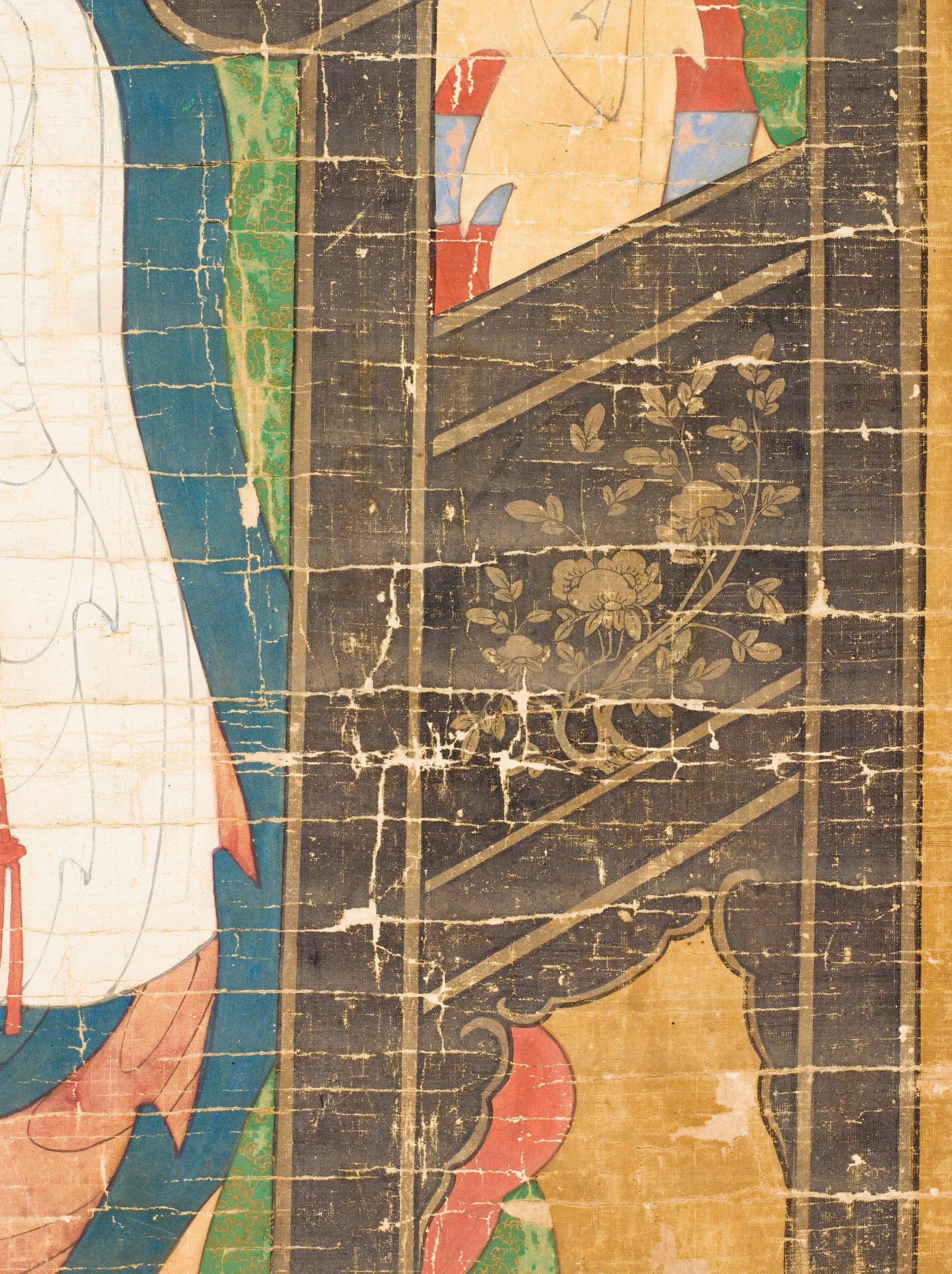
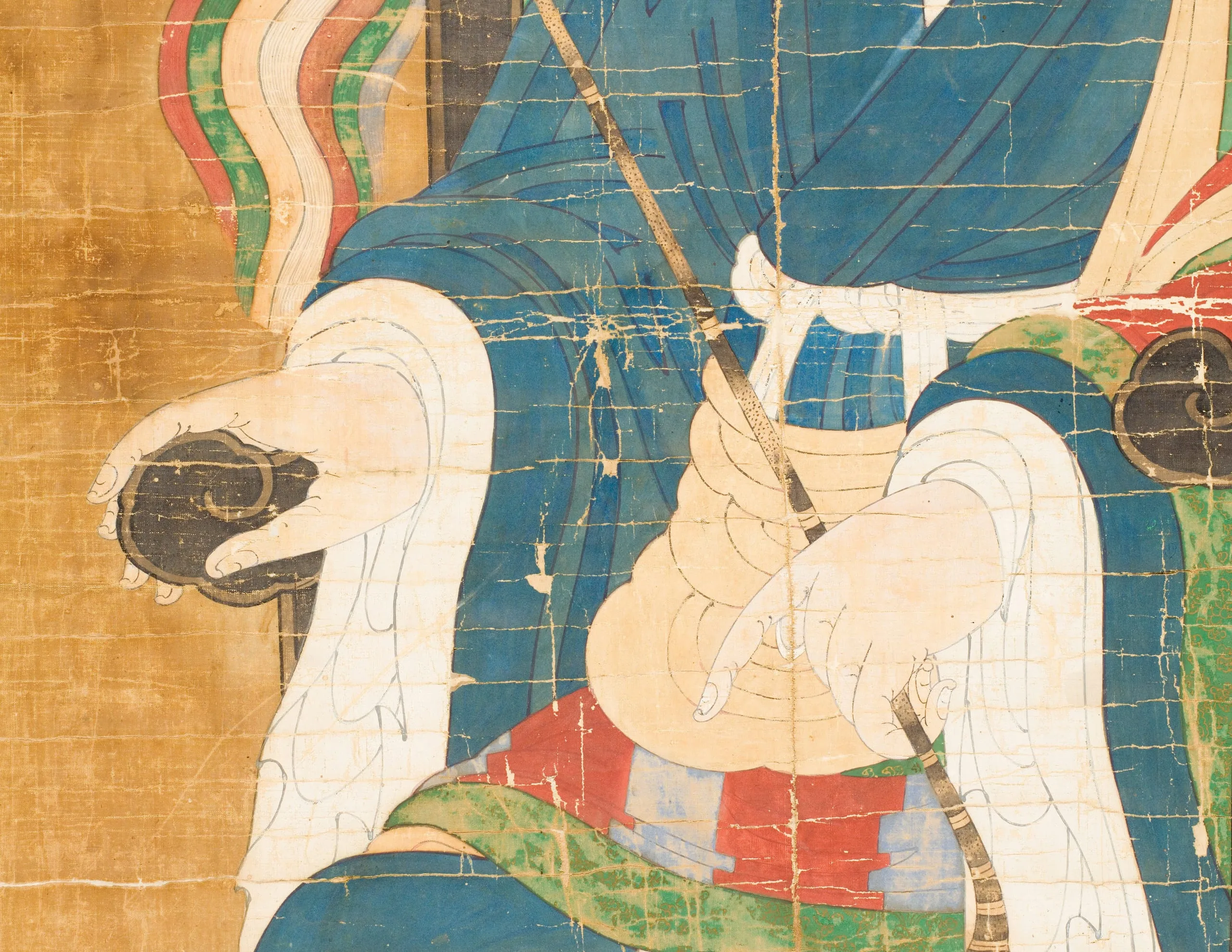
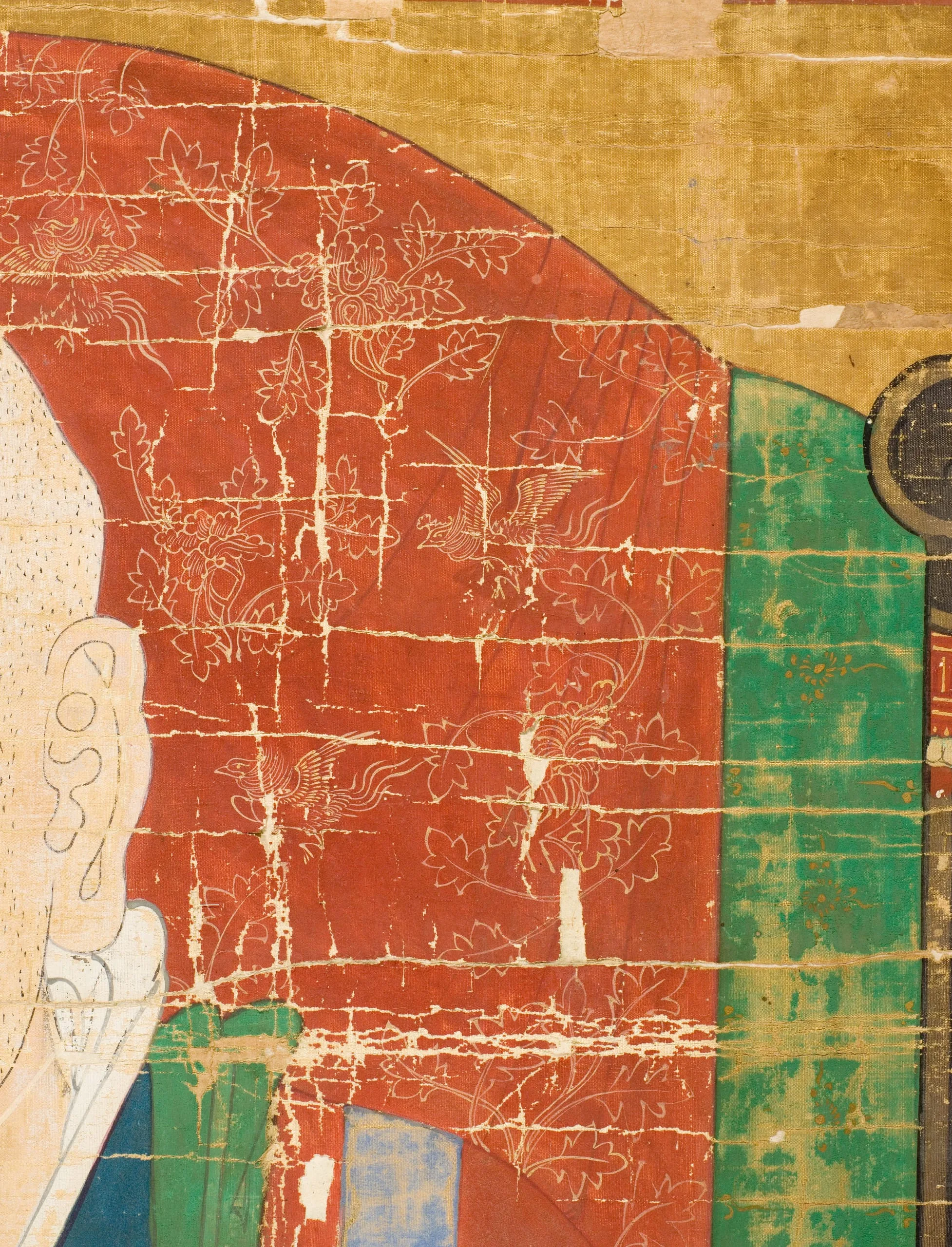
In the LACMA portrait, Sangweoldang is shown in a style from an earlier period. He is sitting on a chair, facing slightly to the left. He holds a bulja, an implement used to brush away insects, in his left hand. The artist omitted all background details and used subtle colors. The pattern on the chair is beautifully depicted (det. 2, 3). The date and artist of the portrait are written in ink on the back of the painting. According to this inscription, the painting was created by Songgye Hyeonjun, a disciple of Sangweoldang, in the year 1742, which is the seventh year of the Qianlong period. Because the specific year of its production is given in this painting, it is a very important reference to date other Joseon period Buddhist patriarch paintings.
It is not clear when this genre was first introduced, but literature indicates that portraits of the Buddhist patriarchs Wonhyo, Doyi, and Beomil existed by the Unified Silla period and that more were actively produced during the Goryeo period. Unfortunately, no portraits from those periods remain. Most of the portraits found today were created in the late Joseon period, after the eighteenth century.
In general, the composition of the portraits followed a standard formula. The patriarchs are typically depicted wearing a Buddhist surplice and holding a brush and prayer beads. They sit either on a chair or on the floor with legs crossed – that is, in the full lotus position – with the floor mat giving the effect of a divided background. Initially, the chair-sitting pose was more traditional; portraits showing patriarchs sitting on the floor were mostly created at the end of the eighteenth century. The patriarch’s name was written either on the top right or top left of the painting; often, words of praise were included as well. It was in the facial features that the artists focused on specific details to portray the uniqueness of individuals. This is especially evident in eighteenth- and nineteenth-century portraits. Unfortunately, the portraits of patriarchs from the Unified Silla, Goryeo, and early Joseon periods were damaged over time. Many were repeatedly repainted and retouched, altering the original image.
Footnotes
[1] Seonam Temple in South Jeolla province is presumed to have been the original repository of the LACMA portrait.
Bibliography
Chung, WooThak. “Buddhist Patriarchs in the Late Joseon Dynasty” [Joseon hugi bulgyo jinyong go]. In Figures Who Followed the Way of Buddhist Enlightenment [Ggaedaleum ui gileul gan eolguldeul]. North Gyeongsang province: Jikji Temple Museum, 2000.
Jikji Temple Museum. Figures Who Followed the Way of Buddhist Enlightenment [Ggaedaleum ui gileul gan eolguldeul]. North Gyeongsang province: Jikji Temple Museum, 2000.
Seonam Temple Museum. Buddhist Painting of Seonam Temple. South Jeolla province: Seonam Temple Museum, 2005.