- Title
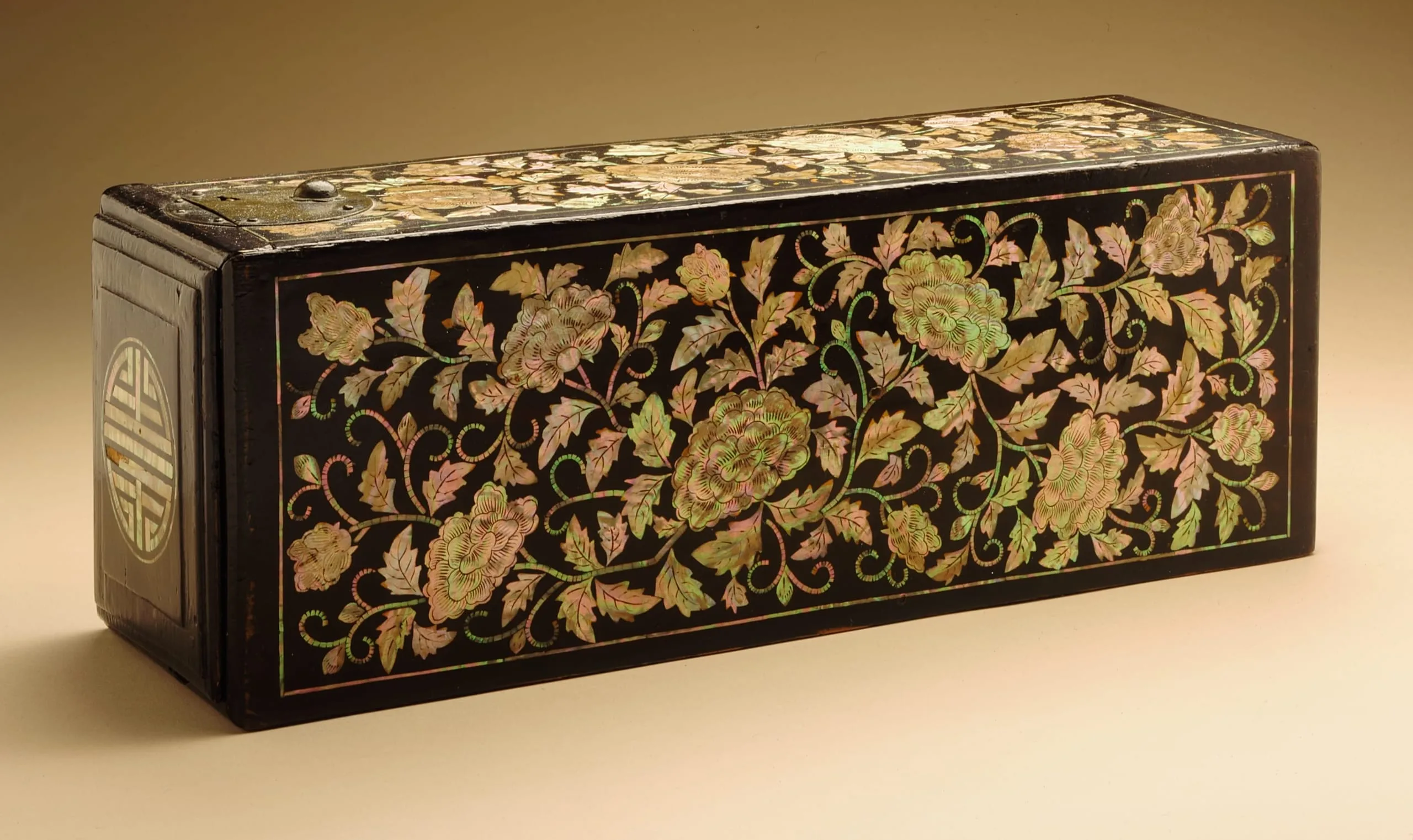
- Black-lacquered Box with Peony Blossom Design
- Date Made
- Joseon dynasty (1392-1910), 18th century
- Medium
- Black lacquer on wood core with gold painted decoration, mother-of-pearl inlay, and metal fittings
- Dimensions
- 5 1/2 x 15 3/4 x 4 5/8 in. (13.97 x 40.01 x 11.75 cm)
- Accession Number
- M.2000.15.149
- Curatorial Notes
Peony blossoms, a popular decorative motif in Korea, mark the spring renewal and symbolize happiness, purity, and prosperity. This small box is covered with peonies made iridescent with mother-of-pearl inlay (najeon chilgi). Often harvested from the inner shell of abalones, conches, or oysters, mother of pearl was applied to the box using two different techniques—mojobeop and kkeuneumjil. On the three visible long sides (the bottom is unadorned), the overall pattern of incised peonies was achieved with the mojobeop technique. On the smaller side panels, the hanja character 壽 (su), meaning long life, was created with the kkeuneumjil process, in which mother of pearl is sliced into thin strips to accommodate curved lines.
While Korean lacquer boxes often open at the front, this particular example holds two small stacked drawers inside that are accessed from the side. The use of lacquer, a practice going back more than a thousand years in East Asia, is both aesthetic and functional: it provides a lovely luster as well as a protective varnish that naturally prevents water and insect damage.
Virginia Moon
April 2025
- Selected Bibliography
- Korean Art Collection of the Los Angeles County Museum of Art, U.S.A. Daejeon, Republic of Korea: National Research Institute of Cultural Heritage, 2012.