LACMA

ShopMembershipMyLACMATickets
LACMA
Los Angeles County Museum of Art
5905 Wilshire Blvd.
Los Angeles, CA 90036
info@lacma.org
(323) 857-6000
Sign up to receive emails
Subscribe
© Museum Associates 2025

Museum Hours

Monday

11 am–6 pm

Tuesday

11 am–6 pm

Wednesday

Closed

Thursday

11 am–6 pm

Friday

11 am–8 pm

Saturday

10 am–7 pm

Sunday

10 am–7 pm


  • About LACMA
  • Jobs
  • Building LACMA
  • Host An Event
  • Unframed
  • Press
  • FAQs
  • Log in to MyLACMA
  • Privacy Policy
© Museum Associates 2025
Collections

Unknown
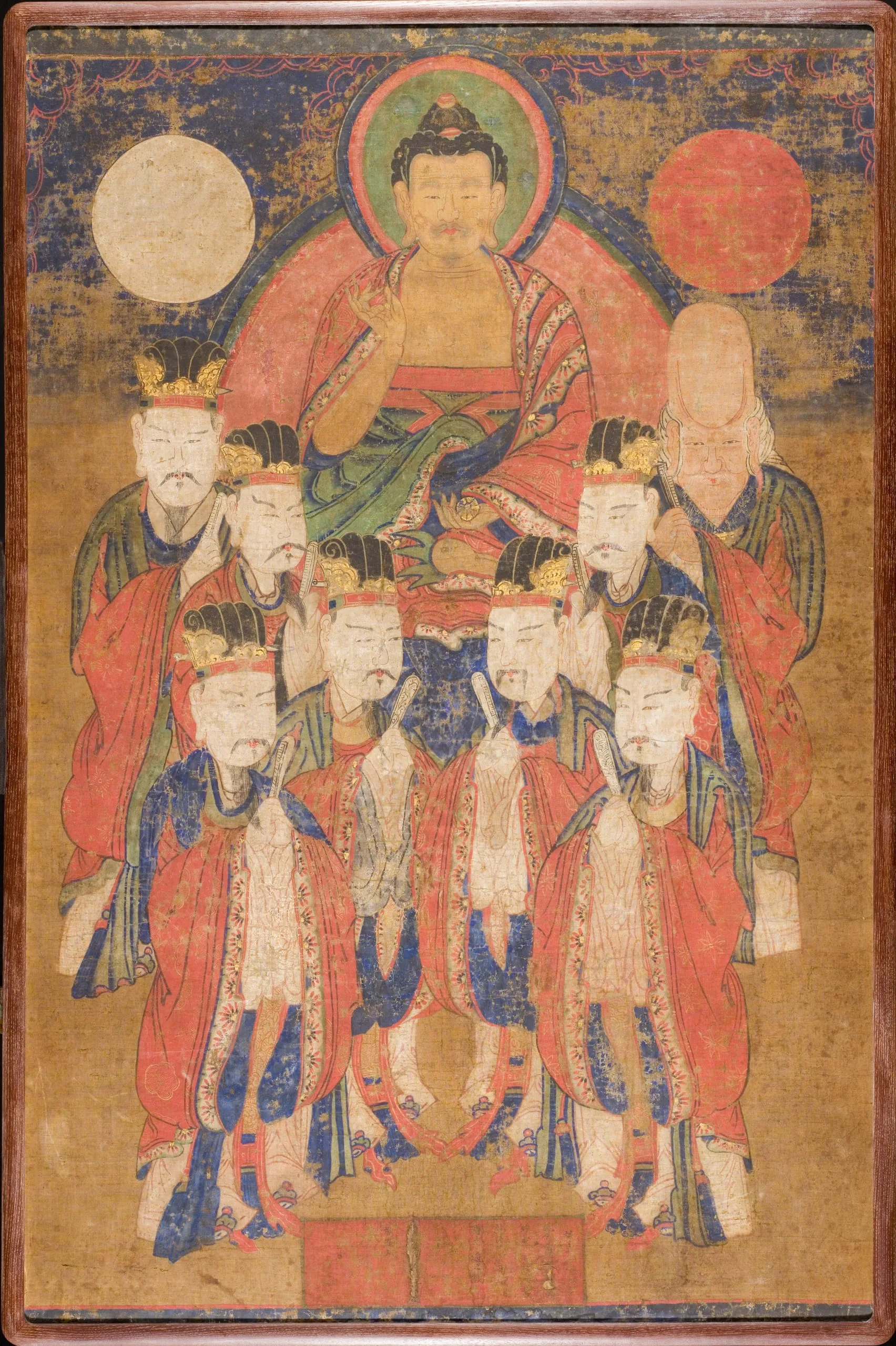
Tejaprabha BuddhaJoseon dynasty (1392-1910), late 19th-early 20th century

Not on view
Vertical painting on gold ground, enthroned central figure with halo surrounded by tiered rows of crowned attendants in crimson and blue robes, sun and moon discs at upper corners
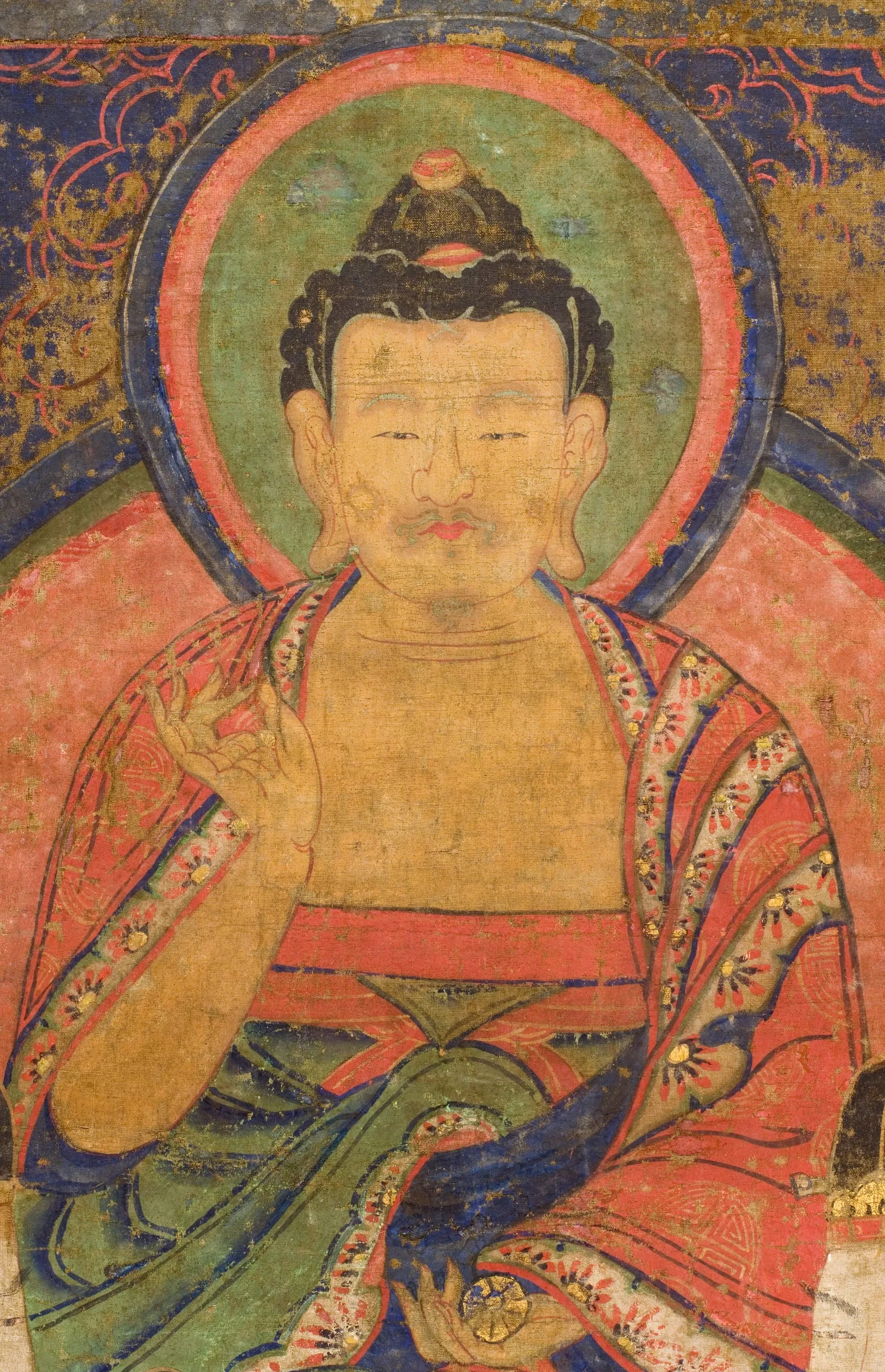
Painted thangka fragment depicting a seated Buddha figure with ushnisha and curled hair, set against a green circular nimbus with blue outer halo. The figure wears a red and green robe with floral patterned borders, right hand raised in vitarka mudra, left hand resting in lap. Gold-toned flesh, deep blue background with gilt cloud motifs, aged and flaking pigment surface.
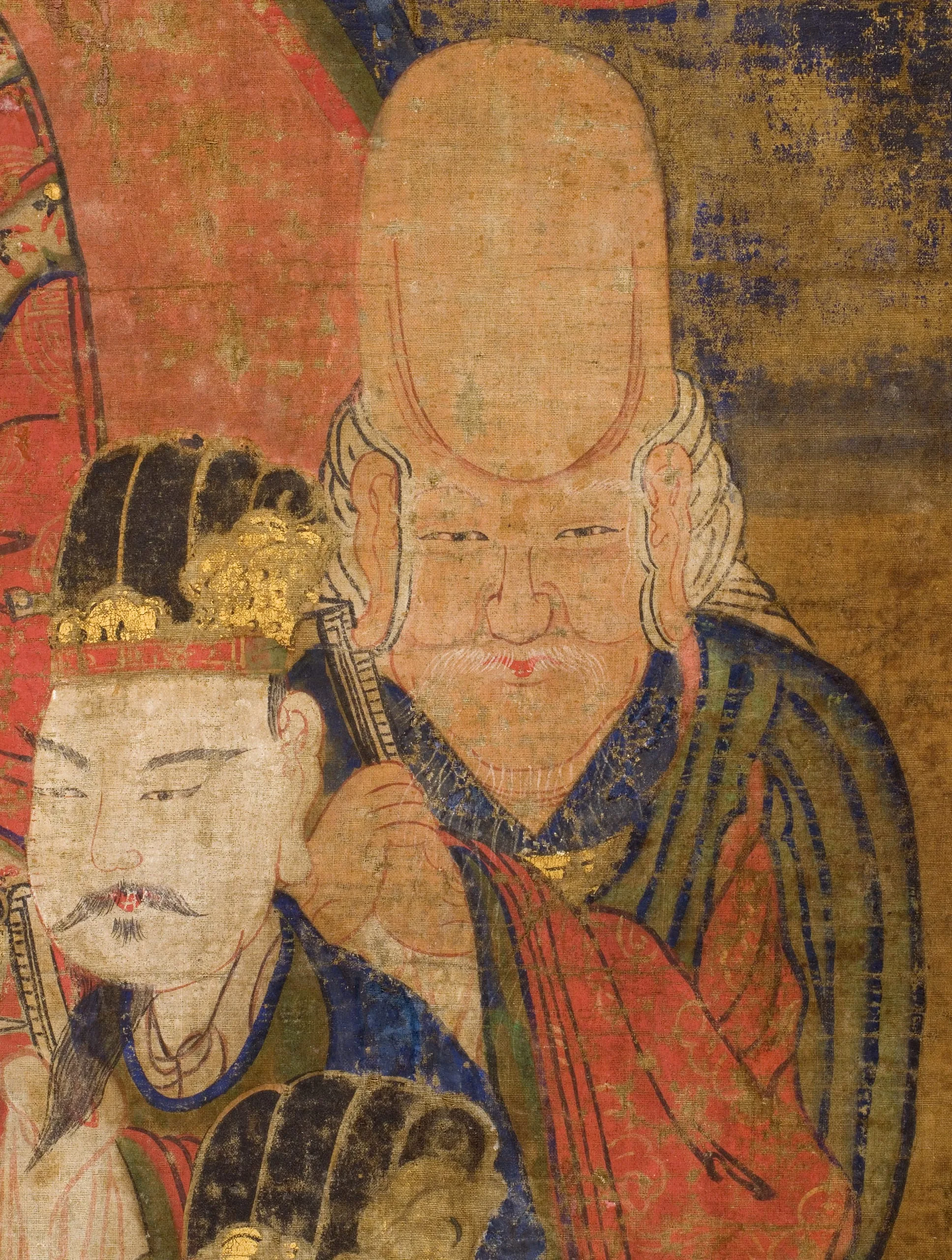
Detail of a hanging scroll painting, two male figures in close composition: a tall bald elder with white beard in layered blue and red robes, standing behind a younger figure wearing an elaborate gold crown and dark court dress, against a worn ochre background with traces of red drapery at left.
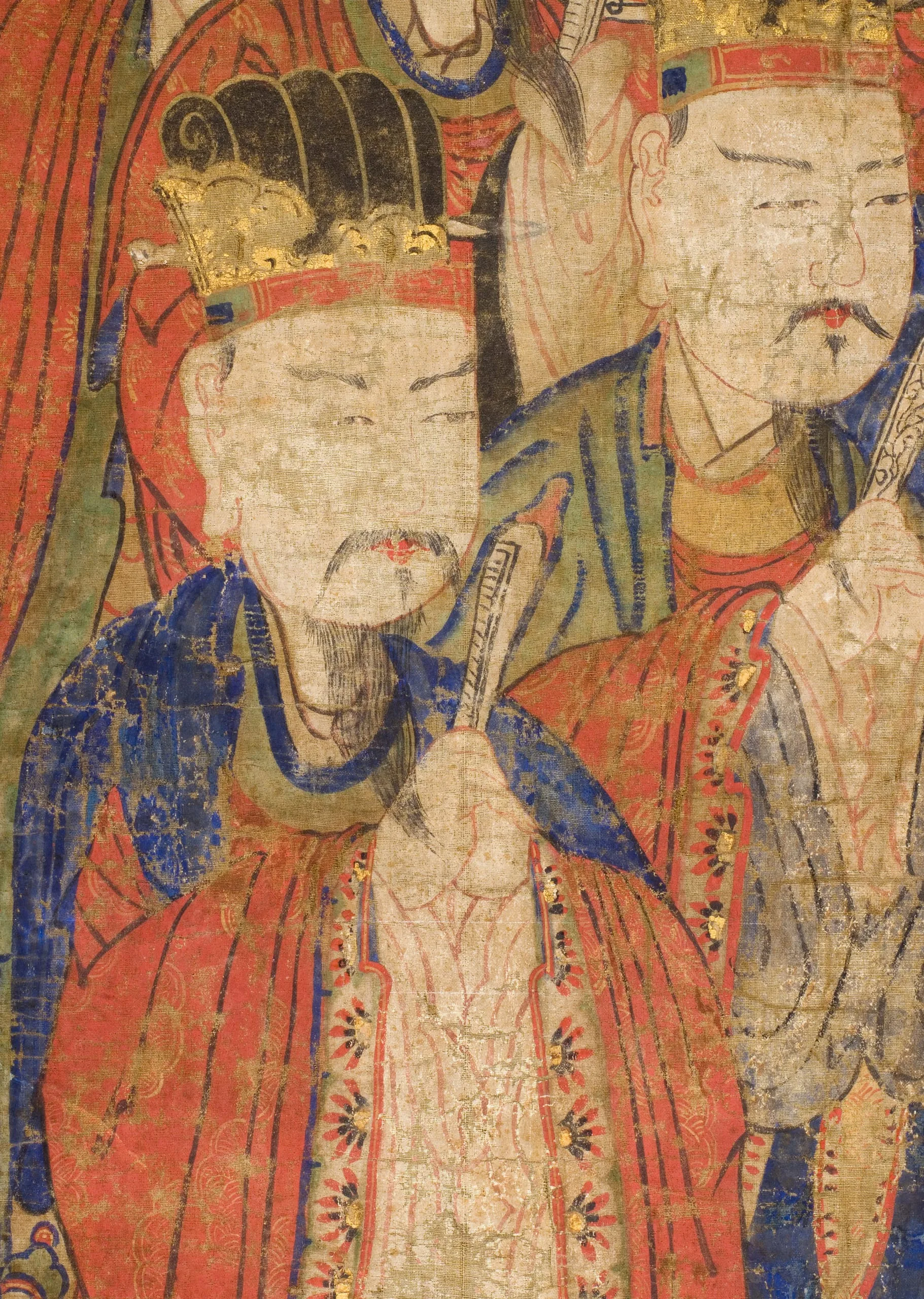
Detail of a hanging scroll painting on silk, showing two male court figures in red and blue robes with gold-adorned headdresses; the foreground figure holds a ceremonial tablet, with visible cracking and pigment loss across the aged surface.
Artist or Maker
Unknown
Title
Tejaprabha Buddha
Place Made
Korea
Date Made
Joseon dynasty (1392-1910), late 19th-early 20th century
Medium
Panel, ink and color on paper
Dimensions
44 1/2 x 29 1/2 in. (113.03 x 74.93 cm)
Credit Line
Purchased with Museum Funds
Accession Number
M.2000.15.5
Classification
Paintings
Collecting Area
Chinese and Korean Art
Curatorial Notes

Since ancient times, travelers have used Polaris, or the North Star, as their guide. In Korea, Polaris was personified as the Buddha of Polaris (Chiseonggwang Yeorae); his attendants are the Buddhas of the Big Dipper (Chilseong Yeorae). This painting depicts the Buddha of Polaris surrounded by the Buddhas of the Big Dipper; all these deities entered the Buddhist pantheon when Korean folk religions mingled with Buddhism.

Paintings of the Buddhas of the Big Dipper were very popular in Korea. They can be found in almost all Korean Buddhist temples, where they are placed in shrines called the Big Dipper Pavilion (Chilseonggak) or the Three Stars Pavilion (Samseonggak). In Korean folk religion, the Big Dipper was believed to guide the sins and mishaps of human beings and ward off disasters, and to be a symbol of longevity. It was also thought to aid in the conception of a baby boy and, during the Joseon dynasty, the Big Dipper became widely revered by women who desired a son.

Similarly, the Buddha of Polaris – a Buddhist manifestation of this folk belief – was worshipped to avert disaster, grant wishes and longevity, and ensure prospering offspring. He was also believed to possess healing powers similar to those of the Buddha of Medicine (Yaksa Yeorae); in fact, two of his attendants – the bodhisattva of Sunlight (Ilgwang) and the bodhisattva of Moonlight (Wolgwang) – are also attendants of the Buddha of Medicine. According to many Buddhist sutras, the Buddha of Polaris holds a golden wheel and sits on a throne supported by seven lions. His body emits an infinite light that turns into great fire, with which he oversees the changes of the sky and rules over people’s wishes.

In Korea, there are two standard formats for the depiction of these deities. One format depicts the Buddha of Polaris and all his attendants together in a single painting, as seen in a large painting of the Buddha of Polaris and his attendants from 1892 in Goun Temple, North Gyeongsang province (fig. 1). The other format features[1] a set of individual paintings for each deity, or for two or three deities, with the Buddhas of the Big Dipper arranged on either side of a central painting of the Buddha of Polaris (see the essay for M.2000.15.1-.2). This painting is clearly an example of the former. The Buddha of Polaris, in the center, sits on a platform in a full lotus position. The large nimbus surrounding him is intended to represent rays of light radiating from his body. In his left hand, he holds a golden wheel (det. 1). He makes the vitarka gesture (the right hand faces upward and the middle figure and thumb touch; the left hand, facing upward, rests on the left leg, and again the fingers touch).The sun in the upper right and the moon in the upper left are symbolic representations of the bodhisattvas of Sunlight and Moonlight.

It is interesting to note that here, the figures surrounding the main Buddha are shown in their Daoist, rather than their Buddhist, personifications.[2] To the left of the Buddha of Polaris, and underneath the sun, is Taesangnogun, who is depicted as a Daoist hermit (det. 2). Taesangnogun’s role was that of a messenger: He preached the Dharma to human beings and related earthly affairs to the deities. The remaining seven figures of the Buddhas of the Big Dipper are also depicted in their Daoist personifications. They wear the gilded hats of officials and hold scepters (det. 3). Daoist iconography became more prevalent and more prominent in Korean art during the nineteenth and twentieth centuries. Its presence is a distinctive feature of Korean paintings of the Buddha of Polaris;[3] it also indicates that Korean Buddhism actively embraced Daoism at this period.

The inscription at the bottom records the names of the people who sponsored the production of the painting. While the date of the painting is not given, the Daoist iconography, the attire of the personifications of the Big Dipper, the use of gold on their hats, and the navy blue on the background stylistically place the work within the late nineteenth and early twentieth century.

Footnotes

[1] There is an example from 1877 in Cheonggok Temple in South Gyeongsang province.

[2] In Buddhism, Polaris and the Big Dipper are personified as the Buddha of Polaris attended by the Buddhas of the Big Dipper; in Daoism, Polaris is called Jamidaeje and the Big Dipper is Chilwon seonggun. LACMA’s painting depicts the Daoist rather than the Buddhist personifications.

[3] Another example of a painting of this type, from 1860, is in Sudo’am of Neungga Temple in Suncheon, South Jeolla province.

Bibliography

Buddhist Cultural Properties Research Institute. Korean Buddhist Painting [Hanguk ui bulhwa], vol. 1-40. Yangsan, Korea: Buddhist Cultural Properties Research Institute, 1996-2006.

Cha, Jae-seon. “Study of Buddhist Chilseong Paintings in the Joseon Dynasty [Joseonjo Chilseong Taenghwa ui Yeongu].” Master’s thesis, Dongguk University, 1987.

Kang, Mingi, et al. Understanding Korean Art Culture [Hanguk misul munhwa ui ihae]. Seoul: Yegyeong, 1994.

Kang, So-hyeon. “Buddhist Chilseong Paintings of the Joseon Dynasty [Joseon sidae ui Chilseong Taenghwa].” Master’s thesis, Seoul National University, 1998.

Mun, Myeongdae. Korean Buddhist Painting [Hanguk ui bulhwa]. Seoul: Yeolhwa-dang, 1977.

Selected Bibliography
  • Woo, Hyunsoo, ed. Treasures from Korea: Arts and Culture of the Joseon Dynasty, 1392-1910. Philadelphia: Philadelphia Museum of Art, 2014.
  • Korean Art Collection of the Los Angeles County Museum of Art, U.S.A. Daejeon, Republic of Korea: National Research Institute of Cultural Heritage, 2012.