LACMA

ShopMembershipMyLACMATickets
LACMA
Los Angeles County Museum of Art
5905 Wilshire Blvd.
Los Angeles, CA 90036
info@lacma.org
(323) 857-6000
Sign up to receive emails
Subscribe
© Museum Associates 2025

Museum Hours

Monday

11 am–6 pm

Tuesday

11 am–6 pm

Wednesday

Closed

Thursday

11 am–6 pm

Friday

11 am–8 pm

Saturday

10 am–7 pm

Sunday

10 am–7 pm


  • About LACMA
  • Jobs
  • Building LACMA
  • Host An Event
  • Unframed
  • Press
  • FAQs
  • Log in to MyLACMA
  • Privacy Policy
© Museum Associates 2025
Collections

Unknown
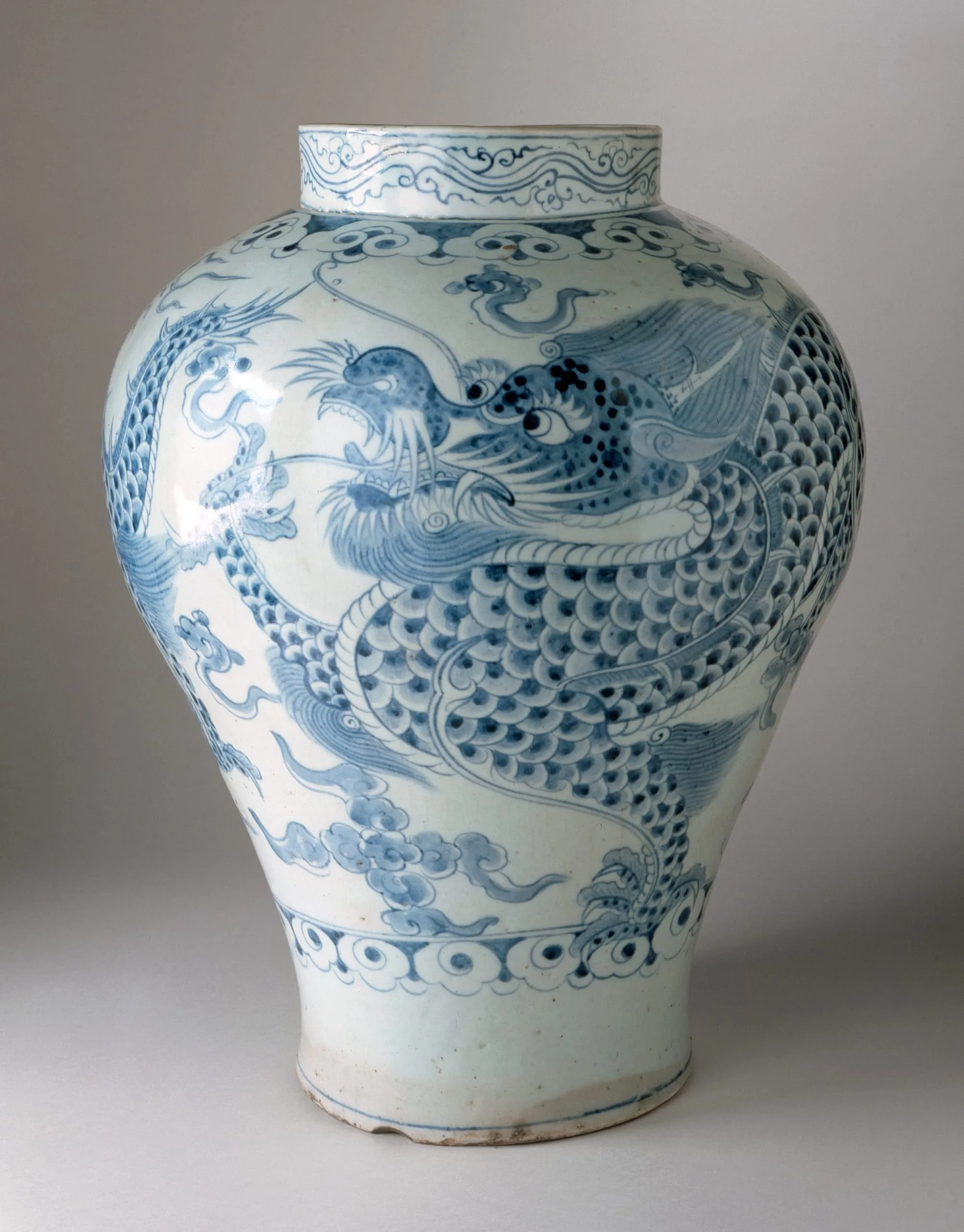
Jar with Dragon in Clouds Design in Underglaze Cobalt - blueJoseon dynasty (1392-1910), 18th century

On view:
Geffen Galleries, Blue-and-White Porcelain of East Asia
Large white porcelain jar with cobalt blue underglaze decoration of a coiling dragon surrounded by cloud scrolls, with banded borders at the neck and foot
Artist or Maker
Unknown
Title
Jar with Dragon in Clouds Design in Underglaze Cobalt - blue
Place Made
Korea, probably Gwangju and South Jeolla
Date Made
Joseon dynasty (1392-1910), 18th century
Medium
Wheel-thrown porcelain with blue painted decoration under clear glaze
Dimensions
Diameter: 12 in. (30.48 cm) Height: 17 in. (43.18 cm)
Credit Line
Purchased with Museum Funds
Accession Number
M.2000.15.98
Classification
Furnishings
Collecting Area
Chinese and Korean Art
Curatorial Notes
Porcelains with underglaze designs painted in blue were first produced in Korea during the fifteenth century. The relatively high iron content of Korean cobalt yielded a somewhat muddy color, and consequently, leading local artisans preferred minerals imported to Korea through China from Iran. Due to the high cost of the foreign pigment, only the royal household was initially entitled to use the precious wares. By the eighteenth century, however, when Korea entered an age of prosperity and renewed cultural activity, blue-and-white wares were available to a broader range of society.
Many porcelains were produced in the late eighteenth century at the royal kilns in Gwangju, near the Joseon capital of Hanyang (modern Seoul). Court painters were frequently employed to paint the surface designs. Beautifully painted, this jar features a scaly dragon with big friendly eyes, sharp teeth, small horns, and a lively mane. Considered auspicious throughout East Asia, the dragon symbolizes royalty and prosperity. This boldly painted creature attests to the brush of a skillful court artist and anticipates later decorative trends in court and folk painting. A fine example, this robust, elegant jar illustrates the well-balanced form and relatively short mouth rim characteristic of eighteenth-century wares.
Hyonjeong Kim, Associate Curator, Chinese and Korean Art, (2008)
Selected Bibliography
  • Los Angeles County Museum of Art. Transformation: the LACMA Campaign. Los Angeles: Museum Associates, 2008.