Korea is a mountainous country, and the folk customs and beliefs of its people reflect their surroundings. According to Chinese historical texts,[1] Koreans revered mountains and rivers because they form natural borders. In the chapter “Gojoseonjo” in the thirteenth-century Korean historical text Historical Records of the Three Kingdoms (Samgukyusa)[2], Dangun, the legendary founder of the first Korean kingdom, is recorded to have become a mountain god.
Eventually, this reverence was personified into protective folk deities called mountain gods, who according to some records from the Joseon dynasty, were worshipped by both the Korean royal household and by the general population. According to those records, the Joseon dynasty royal court held ceremonies for five mountain gods, asking them to protect the country. It is also recorded that, to prevent the natural surroundings from being destroyed, the government had to ban the general population from performing excessive rituals in mountains and rivers.
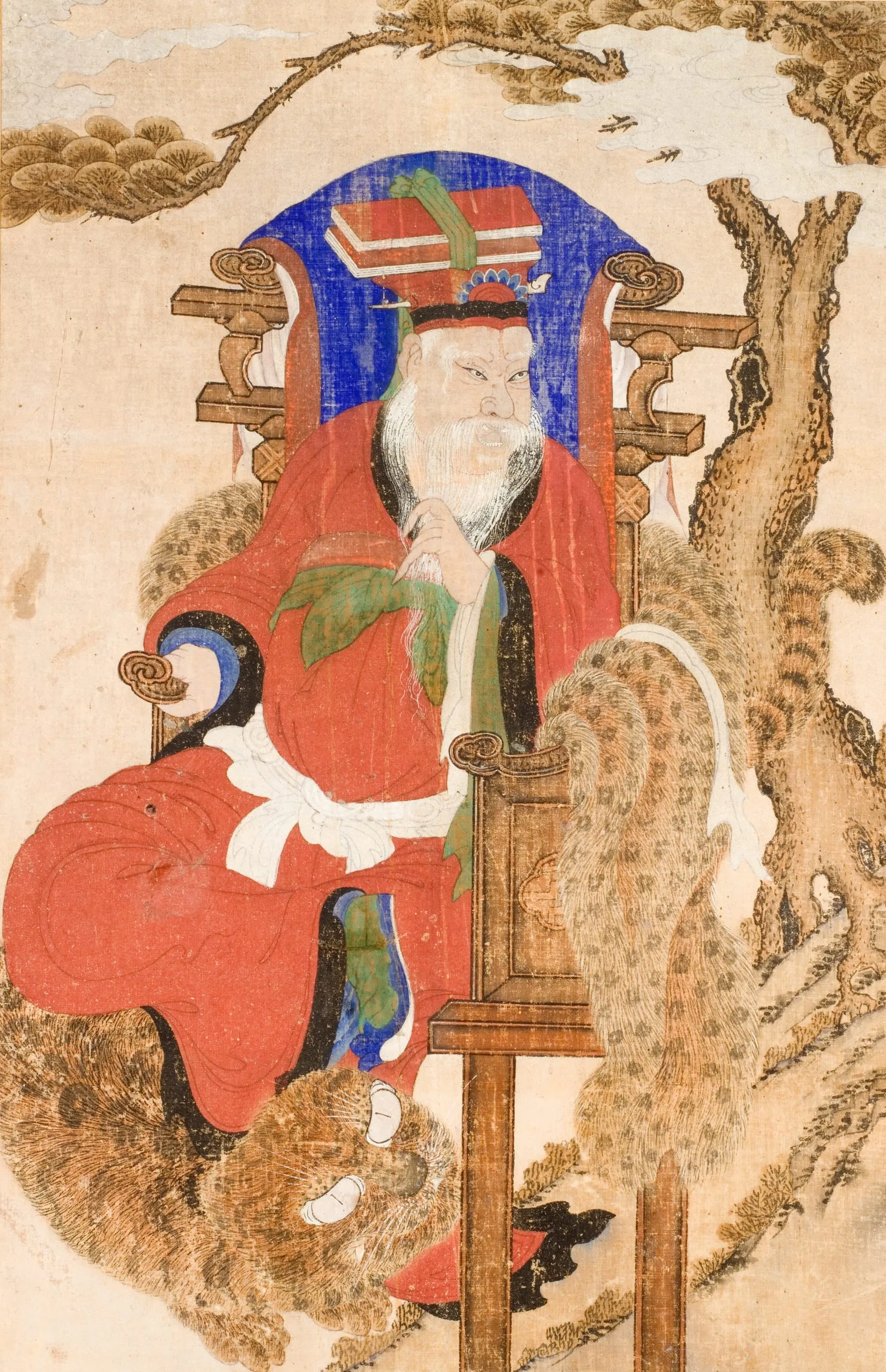
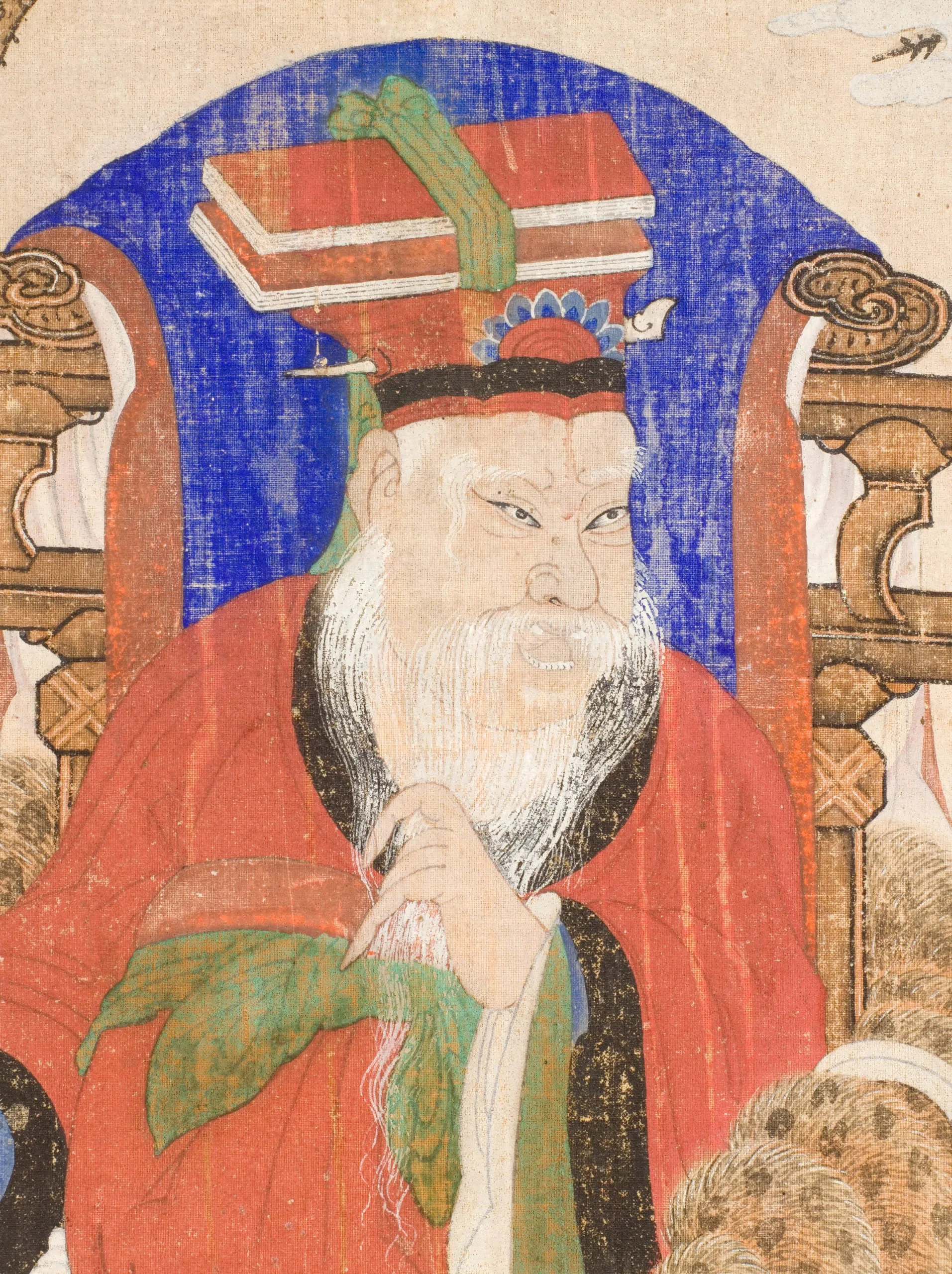
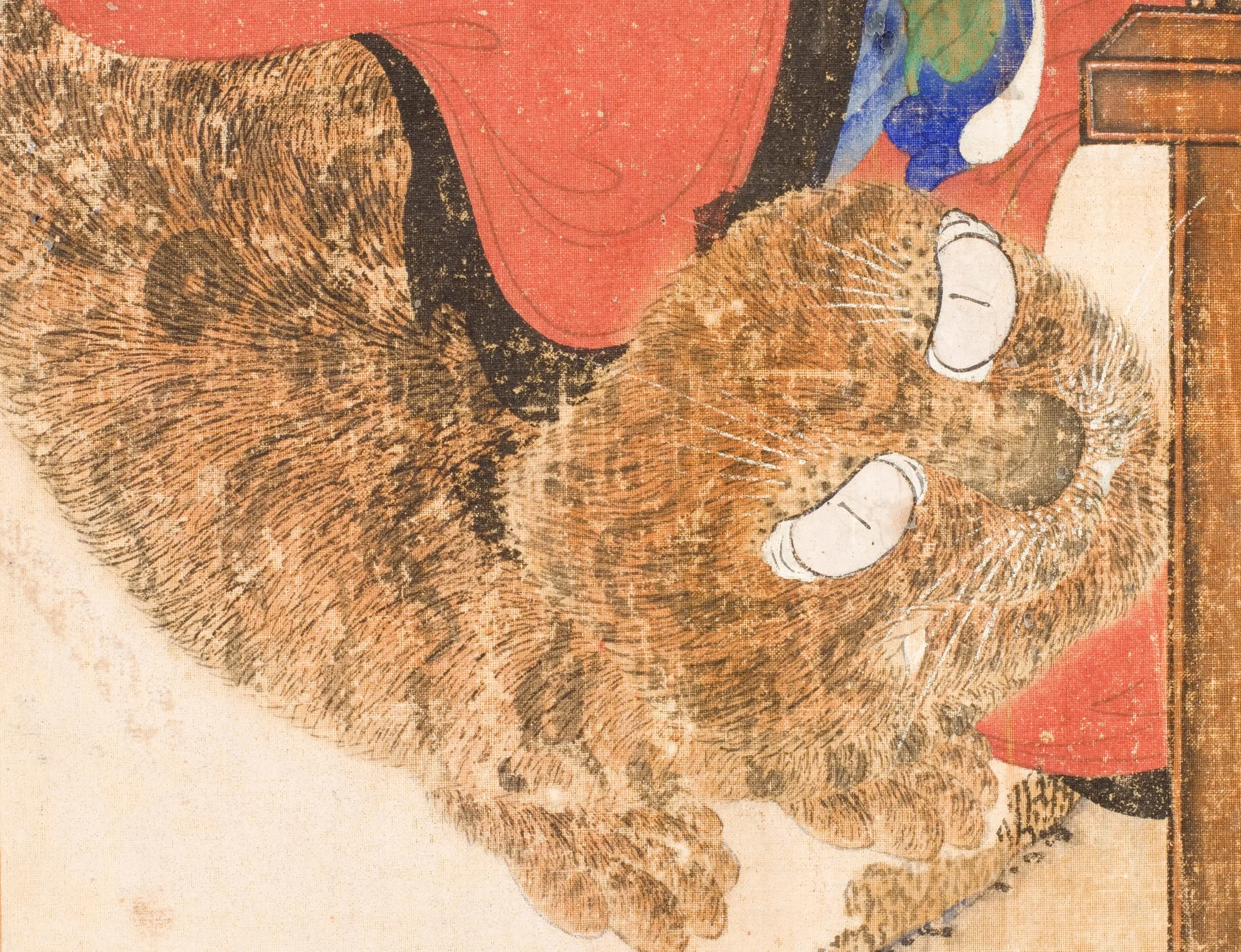
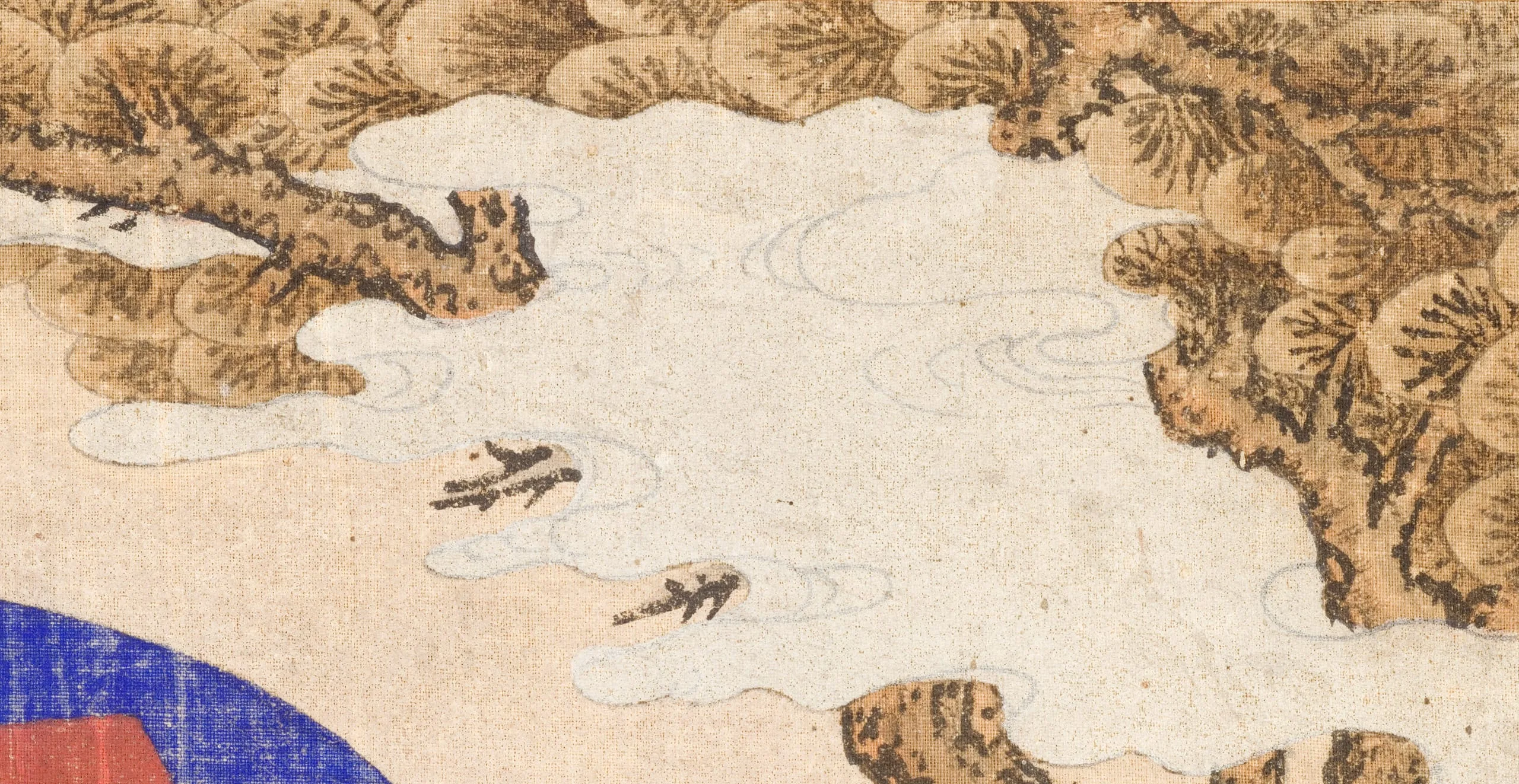
This painting depicts a red-robed mountain god sitting on a wooden chair on a steep mountain slope. He wears a king’s crown mounted with two books (det. 1). He sits with his right foot on his left knee and turns to the left; his mouth is open, as if he is talking to someone, and he strokes his beard with his left hand. A tiger crouches at his feet, looking up (det. 2). The position of the tiger suggests that he ran down the mountain and made a hasty, sharp turn in front of the mountain god; however, the connection between the tiger’s tail and the rest of his body appears unnatural. Behind him on the slope of the mountain is a pine tree with clouds among its branches, and the scene suggests a sublime place where the mountain god resides (det. 3).
The most distinctive feature of this painting is the mountain god’s head gear. No other known paintings of mountain gods show them wearing a king’s crown (Wonyugwan) on which is balanced two books. This iconography is normally found in paintings of the Fifth King of Hell (Yeomla daewang) among the Ten Kings of Hell (Siwang) or in paintings of a Judge of the Underworld (Hyeonwang) (figs. 1 and 2). The iconography of LACMA’s painting seems to be especially related to imagery depicting Judges of the Underworld and the story of the Buddha’s prophecy that the Fifth King of Hell will become a Bohyeonwang Yeorae, a Buddha who saves people from the hell. It is presumed that the artist of LACMA’s work used paintings of the Judge of the Underworld as his source.
It is not clear why iconography commonly associated with a Judge of the Underworld came to be used in a painting of a mountain god. However, that mountain gods were also regarded as kings is evident from inscriptions on early-nineteenth-century paintings that refer to the subjects as “mountain kings”; this implies a possible reason that a mountain god would be depicted as the Fifth King of Hell.
In this painting, the figures of tiger and chair are not very skillfully rendered, and the placement of the other elements seems stiff and unnatural. Although the painting is not dated, it would be reasonable to place it in the early nineteenth century rather than in the mid-nineteenth century, when a tradition for the pictorial representation of mountain gods was already established. In LACMA’s painting, the skilled artist used a technique that involved a variety of light and dark ink lines to express the motifs.
Footnotes
[1] The History of the Later Han Dynasty (Hou hanshu), was compiled in China in the fifth century.
[2] The Historical Records of the Three Kingdoms (Samgukyusa) was compiled in the late thirteenth century by the Buddhist monk Ilyeon. It is the oldest remaining history book on the Three Kingdoms period.
Bibliography
Kim, Yeongja. “The Meaning of Tiger, Background, and Other Instruments Found in Mountain God Painting [Sansindo e natanan horangyi, baegyeong, jimul ui sangjingseong].” Minsokhak yeongu 12. Seoul: Association of Korean Art History, 2003.
———. “Different Types of Mountain God in the Sansindo [Sansindo e pyohyeondoen sansin ui yuhyeong].” Hanguk minsokhak 41. Seoul: The Korea Folklore Society, 2005.
Yun, Yeolsu. Mountain God Paintings [Sansindo].Seoul: Daewonsa, 1999.
———. “Typography of Mountain Gods and Female Mountain Gods [Sansindo ui yuhyeong gwa yeoseong sansindo].” Gomunhwa 53. Seoul: Korean Association of University Museums, 1999.
Additional References
Kim, Hongnam. The Story of a Painting: A Korean Buddhist Treasure from The Mary and Jackson Burke Foundation. New York: The Asian Socity Galleries, 1991, 35, Fig. 34/No. 24 See other artworks in this book