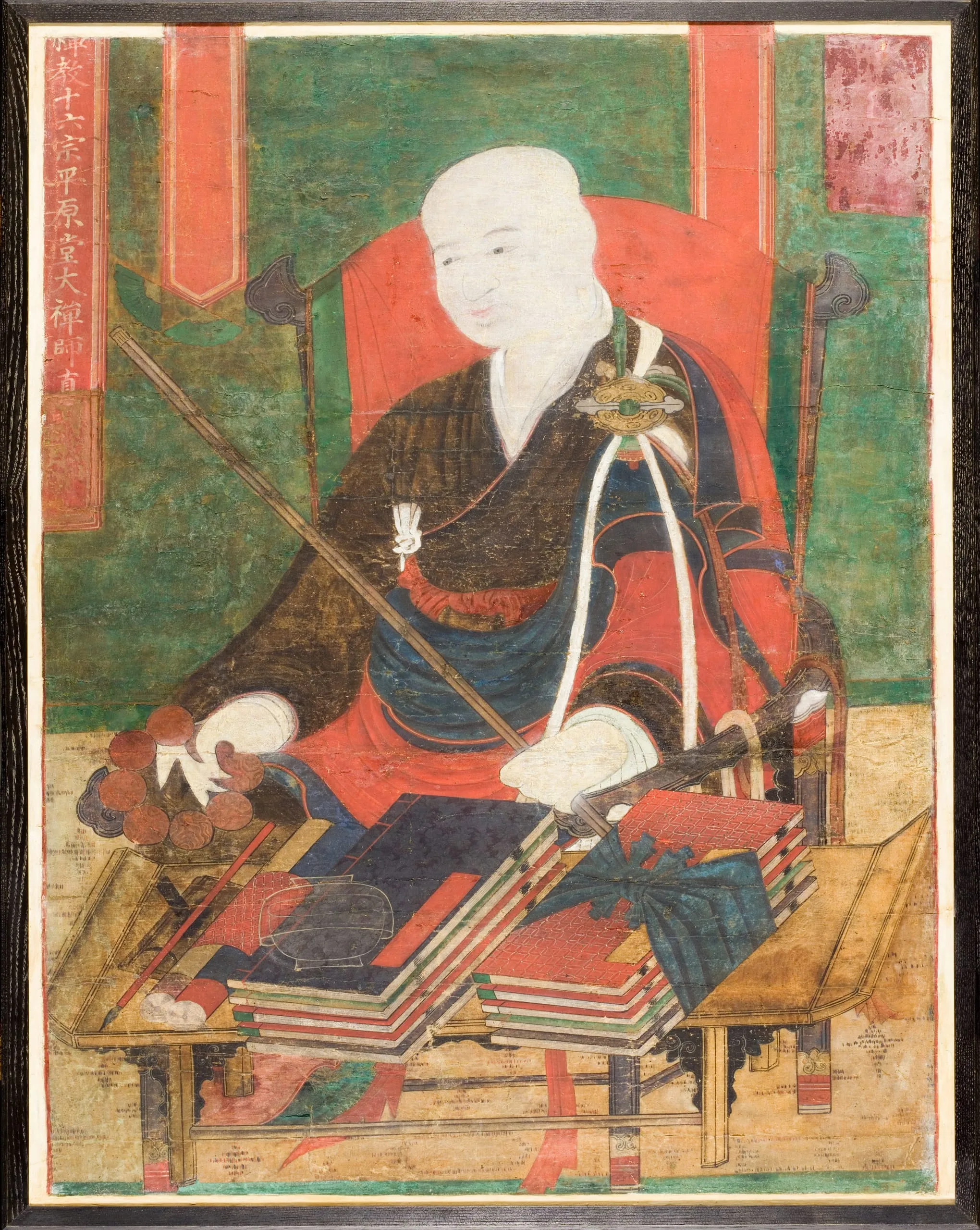
After the death of a Buddhist patriarch, his portrait was often painted to pay tribute to him. These portraits, called jinyeong, also symbolized the long history of succession within the sect, thus strengthening the legitimacy and authority among followers. Often, the portraits themselves became subjects of worship. Many temples housed portraits of the first patriarch of the different schools of Buddhism, well-known monks familiar with the doctrinal studies of Buddhism, and monks who benefited the country.
The inscription in the upper left corner of this painting gives the name of the subject, Pyeongweondang Jinyeong. This is the only known portrait of this Buddhist patriarch, and his deeds and accomplishments are as yet unidentified. Praise for Pyeongweondang might once have been written in the red rectangle at the top right; however, the inscription is no longer legible.
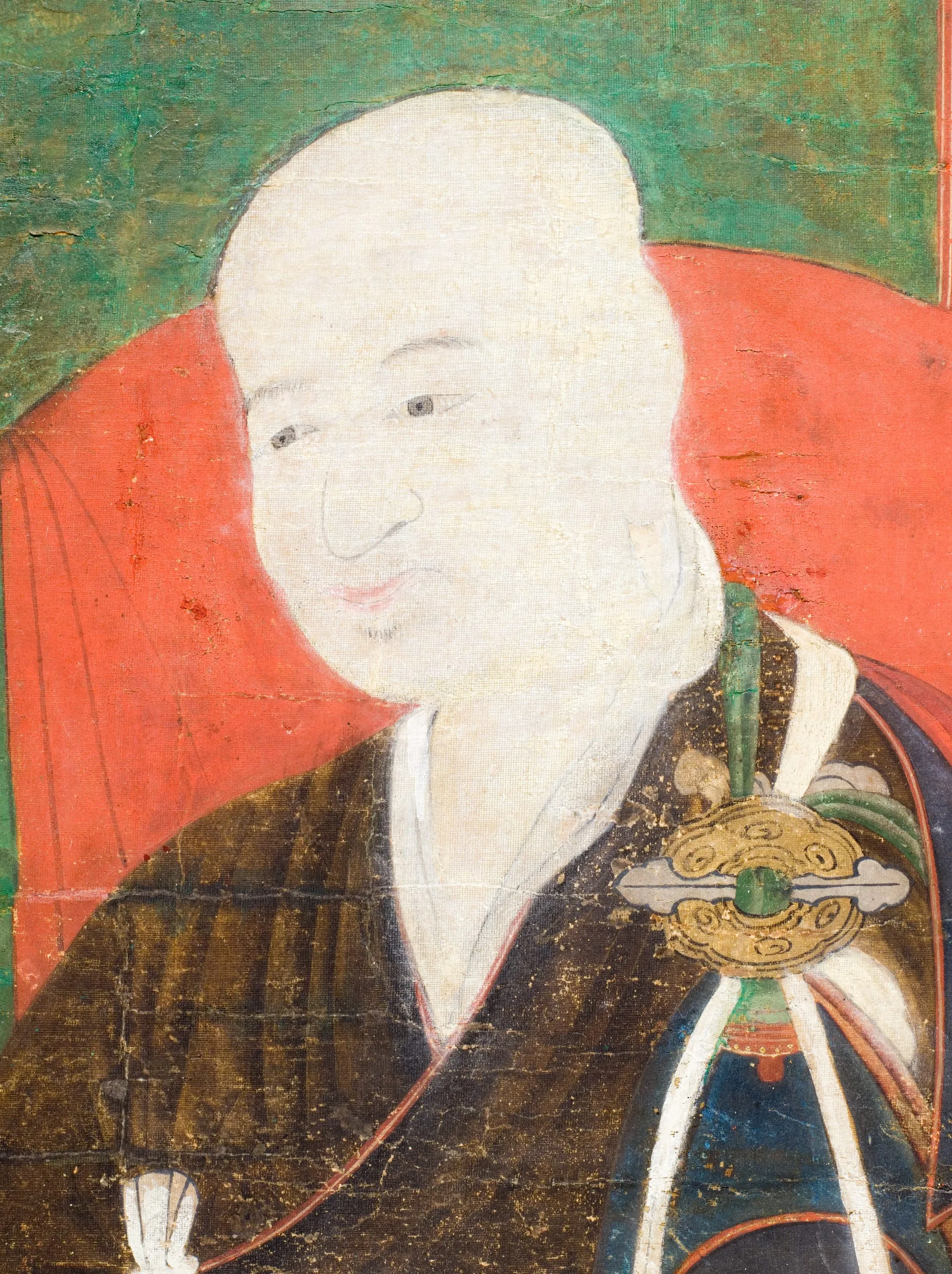
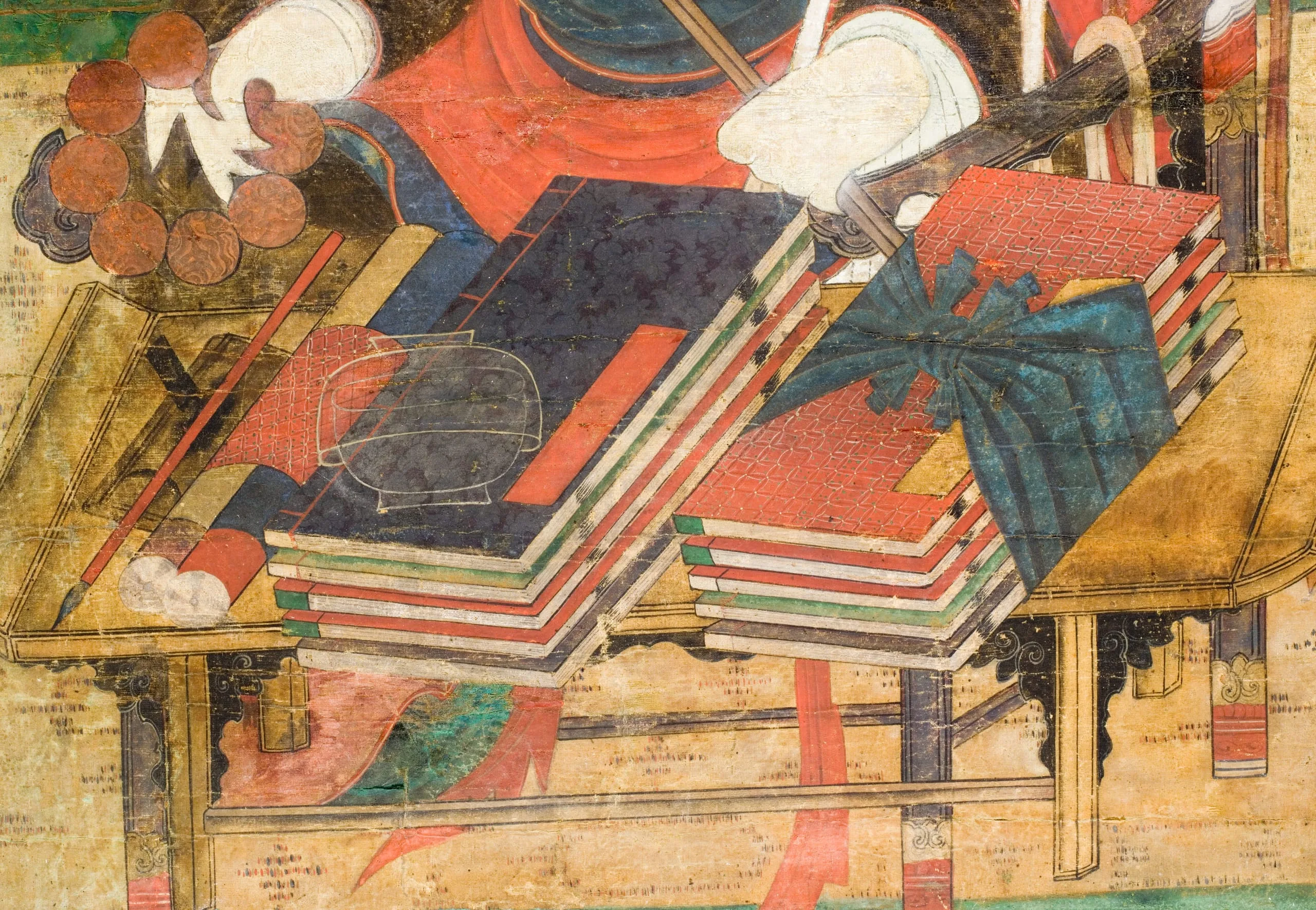
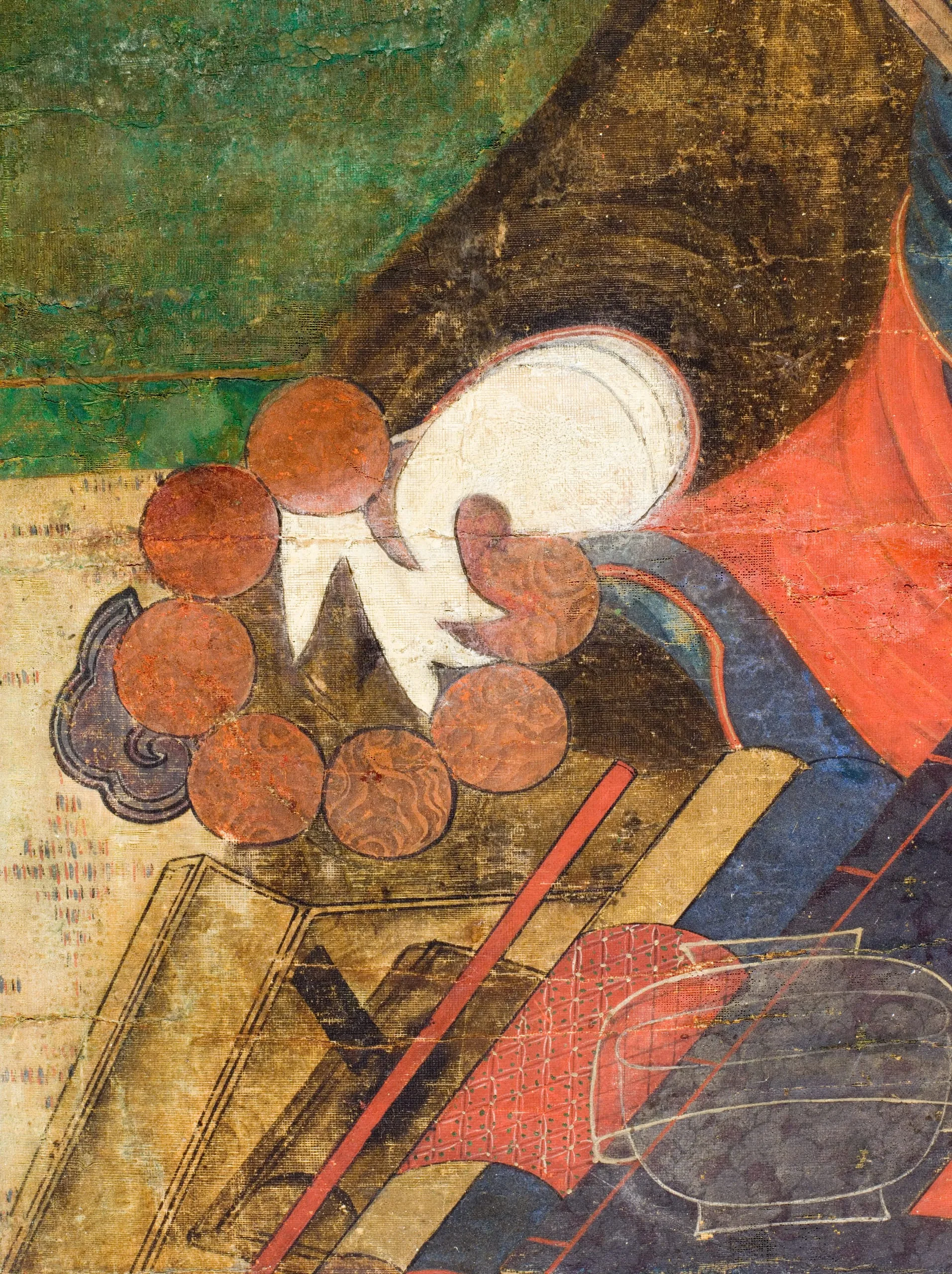
Typical of the genre, the floor mat and wall create a divided background. Pyeongweondang, facing left, sits in a low chair. In his left hand, he holds a Buddhist wooden staff (Sanskrit: khakkhara) and, in his right hand, he holds Buddhist prayer beads (det. 1). On the low table in front of him are ten sutras, two scrolls, and writing implements including a brush, ink stone, and ink (det. 2). A transparent lidded container sits atop one stack of sutras. Pyeongweondang’s face is unwrinkled and his lips are pursed (det. 3). The artist used a complex painting technique: he first applied white paint to the back of the silk for the face, and then thinly applied an ocher hue from the front. Most of the original color has since been lost. It appears that the robe’s white knot, below the patriarch’s right shoulder, was repainted.
The overall composition and color scheme, as well as the subject’s pose, indicate that the portrait was created at the end of the nineteenth century. Another painting, the Portrait of the Great Monk Eunheodang from 1868 at Yongmun Temple, Gyeonggi province, similarly depicts the monk seated before a table with sacred books (fig. 1).
It is not clear when this genre was first introduced, but literature indicates that portraits of the Buddhist patriarchs Wonhyo, Doyi, and Beomil existed by the Unified Silla period and that more were actively produced during the Goryeo period. Unfortunately, no portraits from those periods remain. Most of the portraits found today were created in the late Joseon period, after the eighteenth century.
In general, the composition of the portraits followed a standard formula. The patriarchs are typically depicted wearing a Buddhist surplice and holding a brush and prayer beads. They sit either on a chair or on the floor with legs crossed – that is, in the full lotus position – with the floor mat giving the effect of a divided background. Initially, the chair-sitting pose was more traditional; portraits showing patriarchs sitting on the floor were mostly created at the end of the eighteenth century. The patriarch’s name was written either on the top right or top left of the painting; often, words of praise were included as well. It was in the facial features that the artists focused on specific details to portray the uniqueness of the individuals. This is especially evident in eighteenth- and nineteenth-century portraits. Unfortunately, the portraits of patriarchs from the Unified Silla, Goryeo, and early Joseon periods were damaged over time. Many were repeatedly repainted and retouched, altering the original image.
Bibliography
Chung, WooThak. “Buddhist Patriarchs in the Late Joseon Dynasty” [Joseon hugi bulgyo jinyong go]. In Figures Who Followed the Way of Buddhist Enlightenment [Ggaedaleum ui gileul gan eolguldeul]. North Gyeongsang province: Jikji Temple Museum, 2000.
Jikji Temple Museum. Figures Who Followed the Way of Buddhist Enlightenment [Ggaedaleum ui gileul gan eolguldeul]. North Gyeongsang province: Jikji Temple Museum, 2000.