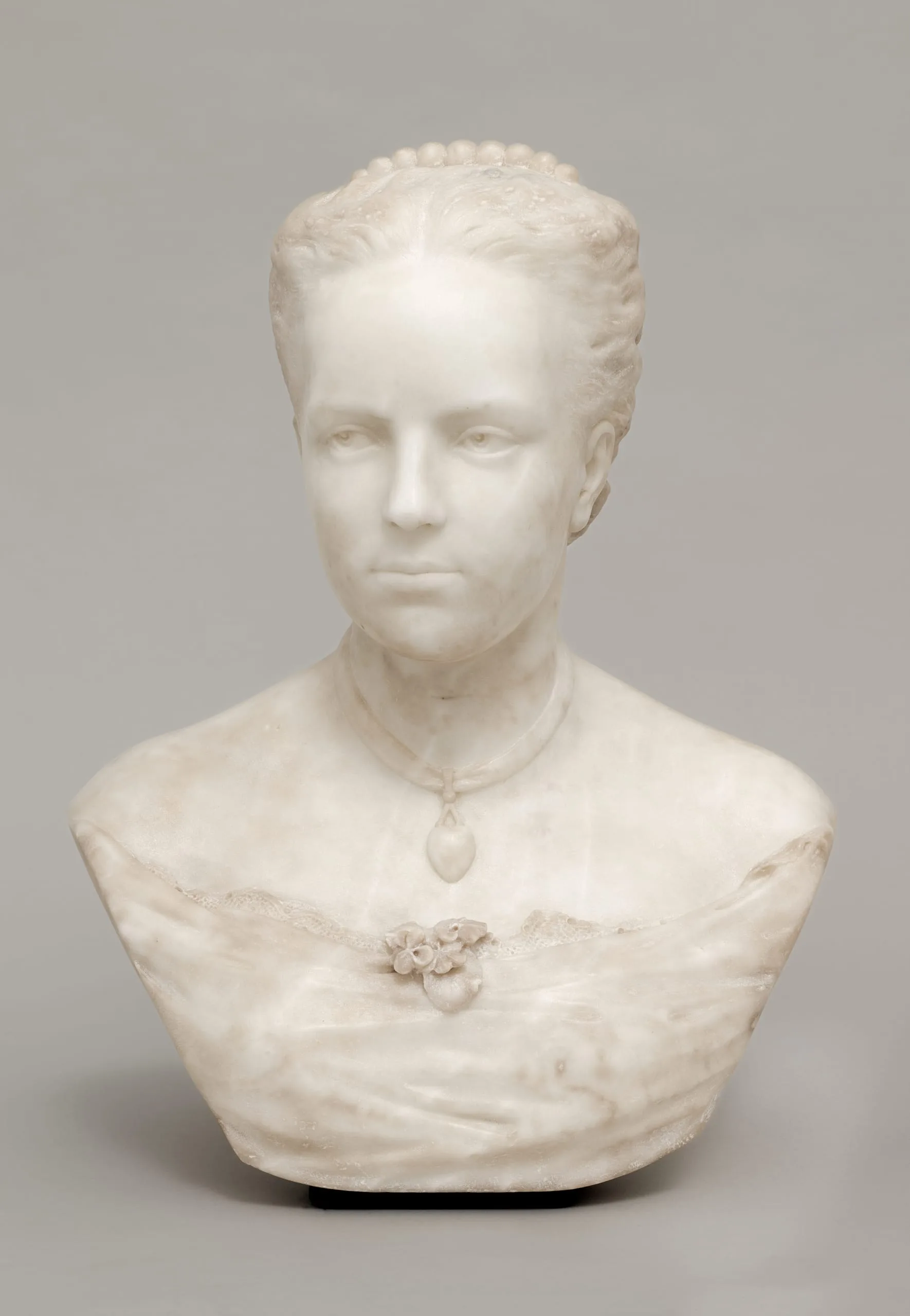
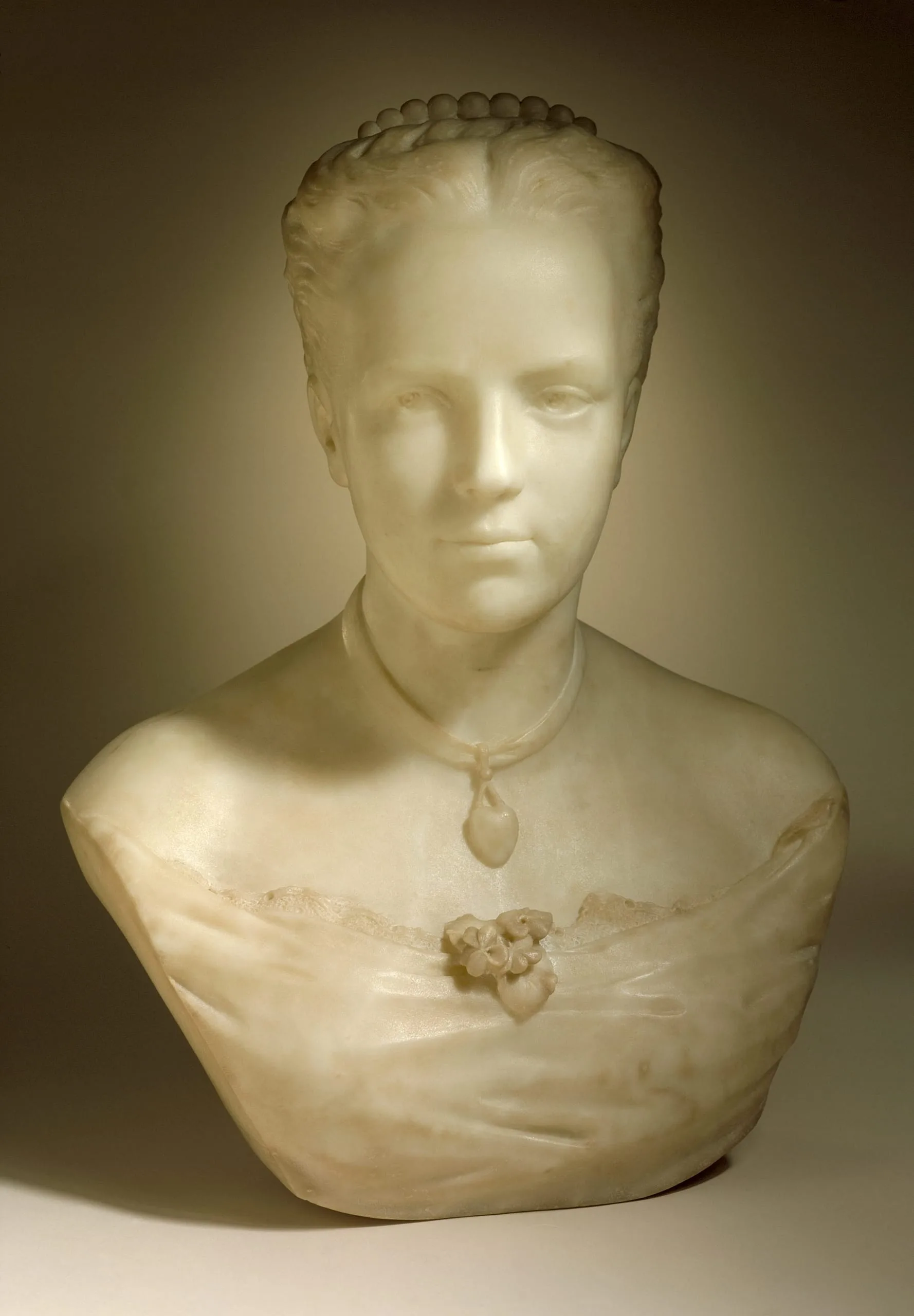
Although Augustus Saint-Gaudens is best known for his bronze sculptures, virtually all his work before 1877 (excluding carved cameos) was carved in marble. His heads of two sisters,
Florence Gibbs and
Belle Gibbs, 1872 (Museum of Fine Arts, Houston, Tex.), were significant early efforts at portraiture, which was to remain an important part of the sculptor’s work throughout his career.
As a young sculptor working in Rome in the early 1870s Saint-Gaudens depended on the patronage of Americans visiting the city. Montgomery Gibbs, father of Belle and Florence, a successful New York lawyer and writer, visited Saint-Gaudens’s studio in January 1872 to order a cameo for his wife. He was so impressed by Saint-Gaudens’s work that on a second visit to the studio, when he met the ailing sculptor, he offered him several commissions. Gibbs was Saint-Gaudens’s first major patron and extended the struggling young artist financial support at a critical time in his career. While the family was in Rome, Saint, Gaudens began the busts of Belle and Florence that Montgomery Gibbs commissioned as part of his agreement to support the sculptor. He needed photographs to complete the likenesses, however; Gibbs wrote from Naples in February that Florence had been too busy to have her photograph taken but that Belle was then at the photographer’s studio. In April Florence wrote from Venice that she had not yet had the photograph taken but would have it done when the family was in Vienna.
In a letter of May 1872 to Montgomery Gibbs, Saint-Gaudens wrote of the busts:
Miss Belle’s bust will be finished in two or three days and I am highly satisfied. I cannot say the same though of Miss Florence’s bust. It has been quite unfortunate. After having the rest of the bust roughed out and commencing to work on the features, a spot in the marble appeared over the left eye, so of course cutting could not go on. I have been obliged to buy another piece, this time not so cheaply. It cost fifty francs. I have had it commenced immediately and now I am sure we shall not be so unfortunate. The misfortune takes back the economies I had made on the first two pieces, because to the sum must be added the forty francs for what work the buffator had done on it. This of course makes it impossible to have it finished for my [proposed] departure [in July]. The features will be finished, but the hair and the accessories will take some time after my departure.
In a letter to the father on July 18, 1872, he reported on the progress of the busts: "Miss Belle’s portrait has also been even a greater success than I expected on the marble. The marble on Miss Florence’s is one of the finest pieces I have yet met with and if the accessories come out as well as Miss Belle’s-and there is no reason for the contrary-it will be finer, if anything than Miss Belle’s." There were additional delays before the Gibbs family received the finished busts, but a letter from Florence Gibbs in September 1874 reports the family’s satisfaction with both.
Despite Saint-Gaudens’s expressed satisfaction with the marble, it should be noted that compared with the flawless marble Hiram Powers (1805-1873) and other neoclassical sculptors insisted upon, the marble in the bust of Florence Gibbs is less than perfect, with some soft rust-colored areas, veins of pure white in the warmer stone, and one open crack on the right shoulder.
The bust came to the museum identified as Belle Gibbs, but a letter to Saint-Gaudens from Florence Gibbs in April 1872 refers to the locket: "I forgot to give you the heart locket to copy, but perhaps you remember it," indicating that Florence is the subject of the museum’s bust.
Saint-Gaudens recalled the sisters as "both young and attractive" and also recalled having a "soft spot" for Florence. Mrs. Thomas Ridgeway Gould, wife of the sculptor and a host to Americans in Rome, noted Saint-Gaudens’s interest in the younger sister, although she felt Florence was coquettish. In one of her several letters to Saint-Gaudens, Florence wrote, "You are bound that my features, including the purely Grecian nose shall go down to posterity in correct shape." The sculptor saw the girls socially on several occasions when they were in Rome. Some association may have continued afterward, to judge from the fact that Belle, then Mrs. John Merrylees, sent the sculptor an announcement of the marriage of her daughter in 1905. Nothing is known of the later life of Florence.
The busts were conceived as a pair and are very similar in format and attire but not in interpretation. Belle’s is a more animated likeness. She looks forward with her lips slightly parted in a slight smile, whereas Florence turns slightly to the right and has a quieter, more thoughtful expression. Although executed in white marble, they are not neoclassical in feeling. Their naturalism and strong sense of personality recall the French portrait sculpture of the late eighteenth century, especially that of Jean-Antoine Houdon (1741-1828), as well as the work of contemporary French sculptors working in a rococo style. Specific stylistic features of Florence Gibbs may have been derived from the work of Houdon, particularly the hollow carving of the pupils, the line of lace edging that vaguely resembles the loose drapery of Houdon, and especially the turning of the head and the glance away that in the work of Houdon suggest an animated but elusive personality glimpsed in an unguarded moment.