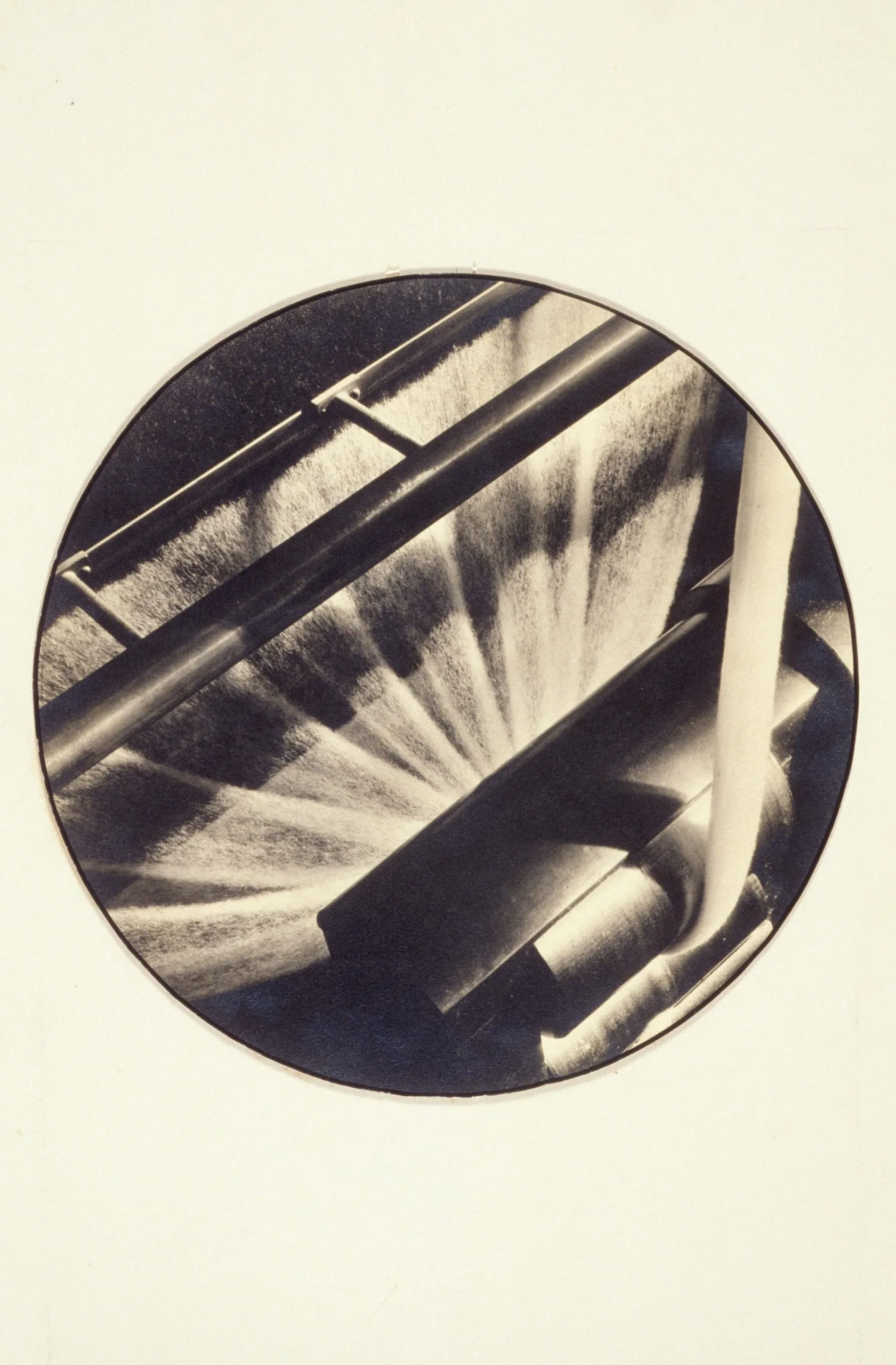
In 1933, the Ford Motor Company commissioned freelance photographer Margaret Bourke-White to produce imagery for the company’s pavilion at the Century of Progress Exposition in Chicago. Bourke-White had previously (c.1930) photographed various manufacturing processes and facilities at Ford’s River Rouge complex in Dearborn, Michigan, and had established a reputation for depicting large-scale industry with precision and grace. Her 1933 assignment was to photograph the production of interior upholstery fabrics at the Amoskeag Company in Manchester, New Hampshire. In the Ford Pavilion, designed by Albert Kahn, these photographs were components in displays about myriad aspects of automotive production, installed in a 900-foot-long main hall. LACMA’s prints (see also M.2006.174.1, .3, .4), trimmed into circles, are presumably unique maquettes for the 5½-foot-diameter enlargements that appeared in the pavilion. In cinematic progression, they show various steps—here, the long, loose, untwisted strand of fibers resulting from carding, called “slivers”—leading to the finished plaid fabric that would grace the interiors of Ford’s 1933 line of automobiles.
Held in the midst of the Depression, the Century of Progress Exposition proclaimed that a prosperous future was just around the corner. While Ford weathered the downturn, the Amoskeag Company was one of the Depression’s casualties, filing for bankruptcy in late 1935.
Britt Salvesen
2025