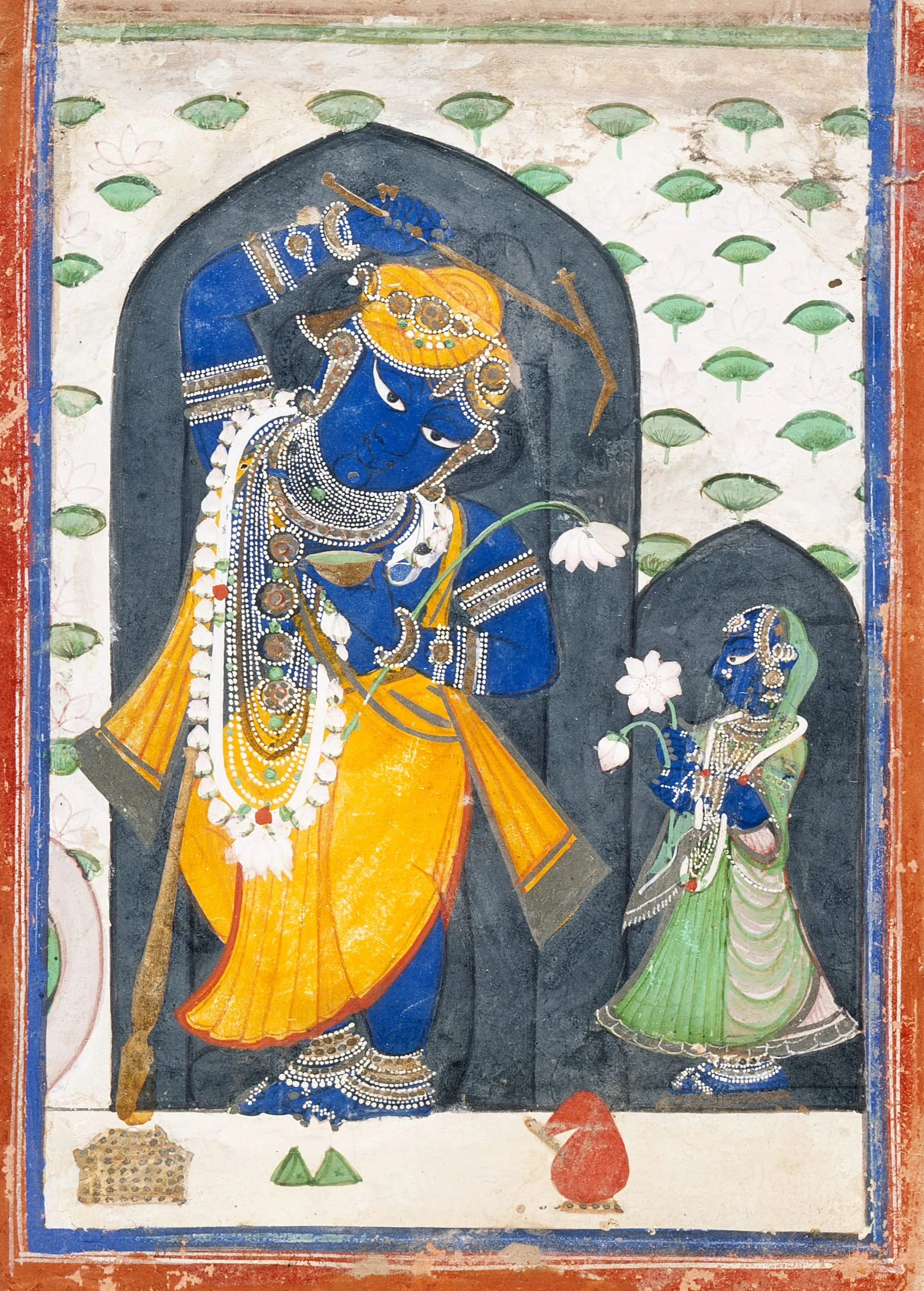
Nathadwara is a pilgrimage town centered around the famous temple of Shri Nathji (a form of Krishna). Located near Udaipur in Rajasthan and formerly part of the Princely State of Mewar, the temple was built in the late 17th century under the patronage of Maharana Raj Singh I (reigned 1652–1680) to house a 14th-century image of Krishna brought from Vrindavan, Uttar Pradesh. Thousands of religious pilgrims and tourists visit Nathadwara annually. Large painted textiles (pichhwai), devotional and commemorative paintings, and small memento icons of Krishna imagery, such as this example, are produced for sale to the devout visitors (see AC1995.102.1 and M.2010.187; M.73.22, M.77.154.26, M.80.7, and M.86.344.2).
Here, Balarama and his consort Revati are shown in arched shrines. Although Balarama is normally portrayed as fair-skinned in comparison to his blue-skinned younger brother, Krishna, in late 19th- and 20th-century paintings and shrine sculptures, representations of Balarama and Revati frequently depict them as dark-skinned, presumably to emphasize their Vaishnava religious affiliation and indissoluble relationship to Krishna. Balarama’s identifying attributes are a plow (hala) [held over his head], a mace (gada) [leaning against his right thigh], a lotus (padma) [supported by his left arm], and a winecup [carried in front of his chest]. Revati holds lotuses, her attribute, and faces Balarama in veneration. Ritual vessels and betelnut (pan) quids are placed on the altar.