The Bhagavata Purana (Ancient Stories of the Lord) is traditionally ascribed to the legendary poet-sage Vyasa in the 8th-10th century CE. It stresses the path of devotion (bhakti) to Krishna, the eighth incarnation or avatar of Vishnu, the Hindu God of Preservation.
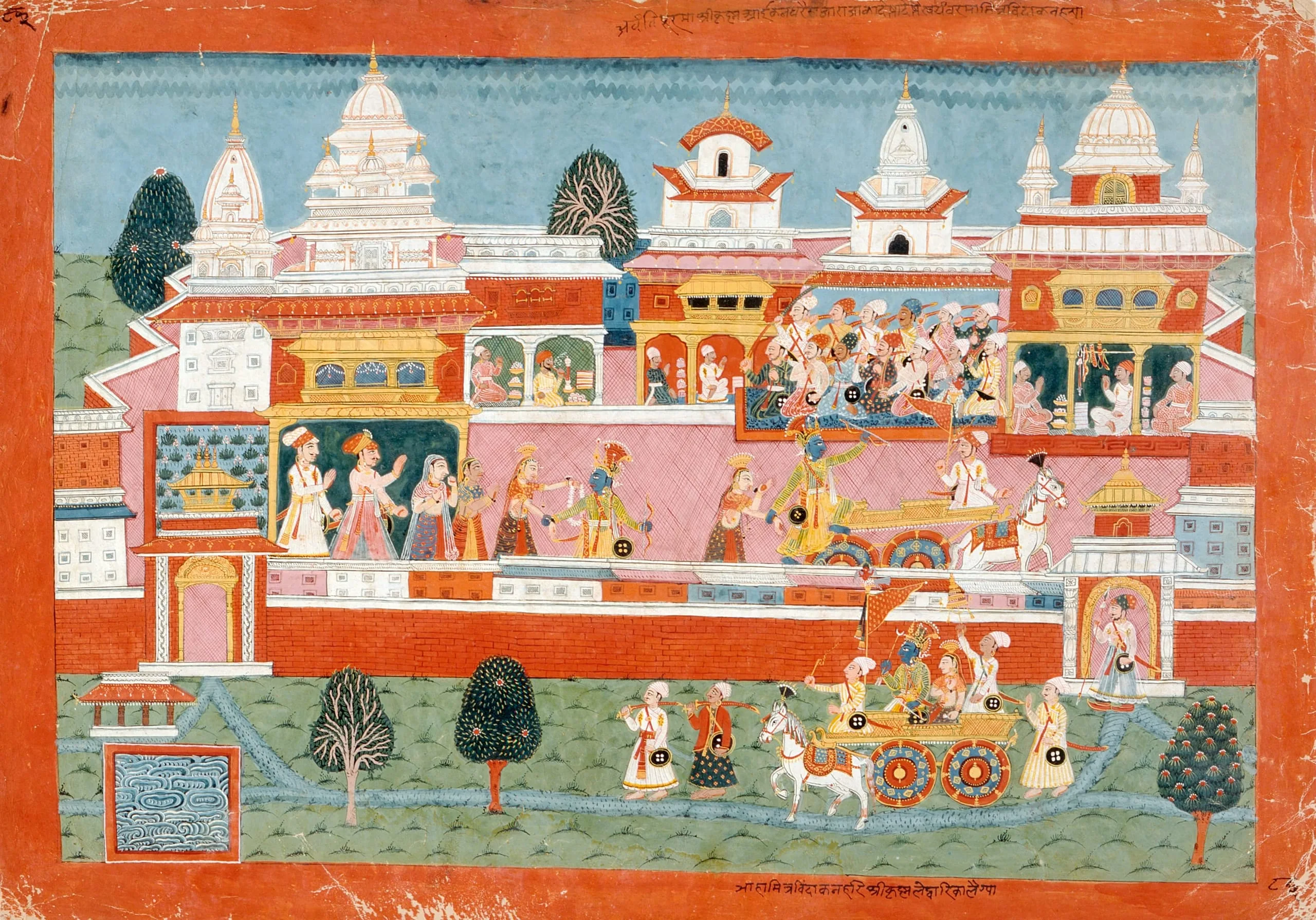
The Newari inscription in the upper border states that Krishna has arrived at Avantipur for a svayamvara ceremony in which a bride to be publicly chooses her groom from an assembly of suitors. Princess Mitravinda, the daughter of King Jayasena of Avanti, desired to wed Krishna against her regent brothers’ wishes and asked Krishna to intervene and rescue her during the ceremony. The inscription in the lower border relates that Krishna abducts Mitravinda (Bhagavata Purana 10:58:30-31). In the center, Krishna grasps Mitravinda by her hand and then leads her into their chariot. In the foreground, the happy couple is depicted leaving for Dvaraka, Krishna’s capital in Gujarat, where they were married and had ten sons.
This painting [folio #72], and its series mates M.71.112.2 and M.72.3.1, are from a dispersed Bhagavata Purana of more than 100 illustrations. The series is distinctive for its aerial perspective of temples and palaces in the Kathmandu Valley. The technique of continuous narration is employed so that principal characters are repeated as the action unfolds.
Additional folios from this series are in the Metropolitan Museum of Art, New York (1975.409.2, 1985.398.10, 2019.64, 2019.65).