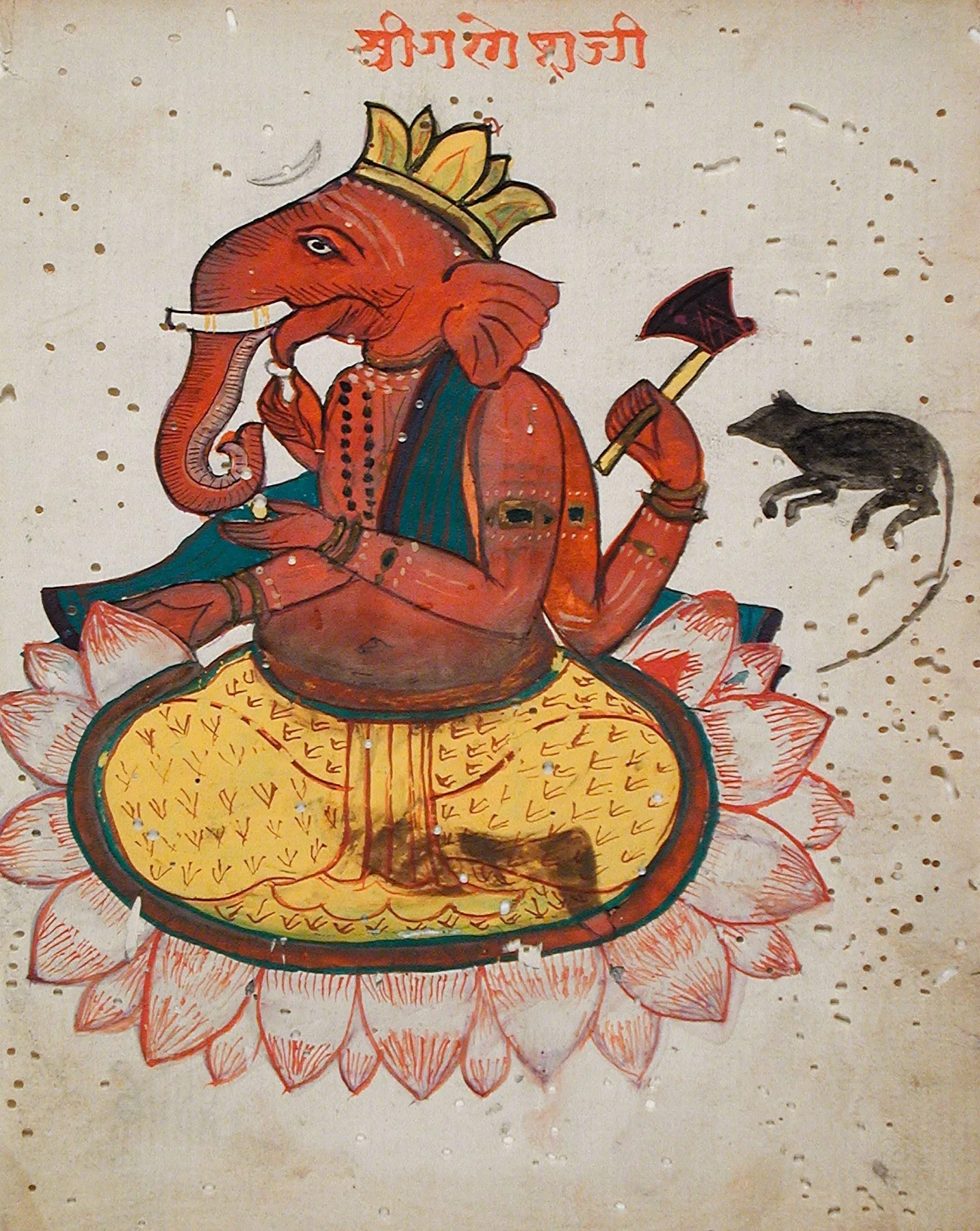
The elephant-headed god Ganesha is regarded as the lord of obstacles because of his power to both remove and create hindrances to one’s undertakings. Hindus, Jains, and Buddhists worship Ganesha at the beginning of every new activity, journey, or ritual. Ganesha’s elephant head attests to the absorption of an elephant cult into mainstream Hinduism and reflects his mythological origin. According to his most common birth legend, his mother Parvati created him from the sweat of her brow and asked him to guard the door of her bath while she bathed. When her husband Shiva returned and tried to enter Parvati’s chamber, Ganesha did not recognize him and barred his entry. Enraged, and unaware of his son’s identity, Shiva beheaded him. When the distraught Parvati demanded that Shiva restore her son’s head, Shiva searched the universe for it to no avail. Out of desperation he took the head of a baby elephant that had sinned by sleeping with its head inauspiciously pointed to the north and with it restored Ganesha to life.
Ganesha, identified by a Devanagari inscription reading Shri Ganeshaji, is seated on a lotus pedestal with four arms. He holds a battle axe in his upper left hand and a sweetmeat (laddu) in his lower left hand. In his upper right hand he holds his broken tusk, which according to various myths was lost in battle or used as a stylus or projectile. His lower right hand is held in the gift-giving gesture (varada mudra). His vehicle, the rat, is beside him.