- Title
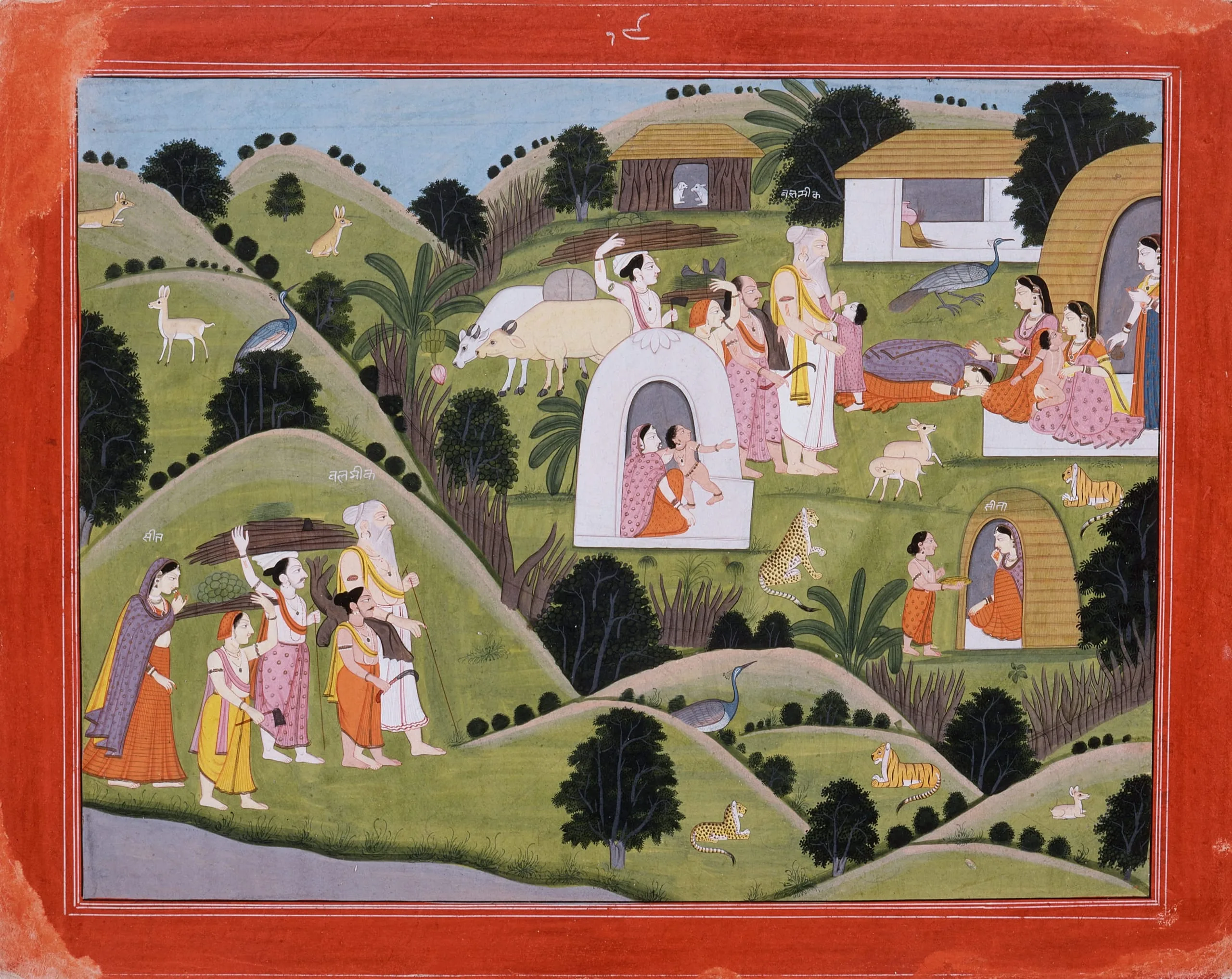
- Hermitage of Valmiki, Folio from the "Nadaun" Ramayana (Adventures of Rama)
- Date Made
- circa 1820
- Medium
- Opaque watercolor, gold, and ink on paper
- Dimensions
- Image: 11 x 14 1/2 in. (27.94 x 36.83 cm); Sheet: 13 1/4 x 17 1/4 in. (33.66 x 43.82 cm)
- Accession Number
- AC1999.127.45
- Curatorial Notes
This idyllic scene of an ashram set in wooded hillocks depicts the hermitage of Valmiki, the celebrated poet-sage who composed the epic Ramayana (Adventures of Rama). A Sanskrit passage on the back of the painting describes how predator and prey animals peacefully coexist within the hermitage, an analogous concept of spiritual harmony that parallels the earthly paradise described in the Book of Isaiah.
The technique of continuous narration is employed in the painting so that principal characters are repeated as the action unfolds. The episode portrayed is when Rama’s wife, Princess Sita, goes to find refuge in Valmiki's hermitage, where she gives birth to the twin boys Lava and Kusha. The sequence begins on the left with the bearded Valmiki (identified by an inscribed label), three acolytes carrying firewood, and Sita (also identified by an inscribed label) approaching the compound. The same group appears again in the center of the painting where Sita prostrates herself to pay her respects to the wives of the sages who reside in the hermitage with Valmiki. In the lower right Sita is again shown in a reed hut being offered food. Along the top of the composition are a rectangular kitchen hall and a small cowshed.
The painting is from a dispersed series known as the "Nadaun" Ramayana. Nadaun is presently a district in Himachal Pradesh near the Beas River. It was previously part of the princely state of Kangra. Another painting from the series is in the Brooklyn Museum (75.203.2).
- Selected Bibliography
- Pal, Pratapaditya; Markel, Stephen; Leoshko, Janice. Pleasure Gardens of the Mind: Indian Paintings from the Jane Greenough Green Collection. Los Angeles County Museum of Art; Mapin Publishing Pvt. Ltd.: Los Angeles, 1993.
- Meller, Susan. Labels of Empire: Textile Trademarks: Windows into India in the Time of the Raj. Novato, CA: Goff Books, 2023.